About the area of activity

Budget Monitoring - logo
As of 1 January 2015, the National Audit Office was mandated to implement the function of a budgetary policy monitoring institution. As of 1 January 2026, the National Audit Office acquired the legal status of an Independent Fiscal Institution (IFI). The Fiscal Monitoring Centre in National Audit Office monitors compliance with fiscal discipline rules and fiscal governance, and submits its opinions to the Seimas of the Republic of Lithuania and makes them publicly available. The Fiscal Monitoring Centre carries out functions of an independent fiscal institution.

ABOUT US


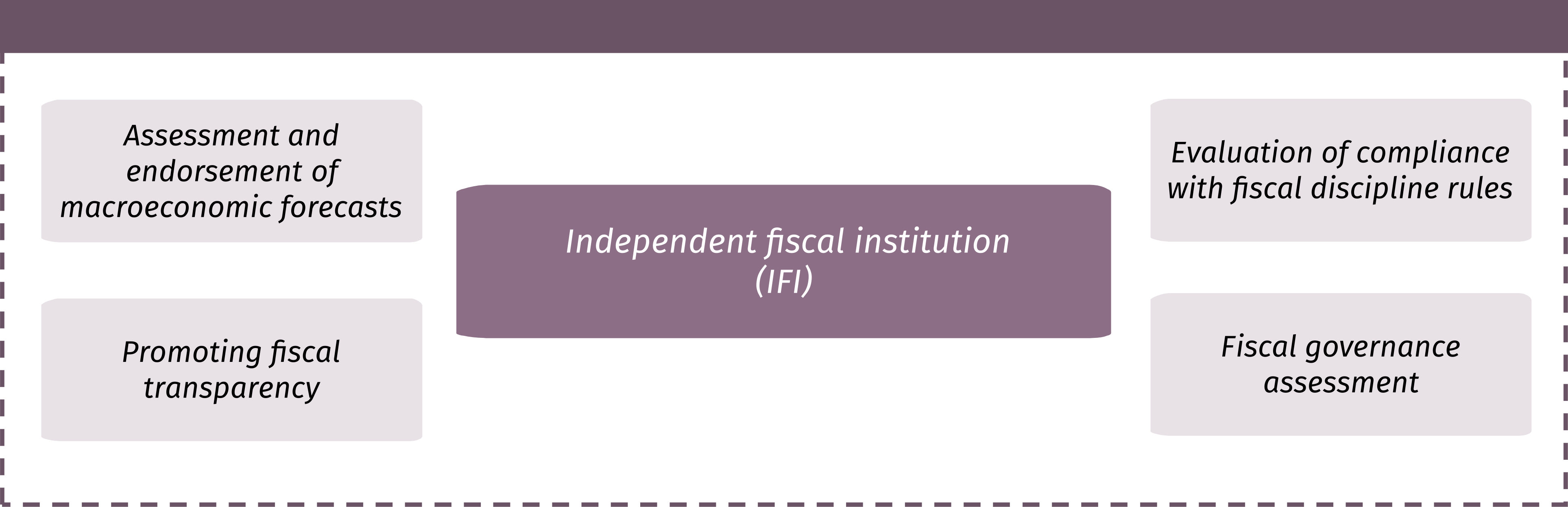
IFI CARRIES OUT THE FOLLOWING ACTIVITIES TO ENSURE THE SUSTAINABILITY OF GOVERNMENT FINANCES AND STABLE ECONOMIC DEVELOPMENT:

Assessment and endorsement of macroeconomic forecasts

The Ministry of Finance prepares and publishes the Economic Development Scenario at least twice a year. We assess and endorse macroeconomic forecasts for fiscal planning to ensure that budget planning is based on the most likely or a more prudent macrofiscal scenario. We do this in accordance with the Description of the procedure for the Assessment and Endorsement of the Economic Development Scenario.

In order to make the process of assessing and endorsing the Economic Development Scenario more credible and transparent, we started publishing our macroeconomic forecasts on 19 September 2023.


Promoting fiscal transparency

One of the objectives of independent fiscal institutions is to promote fiscal transparency. We aim to inform the public about the challenges and benefits of fiscal policy. We do this by regularly presenting our opinions and reports based on analytical information. With regularly submitted opinions and reports, we aim to promote discussions on public finance issues. From 2026, we assess the Economic Development Scenario and general government finance projections errors.


Evaluation of compliance with fiscal discipline rules

Fiscal discipline rules contribute to the sustainability of public finances and reduce the impact of the business cycle. As an independent fiscal institution, our task is to assess whether the Lithuanian general government budgets comply with the requirements of the Constitutional Law on the Implementation of the Fiscal Treaty. This law provides for two rules of fiscal discipline: the fiscal discipline rule for general government and the fiscal discipline rule for municipal budgets. We carry out ex-post and ex-ante assessments of state and municipal budgets.


Fiscal governance assessment

Fiscal governance is the overall framework of fiscal discipline rules, together with the institutions and procedures that ensure compliance with them. At least once every six years, the Independent Fiscal Institution carries out an assessment of the consistency, coherence, and effectiveness of fiscal governance.


THE DOCUMENTS THAT WE FOLLOW IN OUR ROLE AS AN INDEPENDENT FISCAL INSTITUTION


Constitutional Law on the Implementation of the Fiscal Treaty of the Republic of Lithuania;

Law on the National Audit Office of the Republic of Lithuania;

Description of the procedure for the Assessment and Endorsement of the Economic Development Scenario;

Principles of the Organisation for Economic Co-operation and Development for Independent Fiscal Institutions;

Other Lithuanian and European Union legislation (regulations, directives) and recommendations of international institutions.


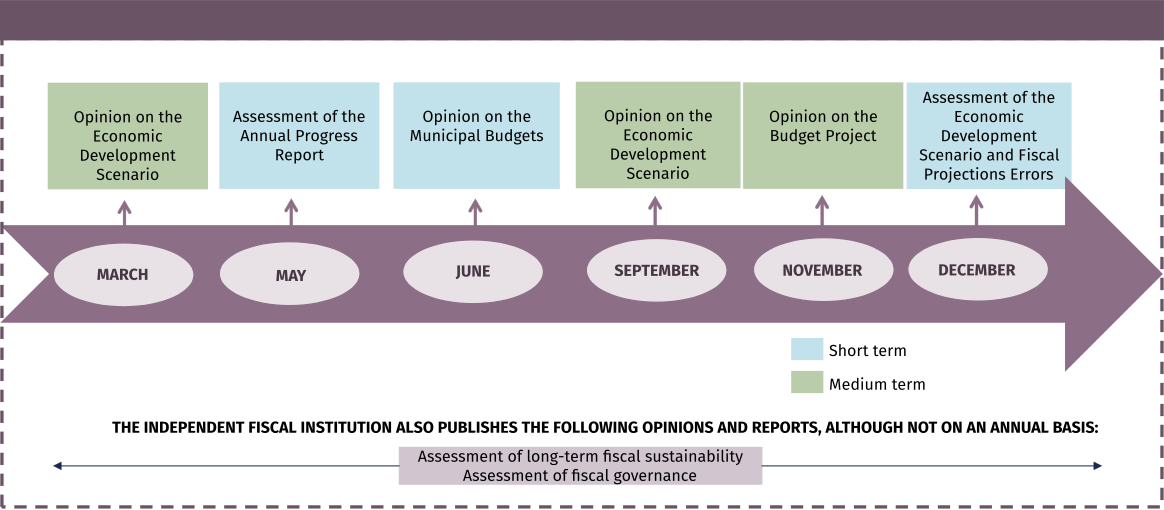
CALENDAR OF OPINIONS TO BE SUBMITTED TO THE SEIMAS


COMMUNICATION AND COOPERATION


The Independent Fiscal Institution provides analyses of public finances and fiscal policy, it actively cooperates with the international community, sharing its experience with colleagues who are improving fiscal transparency around the world.

The IFI participates in the OECD Network of Parliamentary Budgetary Bodies and Independent Fiscal Institutions. The OECD organises annual meetings and publishes documents on public finance and budgetary matters on its website.

IFI actively cooperates with the members of the network of Independent Fiscal Institutions (the EU IFIs) and with fiscal institutions in other countries. The IFI also participates in the Baltic-Nordic meetings.
  
The representatives of the IFI participate in inter-institutional working groups to share their expert insights with public sector institutions.

ADVISORY PANEL

To strengthen the performance and efficiency of the Independent Fiscal Institution and to ensure that the opinions and reports submitted by the Fiscal Monitoring Centre are in line with good practice, an Advisory Panel has been set up in the National Audit Office since 18 April 2016.

Read more

News

Picture for Independent fiscal institution: all municipalities‘ 2026 budgets comply with fiscal discipline rules, but data quality remains an issueIn 2025, one municipality’s budget did not comply with the fiscal discipline rule, but all planned municipal budgets for 2026 meet the requirements. However, the National Audit Office’s assessment showed that the accuracy of financial data remains a problem – without data corrections, more municipalities would fail to comply with the fiscal discipline rules.
  
The National Audit Office, as an independent fiscal institution, assessed whether the fiscal discipline rules were complied with during the implementation of the 2025 municipal budgets and the planning of the 2026 municipal budgets.
  
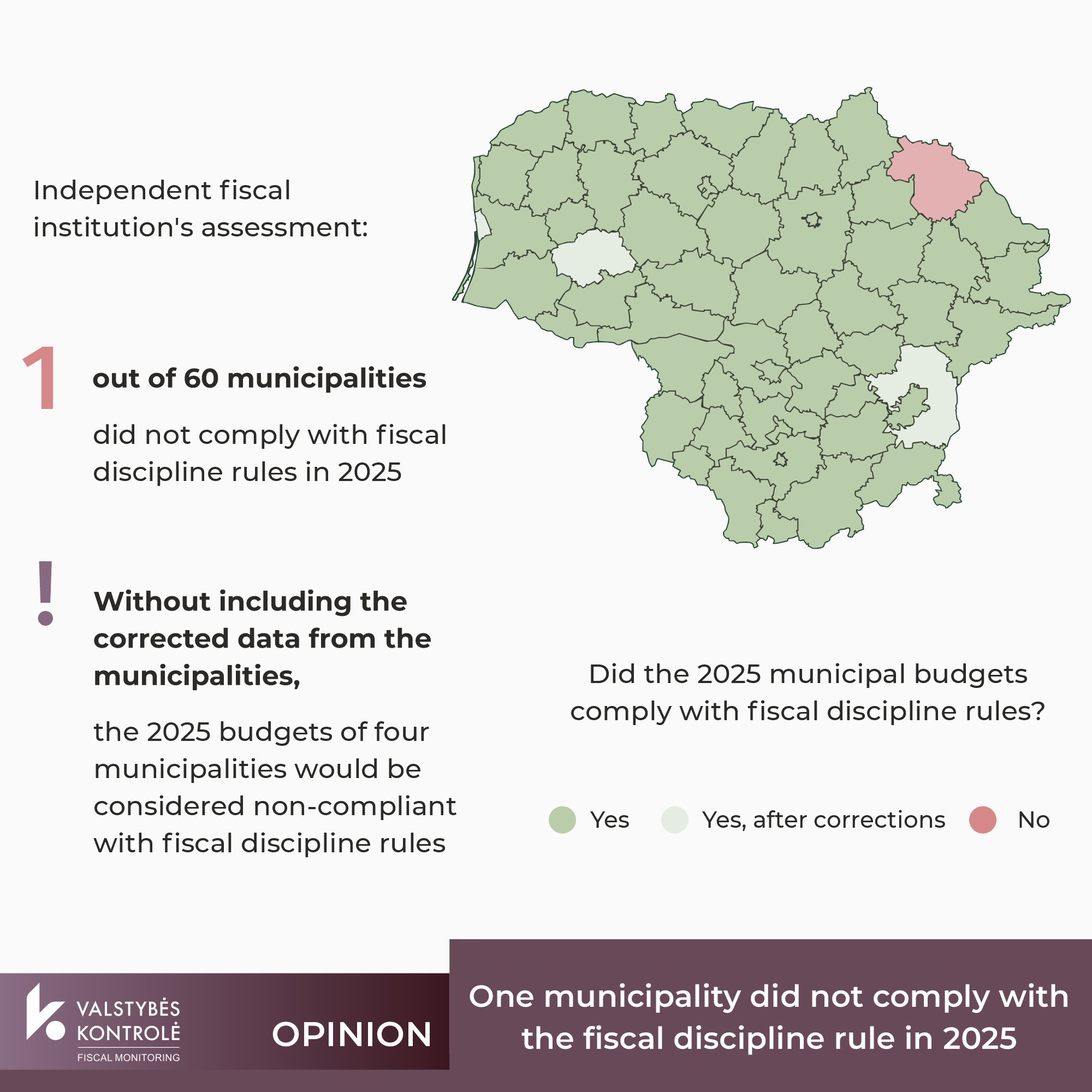
One municipality failed to comply with the fiscal discipline rule in 2025
  
In 2025, Rokiškis District Municipality failed to comply with the fiscal discipline rule. This risk was identified already in 2025 during a preliminary assessment.
  
According to the municipality’s data, the deficit exceeding the permitted limit was caused by increased expenditure for the implementation of an investment project, which required additional borrowing to cover. Under current legislation, the municipality will have two years to make up the resulting deviation of €1.1 million. According to the 2026 budget plan, it is expected to be offset as early as this year.
  
The assessment found that the accuracy of financial statement data remains one of the main issues. Following the identification of potential errors in the documents submitted by the municipalities, they were asked to review the data and, where warranted, to correct it. If the initial, uncorrected data were used, four municipalities would be deemed to be in breach of the fiscal discipline rules in 2025. In that case, they would have had to offset a total deviation of around €6.4 million. If the data in the 2026 budget plans were not corrected, two municipalities would fail to meet the fiscal discipline requirements.
  
“The problem of inaccurate data submission is a recurring one. Errors in municipalities’ financial reporting documents can affect the opinion regarding compliance with fiscal discipline rules, so it is important for municipalities to ensure the accuracy of the information they provide. The quality of the data determines not only the accuracy of the assessment but also the possibility of applying the flexibility provided for in fiscal governance,” says Jurga Rukšėnaitė, Head of the Fiscal Monitoring Centre.
  
It should be noted that although the law requires an assessment of the compliance of municipalities’ planned budget indicators for 2027–2028 with the fiscal discipline rule, there is currently insufficient data for a sound assessment.
  
In 2025, no municipality exceeded the debt and guarantee limits set by law. According to economists’ assessments, all municipalities complied with the fiscal discipline rule when drawing up their 2026 budgets.
  
Updated rules provide more opportunities for investment
  
From 2026, updated fiscal discipline requirements came into force in Lithuania, providing municipalities with more opportunities to finance investments and plan budgets more flexibly. Among the most significant changes are a uniform budget balance rule for all municipalities, a broader revenue base when assessing debt and guarantee limits, and new flexibility conditions for projects financed by the National Development Bank.
  
“The fiscal discipline rule is an important tool for ensuring sustainable public finances and responsible municipal financial management. Compliance with it allows municipalities not only to maintain financial stability but also to take advantage of the more flexible options provided by law for financing investments. The updated fiscal governance system provides more opportunities for investment and greater flexibility in budget management, but at the same time requires a responsible approach to public finance management. It is therefore important that municipalities adhere to the established fiscal discipline requirements when planning and implementing their budgets,” notes Auditor General Irena Segalovičienė.
  
The IFI’s opinion on the compliance with the fiscal discipline rules of municipal budgets during 2025–2026, fiscal discipline compliance spreadsheets and other annexes can be found here: Opinion on the compliance with the fiscal discipline rules of municipal budgets for 2025–2026  

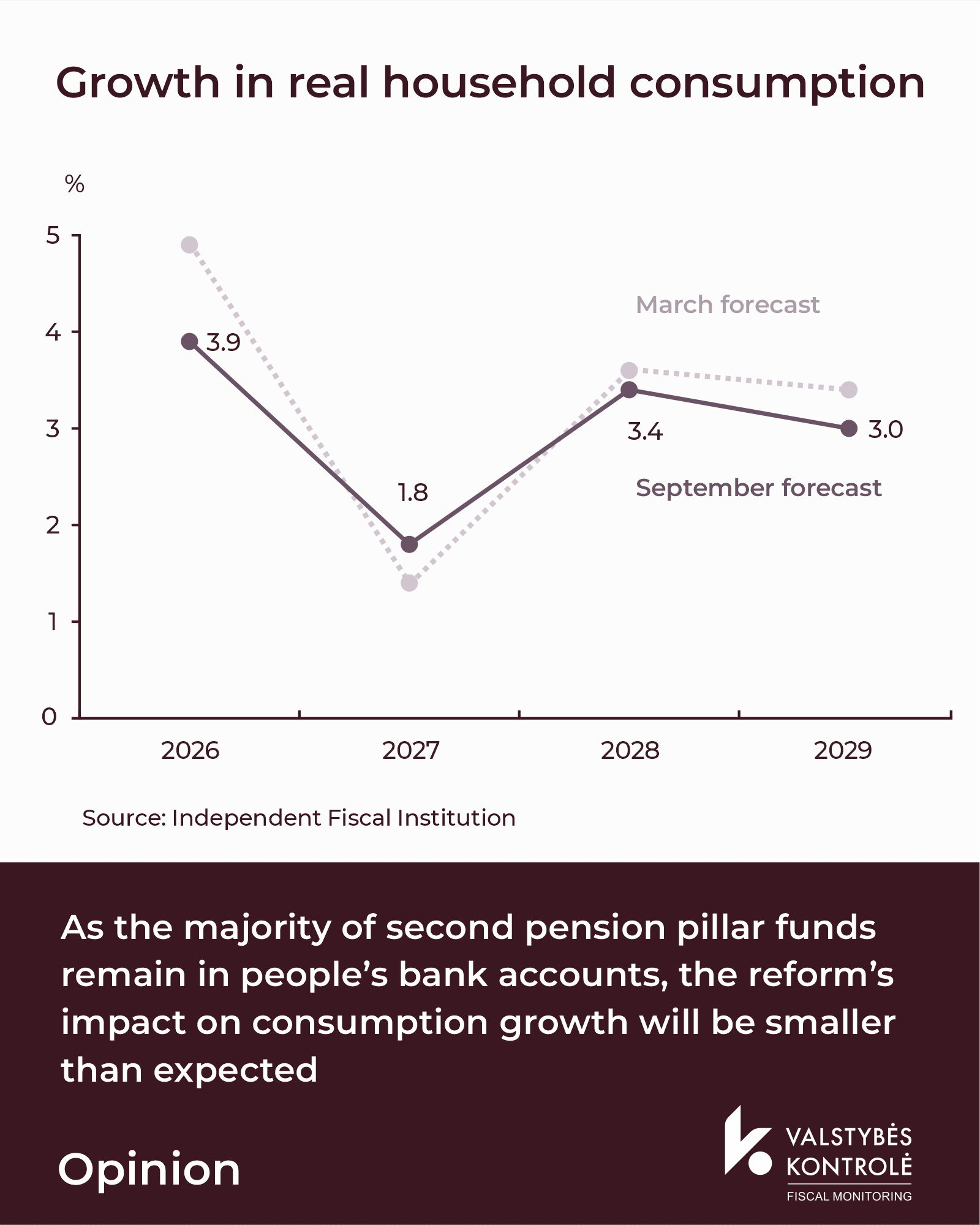
The growing scale of withdrawals from the second-pillar pension scheme raises questions about the impact on public finances. Following the transition to a voluntary participation model in 2026, residents were given the option to opt out of the second-pillar pension scheme by the end of 2027. Already in the first quarter of 2026, nearly 40% of participants decided to stop accumulating for retirement and withdraw their funds. This indicates a particularly significant scale of withdrawal. By comparison, in Estonia in 2021, 20% of participants withdrew from the system during the first phase. In Lithuania, it was mostly young residents (aged 25–35) who stopped accumulating, and in terms of income, those earning around the average wage. Withdrawals from the second pension pillar on this scale already pose risks to its very existence. Given these trends, the question arises: how will this affect fiscal risks, particularly those related to the use of SODRA’s[1] reserves?


AUTHOR 

Jaroslav Mečkovski
Jaroslav Mečkovski
Principal Economist at the Fiscal Monitoring Center
Email: [email protected]

 
In the future, residents’ income in old age will depend even more on the social insurance system. The impact of the changes implemented in 2026 on the country’s pension system and the sustainability of public finances will depend largely on the scale of opt-outs from the second pension pillar. The larger the proportion of the population that opts out of the funded scheme, the weaker the contribution of the second pension pillar to retirement income will become, and the greater the role of the social insurance system will be in ensuring the desired replacement rate. This is particularly relevant when young participants are the ones most likely to withdraw from the funded scheme. As the population ages, this will mean greater pressure to increase the government’s long-term liabilities in the future. This is a fiscal risk that was intended to be managed by establishing the funded pension system in Lithuania. It should be noted that the scale of withdrawals from the second pension pillar is already significant, but it may continue to grow until the period during which residents can make a decision has ended. In that case, the second pension accumulation pillar would become a niche category.

As a result of these changes, SODRA’s reserve will temporarily increase; however, this does not represent additional revenue, but rather future liabilities in the face of demographic challenges.At the end of 2025, the reserve fund stood at approximately EUR 4.5 billion. It is expected that over the next few years, the size of the reserve will be significantly supplemented by contributions from SODRA and the state budget received from second-pillar pension funds. During the first quarter of 2026, approximately EUR 1.3 billion was transferred to SODRA. This creates corresponding long-term liabilities and does not mean that additional revenue has been received that can be used to increase existing liabilities. It is also necessary to take into account the long-term challenges facing the social insurance system, the most significant of which is the inevitable ageing of population. In 2025, there were more than three working-age persons for every elderly person, and by 2050, this ratio is projected to drop to two. This will lead to the emergence of a structural deficit that would have to be financed from the SODRA reserve. An analysis[2] shows that, with no change in policy, demographic pressures would deplete this reserve entirely before 2050. Additional pension indexation would further accelerate the depletion of the reserve. Based on the results of the first quarter of this year, the SODRA reserve will be replenished by a larger-than-planned amount. However, calculations show that, given the liabilities held at the end of 2025, this will not significantly alter the reserve’s situation in the long term. Higher contributions received from the second pillar would allow the reserve to be maintained for an additional year. It should be noted that the SODRA reserve functions as a cyclical stabilisation tool, not as a source of pension indexation. No separate reserve has been established to address long-term challenges.

Using the savings from state budget incentives to increase basic pensions would pose long-term challenges. It is likely that the state budget will save more than EUR 150 million annually, which would be allocated to incentives for participating in the funded pension system. However, it remains unclear how these resources will be used. Without other measures in place, they would reduce the already substantial state budget deficit and borrowing needs. However, there is debate over using these incentives to increase current pensions, which would create additional long-term liabilities for the pension system. If this were implemented by adjusting the basic pension amount, it would have other consequences as well. A rapid increase in the basic pension amount would weaken the link between the social insurance contributions paid by residents and the benefits they receive. In other words, current workers would have less incentive to pay social insurance contributions. Increasing old-age pensions for all recipients is not well-targeted measure for reducing poverty among people of retirement age. Therefore, it is important to consider measures within the social assistance system.

The increased reserve should not be used for decisions that would raise the long-term level of liabilities without creating sustainable sources of revenue. The larger SODRA reserve following the amendments that have come into effect does not indicate a structurally improved financial condition of the pension system. Contributions from SODRA and the state for participants who have withdrawn from the funded scheme become pension points, which implies future liabilities. Furthermore, following a short-term increase in the reserve, the impact of an aging population on public finances will become apparent. In addition, as the role of the second pension pillar weakens, greater pressure for future pensions will fall on social insurance. Therefore, the fiscal risk during this period is not the increase in the reserve itself, but the unwarranted tendency to use it for decisions that would further increase the state’s long-term liabilities. New liabilities could only be undertaken if they were backed by corresponding sustainable revenue sources. To meet existing liabilities and not neglect other social objectives, such as reducing poverty among the elderly, a combination of various measures is necessary. The independent fiscal institution notes that not only revenue measures are needed, but also structural reforms, particularly those that promote labour productivity and sustainable economic growth. The International Monetary Fund[3] also discusses maintaining the SODRA reserve in the future. Preserving accumulated first pillar balances would be essential to build buffers against adverse demographic trends and the weakened second pillar.


[1] SODRA is Lithuania’s State Social Insurance Fund Board, responsible for managing social security contributions and benefits, including pensions, health insurance, and other social support programs.
[2] Available online: https://www.valstybeskontrole.lt/EN/Post/18749/will-the-sodra-reserve-withstand-the-inevitable-changes-in-lithuanias-demographics.
[3] Available online: https://www.imf.org/en/news/articles/2026/05/26/mcs052626-lithuania-article-iv-mission.

Picture for At the OECD headquarters in Paris – discussions among supreme audit institutions and independent fiscal institutions on public financial management, fiscal challenges, and audit independenceOn May 27–28 in Paris, France, the Annual Meeting of OECD Auditors-General and Heads of Supreme Audit Institutions (SAIs) on Public Finance and the 18th Annual Meeting of the OECD Working Party of Parliamentary Budget Officials and Independent Fiscal Institutions (IFIs) are taking place. The National Audit Office delegation attending the meetings—Auditor General Irena Segalovičienė, Head of the Fiscal Monitoring Centre Jurga Rukšėnaitė, and Head of the Communications and International Relations Department Lina Nuobarienė — engaged in discussions on the role of SAIs and IFIs in strengthening public financial management and promoting a better public understanding of the fiscal challenges faced by countries around the world.
  
The visit began with a joint Forum on Restoring Public Finances, where ministers, budgetary officials, and audit leaders from OECD countries shared views on strategies for restoring public finances, communicating fiscal pressures to citizens, building public understanding of the need for long-term fiscal sustainability, and the role of institutions in restoring confidence in public finances.
  
Ms Segalovičienė also participated in a launch event dedicated to the release of a landmark report prepared jointly by the INTOSAI Development Initiative (IDI) and the OECD on Strengthening the Independence of Supreme Audit Institutions. The report emphasises not only the importance of the legal frameworks but also that of trust, communication, institutional norms, and a culture of cooperation in strengthening accountability and transparency in the public sector.
  
with French Supreme Audit Institution
  
In an effort to strengthen inter-institutional cooperation, Auditor General Irena Segalovičienė also met with Amélie de Montchalin, the new First President of the French SAI. During a roundtable discussion, the Auditor General presented to the French colleagues National Audit Office practice in activity planning and impact assessment. The meeting also included an exchange of experiences on how to efficiently measure the implementation of recommendations and ensure that audit results create real value for citizens.
  
The meeting was intended not only to foster closer ties and exchange experiences, but also to prepare for the Annual Meeting of the Contact Committee of Heads of European Union SAIs, which will take place this autumn, in October, in Paris.
  
In the focus of fiscal monitoring: future spending, communication, and artificial intelligence
  
The head of the Fiscal Monitoring Centre (implementing the functions of Lithuania’s independent fiscal institution), Jurga Rukšėnaitė, is representing Lithuania at the Annual OECD IFI meeting, where the focus is on four key topics:

  • Future spending challenges,
  • Budgetary oversight,
  • More effective communication to strengthen fiscal literacy, and
  • Application of artificial intelligence in fiscal analysis.

Meanwhile, Auditor General Irena Segalovičienė, who is continuing her work at the OECD SAI Heads’ Meeting, is discussing with her counterparts from other countries how to enhance the impact of performance audits, the challenges of implementing innovations, the impact of artificial intelligence tools on the quality and efficiency of operations, and the impact of climate change and severe space weather on national budgets.

Macroeconomic and fiscal forecasts

Macroeconomic and fiscal data

OECD review

Piktograma: Peržiūra

The Organisation for Economic Co-operation and Development (OECD) reviews of independent fiscal institutions assess the performance of independent fiscal institutions against the applicable OECD principles and make recommendations to improve their effectiveness and long-term prospects.

In 2019, a group of experts led by the OECD carried out the first external review of the National Audit Office, implementing the function of the fiscal institution.


Second external review
carried out in 2025.