




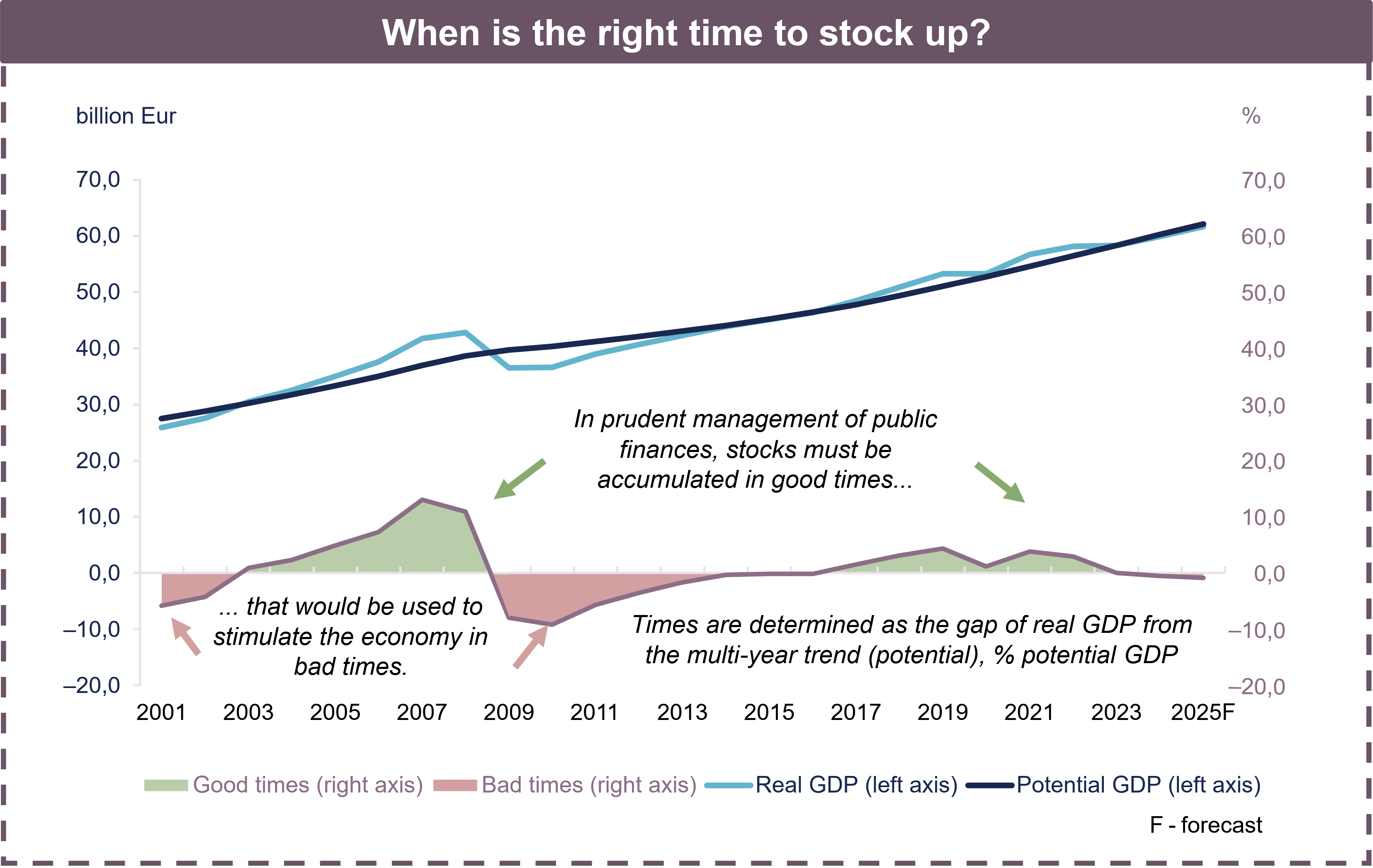
 Fiscal (lot. fiscus – basket, purse, treasury ) discipline is a way of prudently managing public finances – in good times, when the real GDP gap from the long-term trend is positive, not to spend part of the public revenue, but to build up reserves to be used in times of difficulty.
The benefits to citizens of adhering to fiscal discipline include the reduction of the impact of business cycles on the economy, with the aim of securing labour income and keeping inflation under control. Reserves accumulated during economic booms would help to ensure a stable quality of life for an ageing society in times of hardship, by preserving existing and creating new jobs, and by maintaining a stable level of pensions and social benefits. A timely containment of the growth of government spending would help to keep inflation within the 2% threshold and prevent temporary cyclical revenues from being converted into permanent expenditure.
In Lithuania, fiscal discipline is set out in the Constitutional Law on the Implementation of the Fiscal Treaty of the Republic of Lithuania. This law provides for three rules of fiscal discipline: the surplus general government rule, general government expenditure growth limiting rule and the rules for the budgets attributable to general government sector. Compliance with these rules is monitored by the National Audit Office, implementing the function of the fiscal institution.
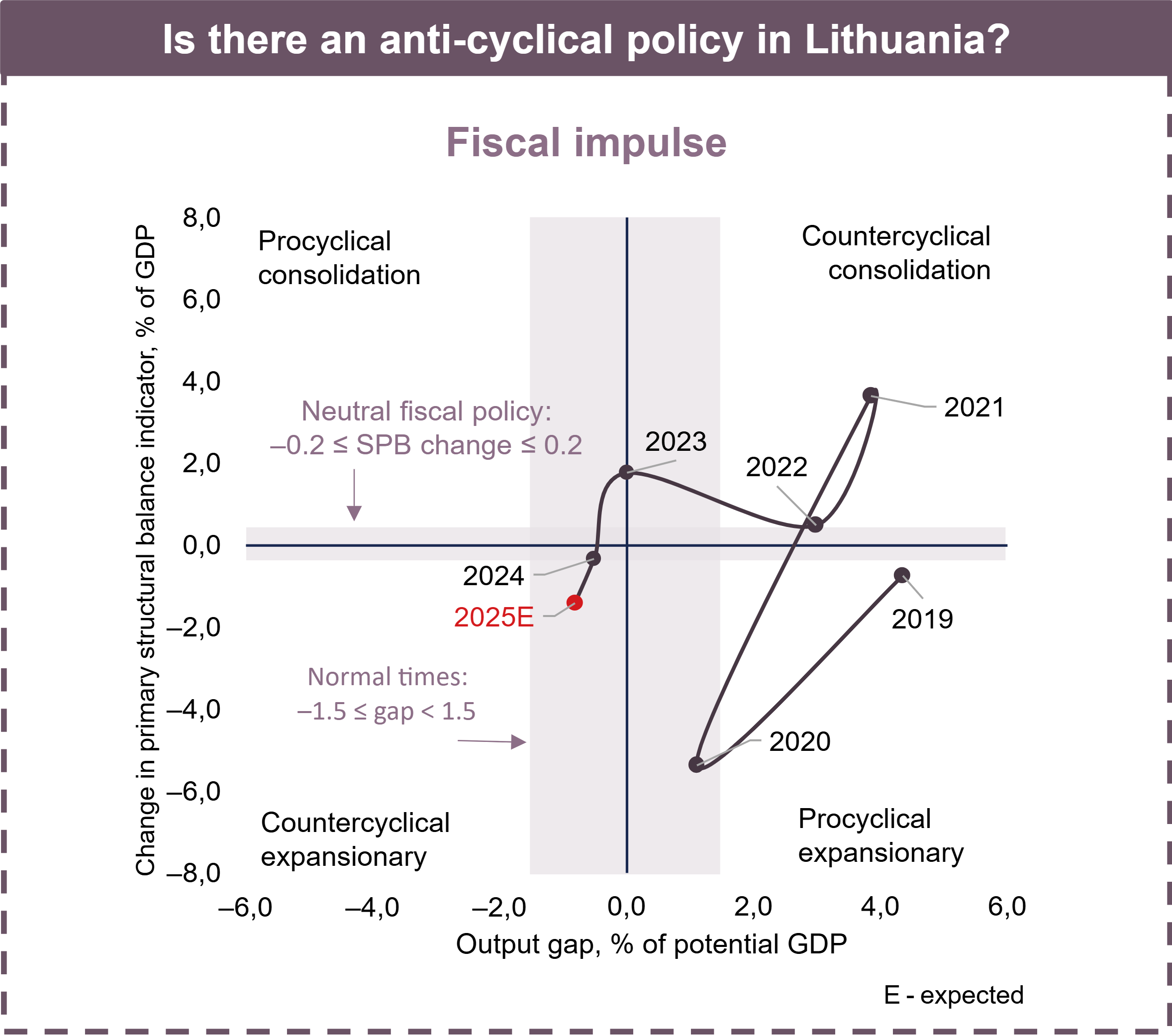 The main one is the surplus general government rule, which aims at ensuring countercyclical fiscal policy. Countercyclical fiscal policy is pursued by managing the structural indicator of the general government balance. This indicator shows what the difference between government revenue and expenditure would be if real GDP was equal to its multi-year trend, without taking into account the impact of one-off and temporary measures. For example, the structural indicators exclude revenues from the privatisation of state-owned enterprises or insurance payments due to the bankruptcy of a financial company.
According to the surplus general government rule, the structural indicator of the general government balance must be in surplus or close to it in cyclical upturns. In bad times, the structural deficit must be no higher than the medium-term objective set by the Seimas If this target has not yet been reached, structural adjustment targets and benchmarks are set, which indicate the amount by which the balance must improve over the year.
The objective of the general government expenditure growth limiting rule is to save for the future by limiting the growth of government expenditure more tightly in cyclical upturns than under the surplus government rule. This allows the government to strengthen economic and price stability, and to seek greater fiscal space for future commitments and difficult times. If sufficient fiscal space is accumulated in good times, expansionary fiscal policy can be pursued in bad times, allowing a faster return to balanced growth.
In order to build up reserves in a timely manner, without jeopardising stable economic growth, the Constitutional Law provides for five exceptions to the general government expenditure growth limiting rule. It does not apply if: the Lithuanian economy is converging too slowly towards the average GDP growth of the European Union at current prices; an improvement of at least 1 percentage point of GDP in the government balance indicator is foreseen, with the increase in expenditure compensated by additional revenues; the five-year actual government balance indicator is in surplus; the government balance indicator must not deteriorate in the course of the revision of the government budget; and a cyclical downturn occurs.
In the event of exceptional circumstances – an extraordinary event – with a significant impact on public finances (e.g. a financial sector shock in the euro area), the surplus general government and general government expenditure growth limiting rules would be temporarily suspended.
The rules for budgets attributable to the general government sector state that, in times of economic upturn, the budgets of the State Social Insurance Fund (SSIF), the National Health Insurance Fund (NHIF) and municipalities with appropriations exceeding 0.3% of GDP must be structurally balanced, while the budgets of other municipalities must be planned without deficits. In times of downturn, the budgets of municipalities with appropriations below 0.3% of GDP must not have planned expenditure exceeding revenue by more than 1.5%, the budget of the SSIF is allowed to run a structural deficit, and the structural balances of the municipalities of Vilnius, Kaunas, Klaipėda and Šiauliai and the NHIF must be planned in the same way as in the good times, avoiding structural deficits.
Application of fiscal discipline rules in the EU and Lithuania
A comparison with the EU rules that were in force until April 30, 2024 is provided.
| Level | European Union | Republic of Lithuania |
| Goal | Sustainability of public debt | Economic stabilisation and sustainability of public debt |
| Compliance of the structural indicator for the general government (GG) balance with the medium-term objective (MTO) | ||
| MTO is determined by | Each EU country individually | Seimas approves for up to 3 years |
| Tolerance for deviation from MTO | < 0.25% p. p. of GDP | < 0.05 % p. p. of GDP due to rounding error |
| Structural reform clause | < 0.5% p. p. of GDP for a period of up to 4 years, subject to a reasonable improvement in the long-term sustainability of GG debt | |
| Investment clause | < 0.5% p.p. of GDP for up to 4 years, in bad times for co-financing projects of EU interest | |
| The structural indicator of the GG balance is determined by | European Commission, based on projections of the spring or autumn economic scenario and the independently assessed budgetary framework of the GG | Ministry of Finance based on the projections of the Autumn economic scenario and the GG budget plan |
| The structural deficit in the GG is: | ||
| ≤ adjusted MTO | Fiscal space to increase GG expenditure irrespective of the state of the business cycle, up to the value of the adjusted MTO | In good times, the structural balance of the GG must be in surplus or close to it; in bad times, fiscal space and reserves are used |
| > adjusted MTO | Setting the structural adjustment target | Setting the structural adjustment target |
| The expenditure criterion and the GG expenditure growth limitation rule | ||
| Restricted | Growth in net general government expenditure | Growth in total appropriations for central government, NSIF and CHIF budgets |
| Net expenditure is obtained by eliminating the following factors: | ||
| One-off measures | Yes | No |
| Interest expenses | Yes | No |
| EU financial support | Yes | Yes |
| GG investments excluding EU financial support | Investment for the planned year is replaced by the average of the last 4 years | No |
| Cyclical unemployment costs | Yes | No |
| Discretionary revenue | Yes | No |
| Criteria for limiting expenditure growth when planning or amending GG budgets: | ||
| Expenditure criterion | 10-year average of potential real GDP growth (5 past, current and 4 future years) + projection of annual change in the GDP deflator + convergence margin | ½ 10-year average of potential nominal GDP growth (7 past, current and 2 future years) |
| The criterion is set by | European Commission based on projections from the spring or autumn economic scenario | Ministry of Finance projections under the Autumn economic scenario |
| Circumstances for not applying the expenditure growth limiting rule : | ||
| Exceptional circumstances | An extraordinary event beyond the control of the public authorities which has a major impact on the financial position of the general government, or a severe economic downturn. | |
| Slow convergence | No | Lithuania's nominal GDP growth is slower than the 5-year EU average + 2 percentage points. |
| Additional revenue | Expenditure can grow faster than the limit if additional discretionary revenue is provided | The projected boost to the GG balance indicator is positive and at least 1% p. p. of GDP |
| Medium-term budget surplus | No | The 5-year arithmetic average of the GG balance is a surplus of at least 0.1% of GDP |
| Cyclical downturn | Taken into account without limiting cyclical unemployment costs | The gap between real and potential GDP in the projection year is negative |
| Changing budgets | No | Changes to GG budgets must not worsen the GG balance indicator |
| Sources: Stability and Growth Pact Handbook 2017, European Commission; Constitutional Law on the Implementation of the Fiscal Treaty of the Republic of Lithuania, 2014-11-06, No XII-1289 | ||