




2026-09-21
Independent Fiscal Institution: Changes to the second pension pillar have not boosted the economy as much as expected
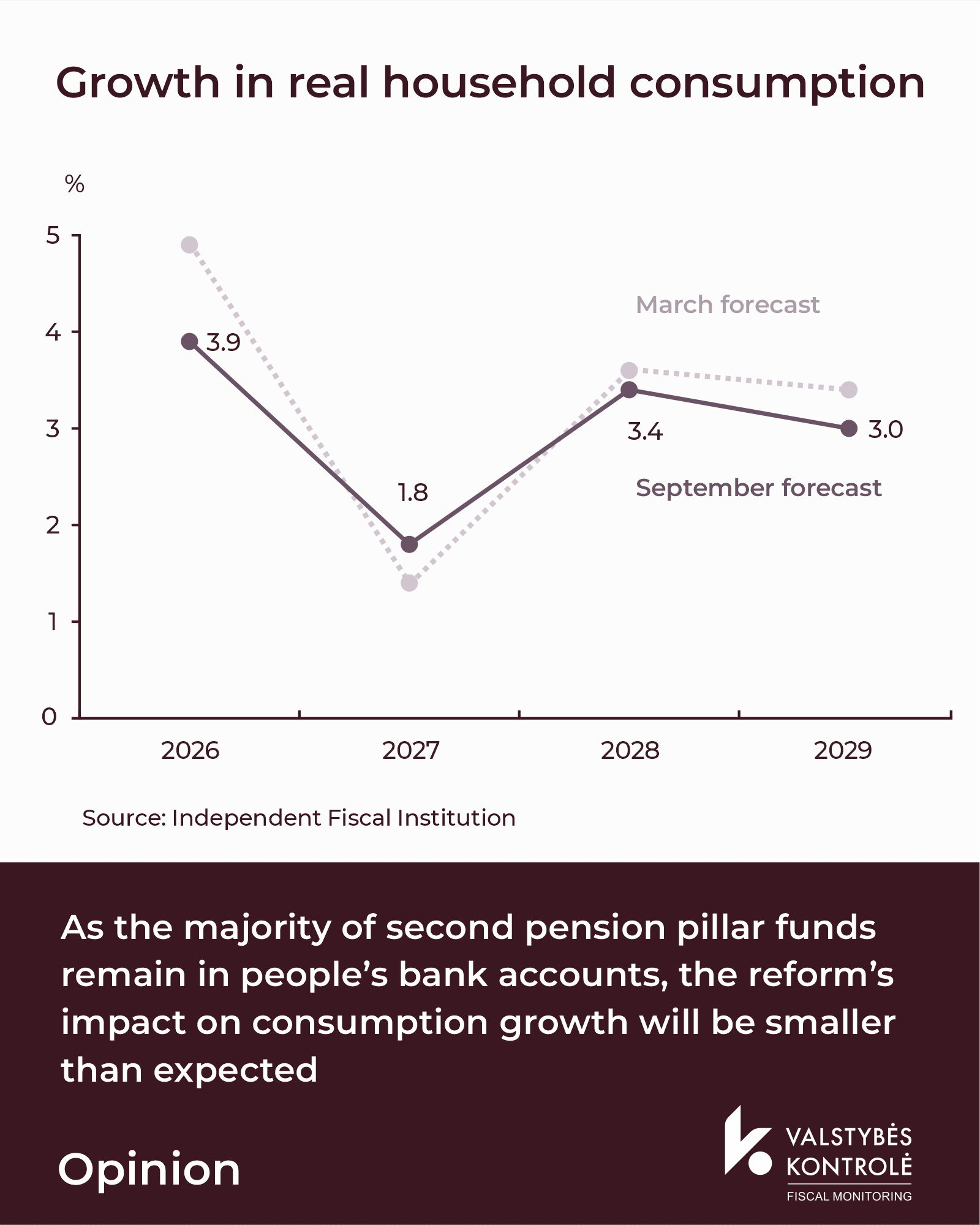 The Independent Fiscal Institution forecasts that the Lithuanian economy is set to grow by 2.9% this year, but growth will be slower than expected in spring. One of the main reasons is that most of the money withdrawn from the second pension pillar has not yet been spent and remains in people’s bank accounts. Economic growth is expected to slow to 2.4% in 2027. Given the ongoing geopolitical uncertainty, particular caution is required when planning the state’s finances for the coming years, in order to not only ensure the sustainability of public finances but also to preserve the state’s ability to respond to unexpected economic and geopolitical challenges.
The National Audit Office, as the Independent Fiscal Institution (IFI), has analysed the macroeconomic environment and prepared projections for economic indicators.
The IFI forecasts that in 2026 the Lithuanian economy will grow by 2.9% – at the same rate as in 2025. In 2027, economic growth is expected to slow to 2.4%. This year’s forecast is lower than that published in March, when growth of 3.3% was expected. This was mainly due to the lower-than-expected impact of changes to the second pension pillar on the economy, despite the significant scale of withdrawals from pension funds.
“The changes to the second pension pillar have given people the opportunity to withdraw their accumulated funds, but so far we can see that a large proportion of these funds is not being spent. In April, the balance of overnight deposits – which essentially corresponds to money in bank accounts – was almost 30% higher than a year ago, reaching more than 22 billion EUR, and rose slightly further in July. When analysing various statistical data, we are currently seeing a significant increase in savings. This explains why economic growth has remained solid but has not generated the momentum that was expected from the billion-euro payments,” says Jurga Rukšėnaitė, head of the Fiscal Monitoring Centre.
Despite rising inflation, people’s purchasing power is expected to grow
At present, the greatest risks to the Lithuanian economy are linked to the situation in the Middle East. Following the rise in energy prices, the IFI has raised its inflation forecast to 5% this year and 3.7% next year.
No major changes are expected in the labour market: the unemployment rate will not rise, the number of employed persons will remain largely unchanged, and the average pre-tax wage will grow faster than prices. This means that the purchasing power of the population should increase, but the overall economic outlook could be significantly affected by the geopolitical situation and its impact on energy prices.
This year’s revenue target is expected to be met, but caution is needed regarding future budgets
Updated economic forecasts suggest that the 2026 government revenue target will be met. Even if corporate income taxes were to fall short of expectations, this could be offset by higher revenue from personal income tax and value-added tax.
However, when planning public finances for the coming years, it is important to bear in mind that the economic environment can change rapidly.
“The outlook for this year’s state budget revenue remains fairly favourable, but this should not serve as a basis for overly optimistic planning of next year’s budget. There is currently a high degree of uncertainty, and should the economic situation change, state revenue would also change. Therefore, when planning budget revenue and expenditure for 2027–2029, it is essential to exercise particular caution and retain room for manoeuvre to cope with potential unforeseen events and ensure a sustainable level of public debt,” says Auditor General Irena Segalovičienė.
Independent Fiscal Institution endorses the Ministry of Finance’s Economic Development Scenario
Based on its own projections and other methods, the IFI has assessed the Economic Development Scenario for 2026–2029 published by the Ministry of Finance on 11 September 2026.
The IFI has endorsed the Ministry of Finance’s macroeconomic projections for fiscal planning. These are consistent with the assumptions set out by the Ministry and are based on relevant statistical data.