





2026-09-15
Before the EUR 681 million public buildings investment, management efficiency must improve
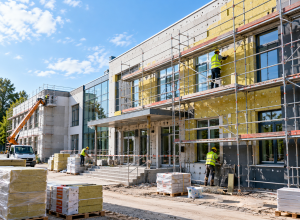 Lithuania plans to renovate nearly 2.2 million square metres of state and municipal public buildings by 2030. An audit carried out by the National Audit Office, entitled “Improving the Energy Efficiency of Public Buildings“, shows that by 2025 only about one-fifth of the planned area have been renovated. Around EUR 681 million would be required to implement the remaining projects. If funding is not secured in time, it will not be possible to renovate almost half of the planned area of public buildings by 2030.
However, the problem is not just about money or pressing deadlines. According to the National Audit Office’s assessment, the state lacks a system to ensure that investments are channelled specifically to those buildings that are essential for the performance of state functions and which yield the greatest return to the budget.
„Today, we are renovating not what is most cost-effective for the state, but whatever is submitted first. Having invested millions, we do not even check whether the promised savings have remained merely on paper. First and foremost, we must not ask where to find a further 681 million euros, but where it would be worthwhile and beneficial to invest them. The aim must be not square metres on paper, but real savings of taxpayers’ money. We are seeing mismanagement of assets, so responsible changes are essential,” says Auditor General Irena Segalovičienė.
Maintaining state property is becoming more expensive, yet the need for it is not being assessed
The audit revealed that none of the ministries or municipalities surveyed assesses how many buildings and what floor area are required to carry out public functions, nor how efficiently this property is being used. Nor is there a system in place to encourage regular reviews of managed assets and the disposal of buildings or floor space no longer required for their functions.
Meanwhile, the cost to the state of maintaining this property is rising. Between 2020 and 2024, the costs of maintaining state-owned property doubled from EUR 176 million to EUR 354 million due to rising energy prices, the increasing cost of maintenance and repair services, and rising labour and other operating costs, even though the total floor area under management decreased by 8.4 percent during this period.
Therefore, before allocating funds for building renovation, it is important to assess not only its energy efficiency, but also whether the building will be needed by the state or municipality in the long term, and whether its entire floor area is actually being used. Investing in an unnecessary or inefficiently used building means not only spending money on its renovation – the state will also have to continue paying for its heating, repairs, maintenance and administration.
A smaller and more rationally utilised area of public buildings would reduce both the investment required for renovation and the annual property maintenance costs. It is estimated that, if the network of necessary buildings were properly modernised and optimised, state budget expenditure on their repair and maintenance could be reduced by at least 40 percent.
Renovation funds are not always channelled where they would be most beneficial
Having assessed how much and what kind of property is absolutely necessary for the state to carry out its functions, it is equally important to decide which of the necessary buildings should be renovated first.
Back in 2017, the Ministry of Energy compiled a list of energy-inefficient central government public buildings suitable for renovation. However, by the end of 2025, 71 percent of the buildings included on that list had still not been renovated.
One of the reasons is the lack of common planning and selection criteria to determine which buildings should be renovated first. Applications for funding were also not ranked according to potential energy savings, the area to be renovated or the cost-effectiveness of the investment. In practice, this means that a building manager who submits an application sooner may have a better chance of securing funding than a project which, for the same investment, would generate greater energy savings or reduce public expenditure.
Millions are invested without checking whether the promised result has been achieved
The prudent management of state assets does not end with the renovation of a building. It is essential to know whether the investment has actually delivered the planned result. The audit revealed that actual energy savings in renovated public buildings are not systematically monitored.
During the audit, 11 out of 14 (or 79 percent) of the renovated buildings assessed failed to achieve the declared heat energy savings. In these buildings, the actual heat energy savings were, on average, 40 percent lower than stated in the energy performance certificates.
Without monitoring actual consumption, it is impossible to say with any certainty whether the investments made in the renovation delivered the planned benefits, why the results fell short, and what changes should be made in future projects.
Solutions proposed by the National Audit Office
The National Audit Office proposes changing the very logic behind the renovation of public buildings: firstly, to decide how much and what kind of property the state and municipalities need, to dispose of unnecessary property, then to determine which buildings are most beneficial to renovate, and to allocate funding according to clear priorities; and, once the investment has been made, to verify whether the promised energy savings have actually been achieved.
It is recommended that the Government draw up a strategy for the centralisation of state-owned property and the reduction of total floor area. This would enable the consistent disposal of property no longer required for its intended functions and prevent investment in buildings that will no longer be needed in the long term.
It is recommended that the Ministry of Energy and the Ministry of Environment establish a clear system for selecting buildings and planning their renovation. Projects should be assessed on the basis of their energy-saving potential , the area to be renovated and the cost-effectiveness of the investment; furthermore, before funding is allocated, an assessment should be made of whether the building will be required in the long term.
It is recommended that the Lithuanian Energy Agency analyse the actual energy savings in renovated buildings, any discrepancies from the planned results and the reasons for these, and put forward proposals on how to ensure that planned energy savings are achieved in the future.