






2026-07-15
National Audit Office: More than half of pupils with special needs do not receive all the necessary support

- In the 2024–2025 school year, as many as 94 percent of children with special educational needs (SEN) attended general schools, but 56 percent of them do not receive the necessary support.
- Support for these children is often delayed or fails to reach them due to the lengthy needs assessment process and parental resistance, while the needs of gifted and talented children often go unrecognized.
- One in two (52 percent) general education schools and 75 percent of vocational training institutions lack educational support specialists and pupil assistants. This leads to uneven workloads—the number of children per full-time position in these institutions ranges from 16 to 337 pupils.
- Funding for educational support is increasing (EUR 287.4 million allocated for 2025), but the independent contribution per student by municipalities varies by a factor of hundreds, and current funding is sufficient only for children with minor needs.
- More than 90 percent of pupils with SEN successfully obtain vocational qualifications, but as many as 70 percent of them do not find employment..
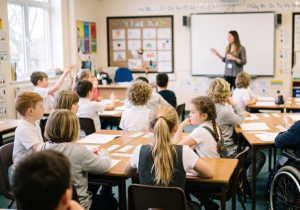 In Lithuania, the vast majority of children with SEN are currently enrolled in general classes or preschool groups alongside their peers. However, an audit conducted by the National Audit Office titled “Educational Support in Schools” shows that the mere opportunity to learn together does not in itself guarantee full inclusion. More than half of pupils with SEN do not receive the full range of support recommended by the Pedagogical and Psychological Service (PPT), and some children are left without any support at all.
“The mere physical presence of a child in a general class does not in itself mean inclusion. Today, the numbers on paper show beautiful statistics—as many as 94 percent of children with special needs are studying alongside their peers—but behind these numbers lies another, painful reality. More than half of these children do not receive the help they need, and families are left to face their challenges alone. We cannot tolerate a situation where a child’s right to a full-fledged education turns into a geographical lottery, in which the support provided to a single child varies by a factor of hundreds across municipalities, and a vocational training diploma ultimately fails to open doors to the labour market. Following this audit, mere cosmetic changes to the system will not suffice—legislation must guarantee real support to every child who needs it,” emphasises Auditor General Irena Segalovičienė.
There is a shortage of specialists, and those who are there are facing critical workloads
In Lithuania, during the 2024–2025 school year, as many as 94 percent of children with SEN will be attending general schools and classes alongside all other children. The accessibility of the education system is also demonstrated by the fact that as many as 93 percent of parents surveyed indicated that their children were successfully admitted to their chosen or preferred school, and that municipalities essentially satisfied all applications.
However, the audit revealed that more than half (56 percent) of pupils with SEN in schools do not receive all the services recommended by educational support specialists, and as many as 5 percent receive no support at all. This creates a risk that pupils will be unable to fully participate in the educational process and reach their potential. This is also confirmed by parents’ experiences—27 percent of them acknowledged that their children do not receive the necessary support at school, and more than half (57 percent) of families were forced to seek out private specialists outside of school.
This situation is further compounded by the fact that, at the time of enrolment, schools often lack prior information about the extent of a child’s needs and are therefore unable to distribute pupils evenly. Although it is recommended that no more than three pupils with significant or very significant needs be placed in a single class, in reality there are classes where the number of such pupils reaches as high as six. To ensure that information about pupils’ special educational needs reaches schools in a timely manner, allowing them to prepare to provide educational support and form classes, the National Audit Office recommends that the Ministry of Education, Science, and Sports (MESS) allow schools to access information about the identified special educational needs of newly admitted pupils before the 1st of September.
This systemic problem is further deepened by the fact that as many as 52 percent of general education schools and 75 percent of vocational training institutions lack educational support specialists and pupil assistants. As many as 91 percent of the audited municipalities are directly affected by this shortage. Although the state and municipalities are implementing various measures to attract staff— such as providing financial support to education students who sign employment contracts with municipalities, attracting the necessary staff nationwide remains extremely difficult due to unattractive working conditions, high emotional and administrative workloads, and part-time positions.
This situation leads to enormous disparities in workload: although the target is for one educational support specialist to be responsible for up to 111 pupils, the actual number of children per full-time position in municipalities ranges from 60 to 176 pupils. In individual schools, these variations are even greater: from 16 to 337 pupils per full-time position, and 6 percent of the country’s schools have no educational support specialists at all. As a result, some pupils do not receive all the services recommended for them, and the support they receive depends on whether a particular school is able to hire such a staff member.
In order to systematically address the enormous disparities in workloads among institutions and ensure that support reaches every child, it is recommended that the MESS urgently address the issue of attracting specialists and update the criteria under which certain primary and basic education classes would be required to have a second teacher (by introducing the open-class model) or a person providing educational support.
Delayed support, parental resistance, and the shadow of gifted children
The country’s extensive PPT network prioritises children with SEN who are most in need of support (e.g., before exams or when changing educational levels). However, support for children with SEN is often delayed: as many as 34 percent of agencies nationwide report that pupils must wait more than a month for a special education needs assessment, even though early intervention is a critical factor in achieving better educational outcomes.
The process and the work of specialists are also hindered by a reliance on documents submitted by parents—85 percent of agencies receive them directly from parents. The process is also hindered by resistance from the parents themselves—as many as 35.8 percent of agencies report cases where schools were unable to register a child for assessment due to parental refusal.
At the same time, another pressing problem has come to light: according to audit data, as many as 88–98 percent of PPTs and 73 percent of educational support specialists working in schools lack standardised tools for assessing pupils’ special educational needs. Furthermore, the country lacks a unified and clear system for assessing the achievements and progress of pupils with SEN that teachers could uniformly follow. When progress is not measured objectively, a child’s potential is restricted. There is also a lack of regulations on how to identify children with exceptional talents, so gifted pupils often go unrecognised.
To ensure that needs are identified in a timely manner, it is recommended that the MESS establish a clear sequence of actions for cases in which parents do not agree to undergo an initial assessment or refuse to sign the conclusions.
To ensure that educational support specialists and educational psychology services across the country can assess pupils’ special educational needs consistently, it is recommended that the Lithuanian Center for Inclusive Education develop and implement a standard for the educational-psychological assessment of children and acquire the necessary tools. It is also recommended that the MESS develop uniform tools for monitoring and assessing the individual progress of pupils and establish clear measures for identifying gifted children.
Growing funding and municipal support that varies by a factor of hundreds
In recent years, total funding for education in the country has increased: in 2025, EUR 287.4 million was allocated for education in schools (compared to EUR 233.4 million in 2024). Of this amount, EUR 199.5 million came from the state budget, while municipalities contributed EUR 87.9 million from their independent budgets.
However, the state’s commitment to educational support should not depend on a child’s place of residence. The amount allocated from municipalities’ independent budgets for educational support varies by a factor of hundreds—from 1 euro to 648 euros per child. Although these financial disparities create unequal starting conditions, the availability of support at a specific institution is also strongly influenced by other complex factors, such as: schools’ ability to organise their work efficiently and the shortage of specialists in the labour market, which means that even schools with higher funding sometimes lack the necessary staff.
The audit revealed that current funding is often sufficient only for children with minor special needs, while pupils with severe or profound special needs would actually require approximately twice as much funding.
Vocational training: Diploma in hand, but the doors to the labour market closed
The prospects for continuing education after finishing school are encouraging—the majority of pupils with SEN who have completed 10th and/or 12th grade in general education schools successfully continue their studies at vocational training institutions (69 percent), and more than 90 percent of them successfully obtain a vocational qualification.
However, the audit revealed another problem—as many as 70 percent of these graduates do not find employment after completing their studies. The problem lies not only in the fact that employers often have preconceived notions about the abilities of pupils with SEN and are reluctant to hire them, but also in the structure of vocational education itself. Current qualifications and the training programs offered are not sufficiently aligned with the real needs of today’s labour market. As a result, young people who have completed their education simply have nowhere to go to work. Furthermore, employers do not benefit from government incentives (such as subsidies), and the mechanism for transitioning from school to the labour market is essentially non-functional.
This shows that simply providing the opportunity to learn is not enough—it is also necessary to ensure a successful transition into the labour market. To ensure that vocational training programs aligned with current trends and focused on the acquisition of practical skills are accessible to individuals with intellectual disabilities, the National Audit Office recommends that the MESS initiate and update qualification descriptions to create new vocational training programs that meet the needs of employers and the labour market.