



2026-06-11
Independent fiscal institution: all municipalities‘ 2026 budgets comply with fiscal discipline rules, but data quality remains an issue
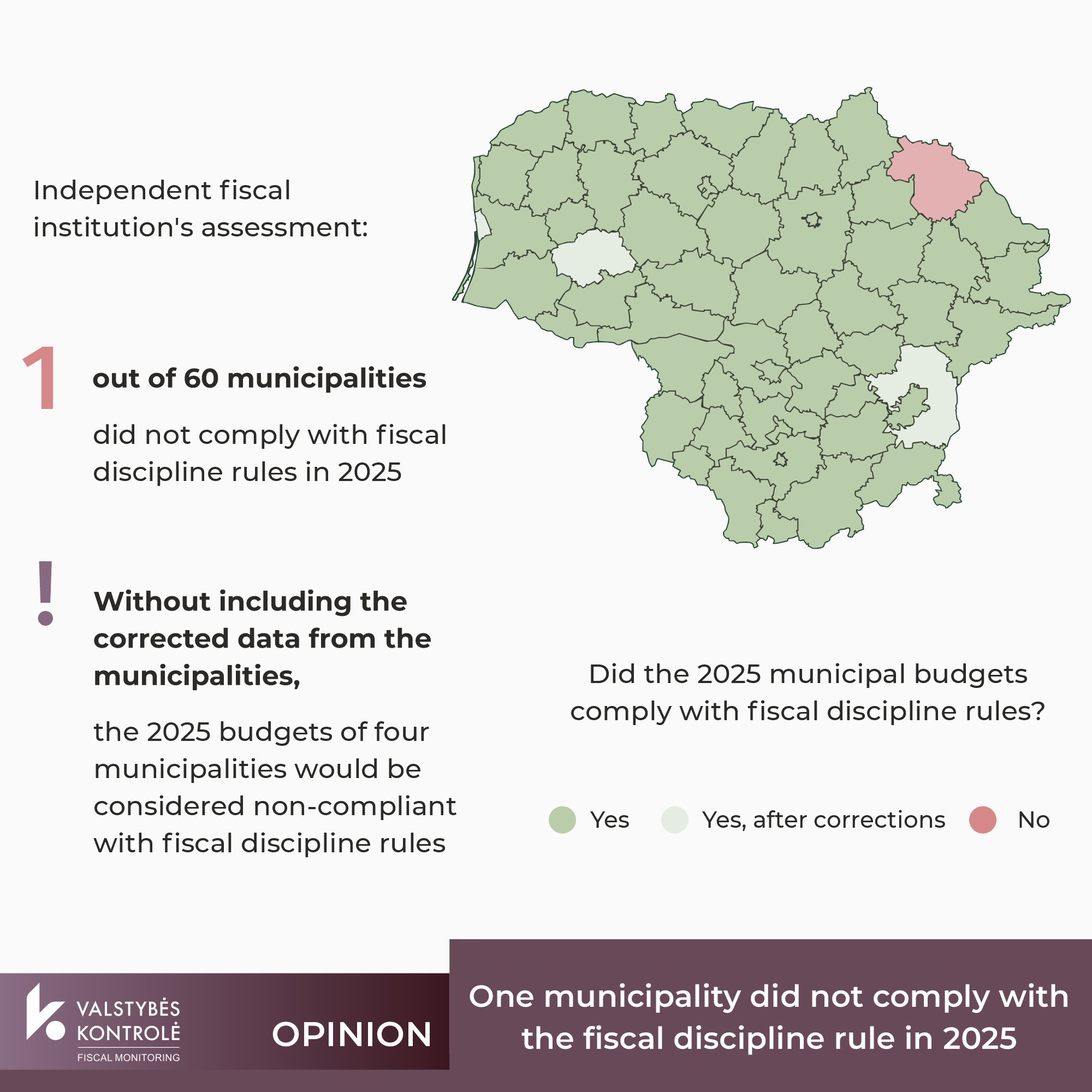 In 2025, one municipality’s budget did not comply with the fiscal discipline rule, but all planned municipal budgets for 2026 meet the requirements. However, the National Audit Office’s assessment showed that the accuracy of financial data remains a problem – without data corrections, more municipalities would fail to comply with the fiscal discipline rules.
The National Audit Office, as an independent fiscal institution, assessed whether the fiscal discipline rules were complied with during the implementation of the 2025 municipal budgets and the planning of the 2026 municipal budgets.
One municipality failed to comply with the fiscal discipline rule in 2025
In 2025, Rokiškis District Municipality failed to comply with the fiscal discipline rule. This risk was identified already in 2025 during a preliminary assessment.
According to the municipality’s data, the deficit exceeding the permitted limit was caused by increased expenditure for the implementation of an investment project, which required additional borrowing to cover. Under current legislation, the municipality will have two years to make up the resulting deviation of €1.1 million. According to the 2026 budget plan, it is expected to be offset as early as this year.
The assessment found that the accuracy of financial statement data remains one of the main issues. Following the identification of potential errors in the documents submitted by the municipalities, they were asked to review the data and, where warranted, to correct it. If the initial, uncorrected data were used, four municipalities would be deemed to be in breach of the fiscal discipline rules in 2025. In that case, they would have had to offset a total deviation of around €6.4 million. If the data in the 2026 budget plans were not corrected, two municipalities would fail to meet the fiscal discipline requirements.
“The problem of inaccurate data submission is a recurring one. Errors in municipalities’ financial reporting documents can affect the opinion regarding compliance with fiscal discipline rules, so it is important for municipalities to ensure the accuracy of the information they provide. The quality of the data determines not only the accuracy of the assessment but also the possibility of applying the flexibility provided for in fiscal governance,” says Jurga Rukšėnaitė, Head of the Fiscal Monitoring Centre.
It should be noted that although the law requires an assessment of the compliance of municipalities’ planned budget indicators for 2027–2028 with the fiscal discipline rule, there is currently insufficient data for a sound assessment.
In 2025, no municipality exceeded the debt and guarantee limits set by law. According to economists’ assessments, all municipalities complied with the fiscal discipline rule when drawing up their 2026 budgets.
Updated rules provide more opportunities for investment
From 2026, updated fiscal discipline requirements came into force in Lithuania, providing municipalities with more opportunities to finance investments and plan budgets more flexibly. Among the most significant changes are a uniform budget balance rule for all municipalities, a broader revenue base when assessing debt and guarantee limits, and new flexibility conditions for projects financed by the National Development Bank.
“The fiscal discipline rule is an important tool for ensuring sustainable public finances and responsible municipal financial management. Compliance with it allows municipalities not only to maintain financial stability but also to take advantage of the more flexible options provided by law for financing investments. The updated fiscal governance system provides more opportunities for investment and greater flexibility in budget management, but at the same time requires a responsible approach to public finance management. It is therefore important that municipalities adhere to the established fiscal discipline requirements when planning and implementing their budgets,” notes Auditor General Irena Segalovičienė.
The IFI’s opinion on the compliance with the fiscal discipline rules of municipal budgets during 2025–2026, fiscal discipline compliance spreadsheets and other annexes can be found here: Opinion on the compliance with the fiscal discipline rules of municipal budgets for 2025–2026