




2025-11-06
Fiscal institution warns: delayed decisions on sustainable revenues risk defence budget cuts in 2029
- If the planned changes to national fiscal discipline rules are not adopted, the 2026 draft budget would not comply with some of the rules currently in force.
- When changing fiscal discipline rules, it is important to ensure that municipalities also contribute to the sustainability of public finances, as unreasonable loosening would reduce the state's ability to finance other important areas.
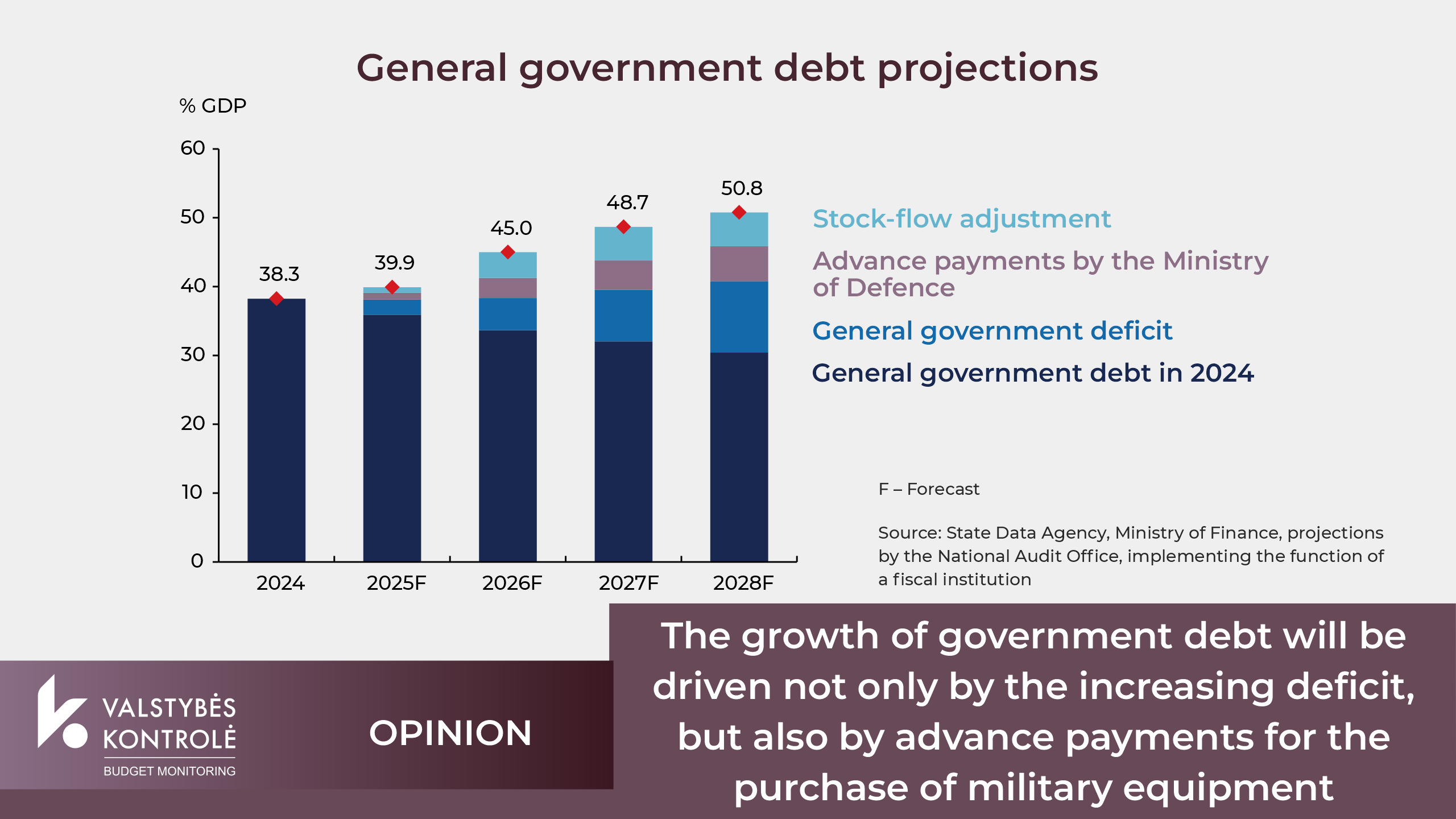
- The general government deficit in 2026 will be higher than in 2025, with advance payments for military equipment contributing to an even faster increase in debt.
- Considering the decisions adopted almost every year that are not provided for in the draft budget, the general government deficit will exceed the 3% of GDP threshold as early as 2028.
- While the national escape clause for defence is in force, the draft budget complies with EU rules, but before it expires, it is necessary to secure sustainable sources of funding for defence and other areas.
 The National Audit Office, implementing the function of a fiscal institution (NAO FI), has assessed Draft Law on budget approval for the period 2026–2028 of the Republic of Lithuania and has submitted its opinion to the Seimas.
The budget complies with EU fiscal discipline rules, but challenges will arise in the future
By the end of this year, legal acts must be adopted to align national and EU fiscal discipline rules. If the planned amendments are not adopted, the draft budget for 2026 would not comply with some of the national rules currently in force. The draft budget complies with EU fiscal discipline rues.
"In the medium term, Lithuania is adhering to the expenditure plan endorsed by the European Council, taking into account that the defence expenditure escape clause allows for a deviation from it of up to 1.5% of GDP. The country will fully utilise this clause by 2028. If we do not take timely decisions on sustainable defence financing, we will need to rapidly reduce the deficit after 2028. This would mean either new sources of revenues or expenditure cuts. I invite you to face reality – if we do not want to reduce defence financing in 2029, the issue of additional revenues must be resolved before the defence expenditure clause expires in 2028," notes Auditor General Irena Segalovičienė.
Sustainability of public finances – a shared commitment of all government subsectors
In the new EU rules, the main limiting indicator is general government expenditure*, the growth trajectory of which is set by countries in their fiscal structural plans. These expenditures will also be used as a basis for national rules. Changes to municipal fiscal discipline rules are also planned – regardless of the economic cycle, municipalities would be allowed to run higher budget deficits. Proposals submitted to the Seimas would further expand the borrowing possibilities of municipalities.
"It is now important to adopt new national fiscal discipline rules that would ensure that each subsector of government contributes to the sustainability of public finances. If municipalities are given exceptionally broad opportunities to rapidly increase deficits, this will reduce the state's ability to finance other important areas," says Jurga Rukšėnaitė, Head of the Budget Monitoring Department.
Deficit and debt: increasing pressure on public finances
The projections of the NAO FI and the Ministry of Finance for the general government deficit in 2025–2026 do not differ significantly, but the NAO FI sees higher pressure on public finances in 2027–2028. Taking into account the decisions taken almost every year to increase public sector wages, additionally index pensions, etc., the general government deficit will reach around 3% of GDP in 2027 and exceed this limit in 2028.
It should be noted that advance payments for military equipment will be reflected in the deficit in the future but are already increasing the government debt. Based on deficit projections and information presented in the draft budget, the NAO FI projects that debt will reach almost 51% of GDP in 2028, which would be about 12 percentage points more than in 2024. This means that the need for additional revenue will only increase.
* The net expenditure indicator will be used – general government expenditure minus net interest expenditure, discretionary revenue measures, expenditure on programmes of the Union fully matched by revenue from Union funds, national expenditure on co-financing of programmes funded by the Union, cyclical elements of unemployment benefit expenditure, and one-offs and other temporary measures.