





2025-11-03
National Audit Office: LRT audit identified systemic risks to employee social guarantees, significant gaps in content accessibility and procurement
- Risks to the social guarantees of employees have been identified, the principles governing employee selection, remuneration, and the application of authorship agreements are not clearly regulated.
- Excessive repetition on LRT Plus, which poses a risk to content diversity.
- The amount of paid information broadcast is excessive – LRT, which fulfils the mission of a national broadcaster, must broadcast more messages on cultural, educational, and social topics free of charge.
- Shortcomings identified in public and programme procurement: internal procurement controls must be strengthened and legal regulations improved.
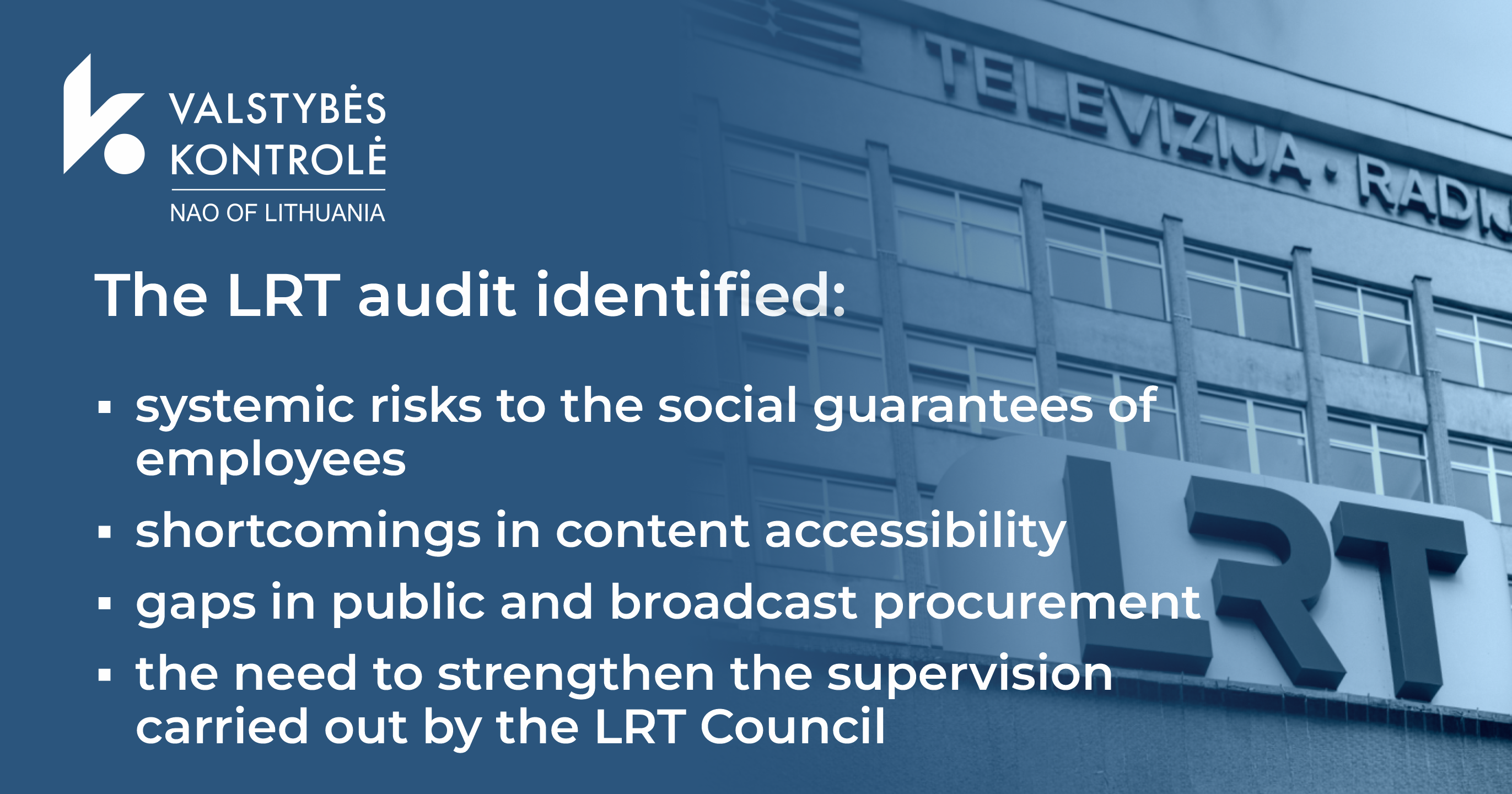 The National Audit Office carried out a public audit assigned by the Seimas (Resolution No. XV-171 of 17 April 2025) and assessed the activities of the public body Lithuanian National Radio and Television (LRT) for 2021–2024 in terms of economy, efficiency, and effectiveness. The audit identified systemic risks to the social guarantees of employees, gaps in the accessibility of programme content, and gaps in public and programme procurement.
"The constitutional mission of a public broadcaster requires the highest level of efficiency and transparency in the management of state budget funds. The audit revealed areas where LRT's activities need to be improved, ranging from social guarantees to procurement practices. We believe that the audit results will be used as a positive incentive to implement the necessary changes and strengthen LRT, responding to the public interest in receiving reliable and independent information," stresses Auditor General Irena Segalovičienė.
Risks to ensuring social guarantees of employees
The audit revealed that LRT does not have clearly defined principles for employee selection, remuneration, and the application of authorship agreements. Employee selection is carried out in accordance with the procedure established by LRT, which states that in certain cases the selection process may not be applied. Between 2021 and 2024, 113, or 38% of permanent LRT employees were hired under this exception. In addition, it was found that the selection process is not properly documented. The auditors note that the application of the exceptions provided for in the procedure does not create conditions for more candidates to apply, and the lack of documentation of the selection process does not ensure the transparency and traceability of the selection process.
The audit report notes that there is also a lack of procedure for when LRT establishes a position and when it concludes an authorship or service agreement. At the end of 2024, LRT had 661 employees. For the period 2021–2024, between 1,027 and 1,638 authorship agreements and between 126 and 329 individual activity agreements were signed each year with individuals (full-time and part-time employees) to perform various tasks. Their number increased significantly in 2024.
This type of agreement practice is more favourable to the employer than to the employee—the institution saves money, but the person loses the opportunity to receive the full range of benefits and social guarantees offered by the employer, such as annual leave or unemployment insurance. Ultimately, stability is not guaranteed. LRT should pay close attention to this. In order to ensure that authorship and service agreements are not concluded when they are essentially employment relationships, the growing number of these agreements should be assessed and, based on this, the actual need for employees should be determined and the current practice changed. Efficiency cannot be achieved at the expense of social justice," says Auditor General Irena Segalovičienė.
The National Audit Office recommended LRT to abandon the exceptions applied to employee selection and to document the selection process. It is important to note that LRT's remuneration principles, structure, forms and amounts of remuneration, grounds and procedure for additional remuneration and bonuses are regulated by LRT's remuneration policy. The remuneration of LRT Council members and committee members is determined by the Council itself. Since LRT's activities are financed from the state budget, the auditors believe that the principles of remuneration for all LRT employees and Council members should be laid down in the LRT Law, which is not currently the case.
Although the average salary (AS) of LRT employees in 2021–2024 was lower than that of UAB Laisvas ir nepriklausomas kanalas (37.2% in 2021, 34.7% in 2024) and UAB All media Lithuania (42.8% in 2021, 24.7% in 2024), and in 2024 it was 29% higher than the AS of public sector employees and amounted to EUR 3,098.87, employee turnover and satisfaction indicators show that remuneration has a positive effect on employee motivation. This may be influenced by additional benefits offered to employees, one of which is free electric vehicle charging. Thirty-nine employees use the eight charging stations installed on LRT territory. According to the meters at all stations, 32,900 kW were consumed during the year, amounting to EUR 3,800. The benefit received by LRT employees in the form of free charging of their personal electric vehicles at the employer's expense should be considered as income received in kind. LRT should assess and tax this income in the same way as salaries, in accordance with the procedure established by law. This situation is unfavourable for employees, as unpaid taxes and contributions reduce their social insurance base.
Insufficient accessibility of content for people with disabilities and non-commercial disseminators of information, repetition issue
LRT radio and TV programmes are still not sufficiently accessible to people with hearing or visual impairments. The LRT Law stipulates that programmes with Lithuanian subtitles must account for at least 50% of total monthly broadcasting time. However, between 2021 and 2024, the percentage of these programmes increased by only 1.03 percentage points (from 12.67% to 13.70%) and did not reach the 5% annual growth target until the 50% threshold is reached. Programmes translated into Lithuanian sign language in 2024 did not reach at least 1% growth until the 20% monthly broadcasting time limit was reached. In order to ensure the accessibility of programmes, the National Audit Office recommended setting annual targets and implementation schedules for programmes with Lithuanian subtitles and for those translated into Lithuanian sign language.
Since 2015, advertising and commercial messages have been prohibited on LRT programmes, but information on cultural, social, and educational topics (paid or free) is permitted. The audit shows that the amount of information broadcast by LRT for a fee has increased by almost 44%, while revenue from television messages has increased by 55% (from EUR 0.98 million to EUR 1.52 million). LRT does not use commercial activity revenue ranging from EUR 449,400 in 2021 to EUR 796,400 in 2024 each year, and the cash balance increased from EUR 2.5 million to EUR 4.8 million during the same period. In the auditors' opinion, the national broadcaster's mission would be better served by more free-to-air educational, cultural, and social content, so they recommended that LRT's management define criteria for the dissemination of free cultural information and allocate more airtime to it.
Although the number of repeated programmes is decreasing, according to the auditors, there are too many repeats on LRT Plius, which poses a risk to content diversity: repeats on LRT Plius accounted for as much as 56.4% of weekly airtime (the target is no more than 20-30%). Of all six LRT channels, only LRT Opus programmes were not repeated. According to the auditors, it is necessary to ensure content diversity in order to attract various social groups and encourage local creators.
Lack of transparency in programme and other public procurement
One of the most important audit observations concerns the regulation and supervision of procurement: shortcomings were identified in 4 (out of 12 assessed) public procurements and in all 12 (out of 12 selected for assessment) programme procurements. In 2024, 89% (516 out of 578) of programmes were procured through unannounced surveys, i.e., by contacting a specific supplier. The total financial value of these procurements was EUR 12.74 million, or 53% of the total procurement amount. The share of public procurement from a single supplier must be reduced, as the lack of competition increases the prices of goods, services, or works purchased and reduces the possibilities for the rational use of public funds.
In order to ensure that the procurement of programmes, their creation and production is carried out in a transparent and economical manner, the National Audit Office recommended strengthening internal control over the organisation of procurement, ensuring that identified non-compliance is corrected and does not recur in the future, and the Government of the Republic of Lithuania to revise the description approved by the Government's resolution on the choice of procurement method, the evaluation of unannounced surveys, and cases where the procurement of programmes, their creation, and production may be carried out by contacting a specific supplier.
The supervision carried out by the LRT Council must be strengthened
The audit report also notes that the LRT Council should pay more attention to supervising LRT's activities by making more targeted use of the powers granted to it. It should also conduct an annual analysis of its own activities in order to identify the competencies needed to ensure the quality of its decisions. The National Audit Office recommended that the LRT Council adjust the ratio of independent members to Council members in committees so that there are more independent members. In the opinion of the auditors, greater participation by independent members would improve the quality of decision-making and reflect good corporate governance practices.
It is important to note that during the audit, LRT corrected the identified non-compliances and made several positive changes in the areas of improving programmes accessibility, employee selection, and public procurement documentation and transparency.
In order to ensure the efficiency, effectiveness, and economy of LRT's activities, the National Audit Office made recommendations to the Government of the Republic of Lithuania, the Ministry of Culture, the LRT Council, and the LRT administration.