






2025-09-18
National Audit Office: temporary surge in budget revenue is no basis for long-term commitments
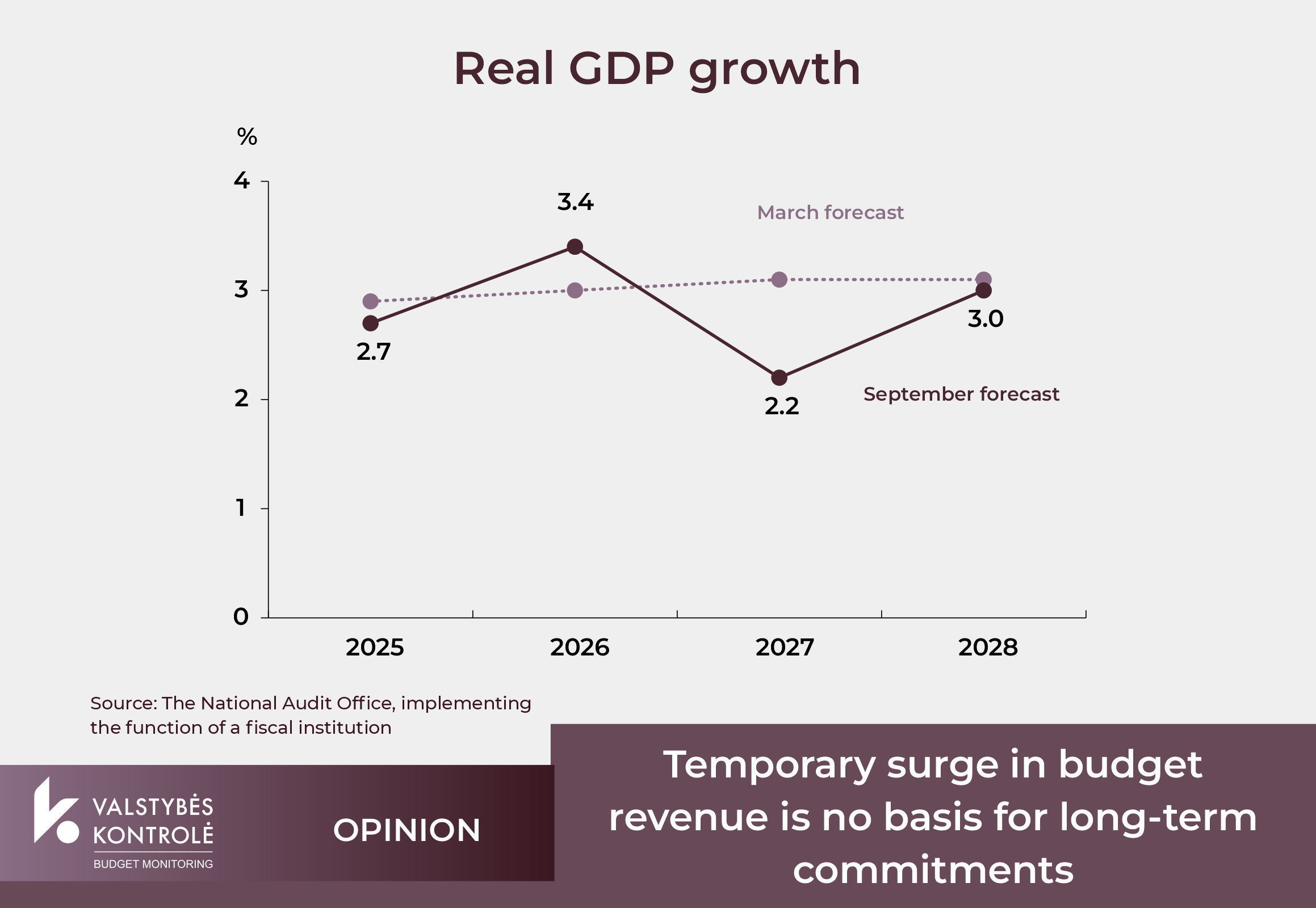
- The National Audit Office, implementing the function of the fiscal institution, has revised its economic growth forecast for this year down to 2.7%. Economic growth will be driven by domestic demand and exports.
- Changes to the second pension pillar will significantly boost household consumption. This will lead to higher GDP growth and inflation in 2026 than projected in March.
- Once the one-off surge in consumption fades, economic growth will slow significantly in 2027.
- Changes to the second pension pillar will temporarily increase general government revenue, so it is important not to make long-term commitments on this basis.
- The labour market will remain strong, over the medium term, high number of employed persons and rapid wage growth exceeding inflation are projected.
 The National Audit Office, implementing the function of the fiscal institution (NAO FI), has analysed the macroeconomic environment and prepared its projections. These projections take into account the impact of tax changes, increased tariffs, and changes to the second pension pillar on the country's economic development.
"We project that the country's economy will grow unevenly in the medium term, mainly due to a temporary surge in consumption caused by changes to the second pension pillar. Assuming that an additional €1.2 billion could be spent on consumption, we forecast that real GDP will grow by up to 3.4%. This, together with changes in VAT, will also lead to faster inflation. Once the one-off effect subsides, both household consumption and real GDP are likely to grow more slowly in 2027," says Jurga Rukšėnaitė, Head of the Budget Monitoring Department.
Real GDP is expected to grow by 2.7% in 2025. This will be driven by household consumption, recovering investment, and faster exports than last year. Given the slower development of trading partners and increased US import tariffs, export growth is expected to be sluggish in 2026–2028. The situation in the labour market will remain stable: the unemployment rate will decline steadily, and average wages will grow faster than inflation.
"We see that changes to the second pension pillar could have a significant impact on economic growth and general government revenue in 2026. They will be temporary in nature, so expenditure decisions must be responsible. When preparing the state budget, long-term commitments should not be made on the basis of these unsustainable revenues," notes Auditor General Irena Segalovičienė.
The agreement reached between the EU and the US at the end of July on a 15% tariff has provided more clarity for EU manufacturers and investors, but uncertainty remains. Lithuania's economic development could be boosted by the defence industry, higher household consumption, which would be influenced by changes in household savings, and changes to the second pension pillar.
Based on its projections and other methods, NAO FI has assessed and endorses the Economic Development Scenario for 2025–2028 published by the Ministry of Finance on September 11. It is consistent with the assumptions made by the Ministry of Finance and is based on relevant statistical data. The Scenario is suitable for preparing the 2026–2028 draft budget.
The Opinion on the Endorsement of the Economic Development Scenario, the macroeconomic forecasts of the NAO FI are available here:
Opinion on the Endorsement of the Economic Development Scenario.