




2024-11-07
The planned deficit in 2025 is not in line with national fiscal discipline rules and risks breaching the Maastricht criterion
- The planned deficit for 2025 does not comply with the requirements of the surplus general government rule.
- The Government's proposal to Seimas to suspend the surplus general government rule in 2025 poses risks to long-term fiscal sustainability.
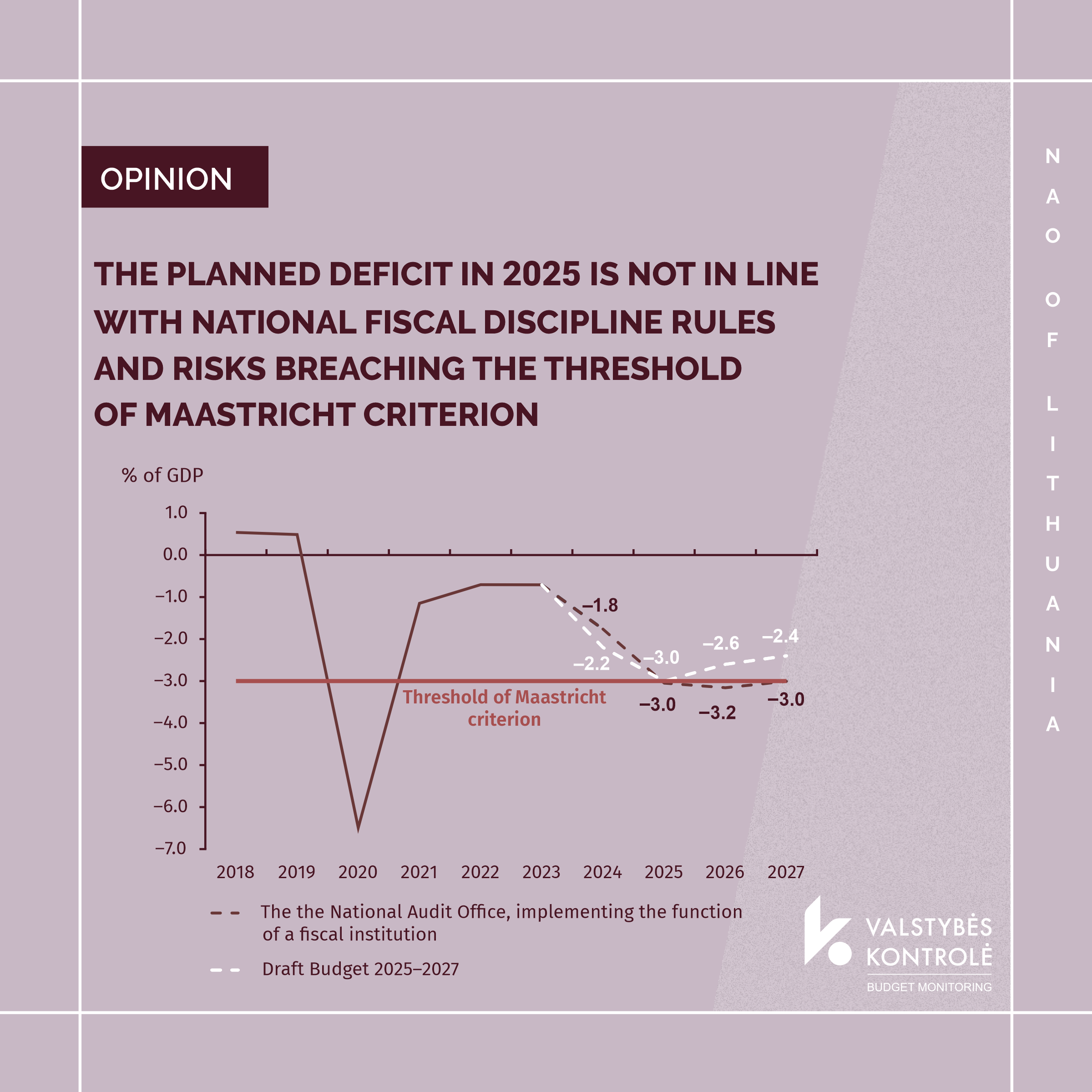
- There is a risk that the general government deficit will be above 3% of GDP in 2025.
- Taking into account the annual decisions and the long-term commitments that are not foreseen in the draft budget for 2026–2027, the NAO FI projects the general government deficit to exceed the 3% of GDP threshold in 2026.
- Financing general government debt will become more expensive every year and, without the necessary decisions, the debt will increase and is expected to reach almost half of the country's GDP in 2027.
 The National Audit Office implementing the function of a fiscal institution (NAO FI), has assessed the Draft Law on Budget Approval of the Republic of Lithuania for the period 2025–2027 and has submitted its opinion to the Seimas.
There are no significant differences between the projections of the general government deficit for the period 2024–2025 of the NAO FI and the Ministry of Finance. The draft budget projects a general government deficit of 3% of GDP in 2025, higher than in 2024. According to the NAO FI's assessment, it is unlikely that the 2025 deficit would be better than 3% of GDP, due to previous commitments and decisions that increase general government expenditure. There is little scope for general government revenue to be significantly higher than projected in the draft budget. It cannot be excluded that various risks could push the deficit above the Maastricht criterion threshold in 2025.
Exceptional circumstances were applied between 2020 and 2024, which allowed for an exemption from the fiscal discipline rules limiting general government deficits. These circumstances will no longer apply from 2025. The draft budget projects a general government deficit of 3% of GDP in 2025, which raises the risk of non-compliance with the surplus general government rule. Based on developments in EU legislation, the Government has submitted a proposal to the Seimas to add a provision to the Constitutional Law implementing the Fiscal Treaty to suspend the application of this rule in 2025.
"In our view, this proposal poses risks to long-term fiscal sustainability and only postpones the resolution of fiscal problems to the future. Moreover, it may require more effort to stay within the rules of fiscal discipline than the draft budget would suggest, as it does not include routine decisions, such as salary increases for public sector employees, additional indexation of pensions, and tax-exempt amount of income in 2026–2027," Jurga Rukšėnaitė, Head of the Department of Budget Monitoring, said.
According to the assessment of the NAO FI, the general government deficit in 2026 could exceed the Maastricht criterion, taking into account the decisions taken annually and the long-term commitments that are not foreseen in the draft budget for the years 2026–2027. Debt is projected to reach close to 43% of GDP in 2025 and close to 50% of GDP in 2027. It is important to note that financing general government debt is becoming increasingly expensive. This means that in the future more resources will have to be devoted to debt servicing when they could be used for other important public areas such as healthcare, etc.
In the longer term, the need for spending will grow in the future, not only because of commitments, possible discretionary decisions, but also because of an ageing population. Structural revenue and expenditure decisions are needed now to achieve sustainable public finances.
The opinion on the structural adjustment target, the projections of the National Audit Office implementing the function of a fiscal institution and other annexes are available here.
Opinion on the structural adjustment target