


2024-09-19
The Economic Development Scenario for 2024–2027 is appropriate for the preparation of the draft State Budget
- The National Audit Office, implementing the function of the fiscal institution, endorses the September Economic Development Scenario for 2024–2027 published by the Ministry of Finance.
- Risks to the Lithuanian economy remain mainly related to the geopolitical situation and international trade.
- Real GDP may grow faster in 2024 than expected in the summer.
- In 2025, the recovery in production and consumption abroad is expected to boost Lithuania's economic growth.
- To remain competitive, it is essential to boost growth in high technology manufacturing.
- In order to make three-year budget plans more realistic, indicators, coefficients and other variables affecting the state budget should be projected for a period of at least three years.
 The National Audit Office, implementing the function of the fiscal institution, has assessed and endorses the Economic Development Scenario for 2024–2027 published by the Ministry of Finance on 11 September. It is consistent with the assumptions identified and is based on relevant statistical data. Both institutions‘ views on the Lithuanian economic outlook are similar.
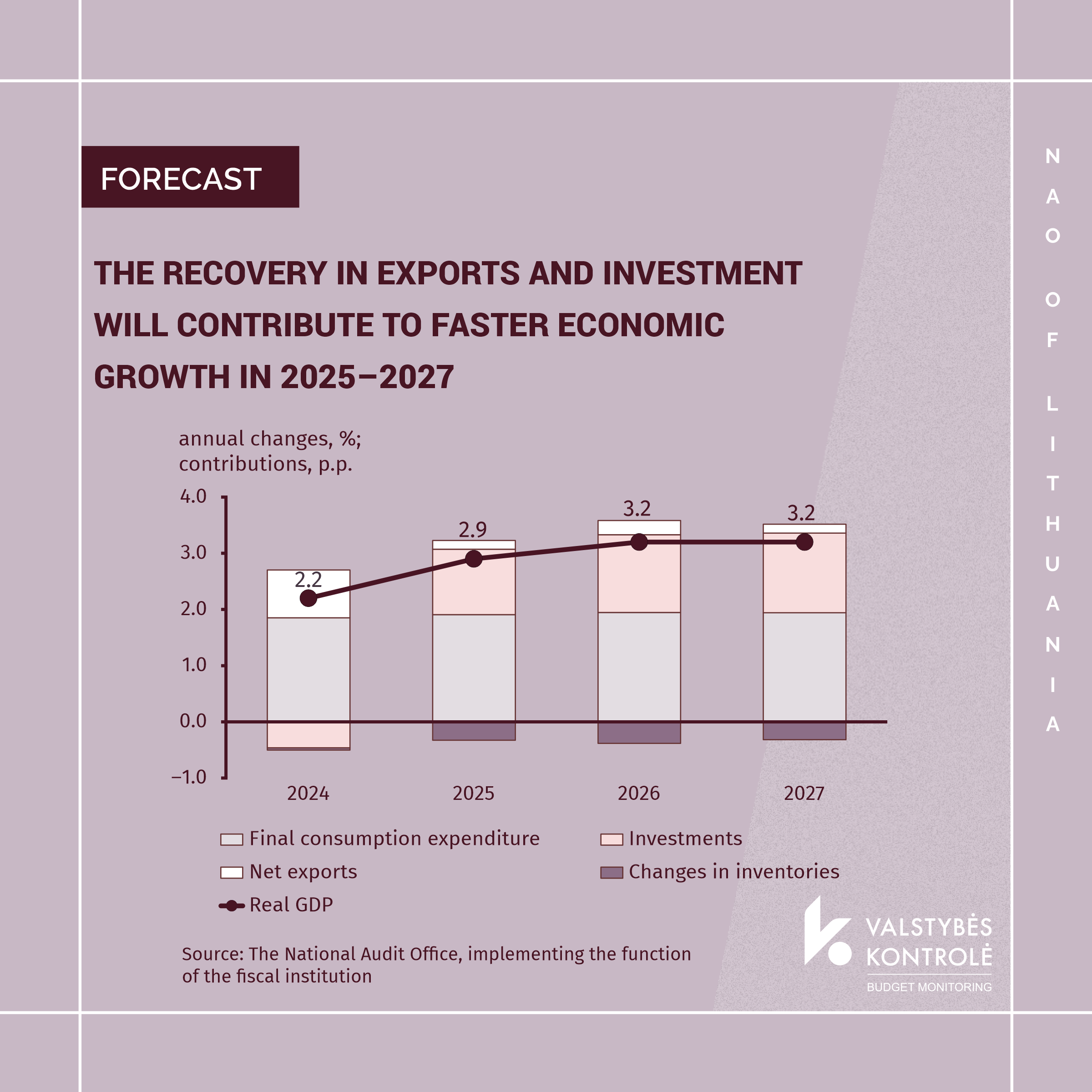
"We have slightly revised upwards our 2024 real GDP projections in light of the first half of 2024 results and updated assumptions. We forecast economic growth of more than 2%, driven mainly by household consumption and positive net exports. The country's economic growth will accelerate to around 3% between 2025 and 2027. However, geopolitical situation and international trade remain the main risks to Lithuania's economic development," said Jurga Rukšėnaitė, Head of the Budget Monitoring Department.
In the medium term, GDP expansion is projected to be driven mainly by real exports, which are expected to benefit from a recovery in external demand. Investment and household consumption will also contribute to economic growth. Wages and employment will be higher in 2024 than expected in June and the labour market situation will be stable between 2025 and 2027, with a steady decline in the unemployment rate and continued growth in average wages. A more favourable economic development could be driven by a better labour market situation, faster investment growth and higher household consumption. However, Lithuania's labour productivity growth, which was strong during the pandemic, is lagging behind the multi-year trend, which may pose challenges to competitiveness. In line with the recommendations of international institutions, it is important to increase investment and innovation in higher value-added sectors in order to remain competitive.
In October, a draft budget law will be presented for the first time on the basis of the updated Law on the Budget Structure (BSL). One of the strengths of the updated BSL is the requirement that the values of indicators, coefficients and other values established by law should be set or forecasted for a period of at least three budgetary years. Rates that are projected for the entire medium term would allow for more accurate and transparent planning of draft budgets, a more appropriate assessment of the impact of decisions taken on future budgets, and the identification of risks to compliance with fiscal discipline rules. In the view of The National Audit Office, implementing the function of the fiscal institution, clearer guidelines for rates such as the minimum monthly wage could also help to forecast macroeconomic indicators more accurately, which is why it is important for the responsible institutions to make such rates publicly available at the beginning of the budget preparation cycle.
The Opinion on the Endorsement of the Economic Development Scenario, the macroeconomic forecasts of the National Audit Office, implementing the function of the fiscal institution and other annexes are available here:
Opinion on the Endorsement of the Economic Development Scenario