


2024-07-02
Q1 2024 results have led to an upward revision of this year's GDP projections, but uncertainty about the macroeconomic situation remains
- The National Audit Office, implementing the function of the fiscal institution (NAO FI), endorses the June Economic Development Scenario for 2024–2027 published by the Ministry of Finance.
- Economic growth in 2024 will be driven mainly by household consumption and investment, with GDP growth projected to accelerate in 2025 as export markets recover.
- The labour market remains resilient to challenges: the employment and wage projections for 2024–2025 are higher than those published in March 2024.
- Uncertainty about Lithuania's future economic growth is mainly related to the geopolitical situation and international trade.
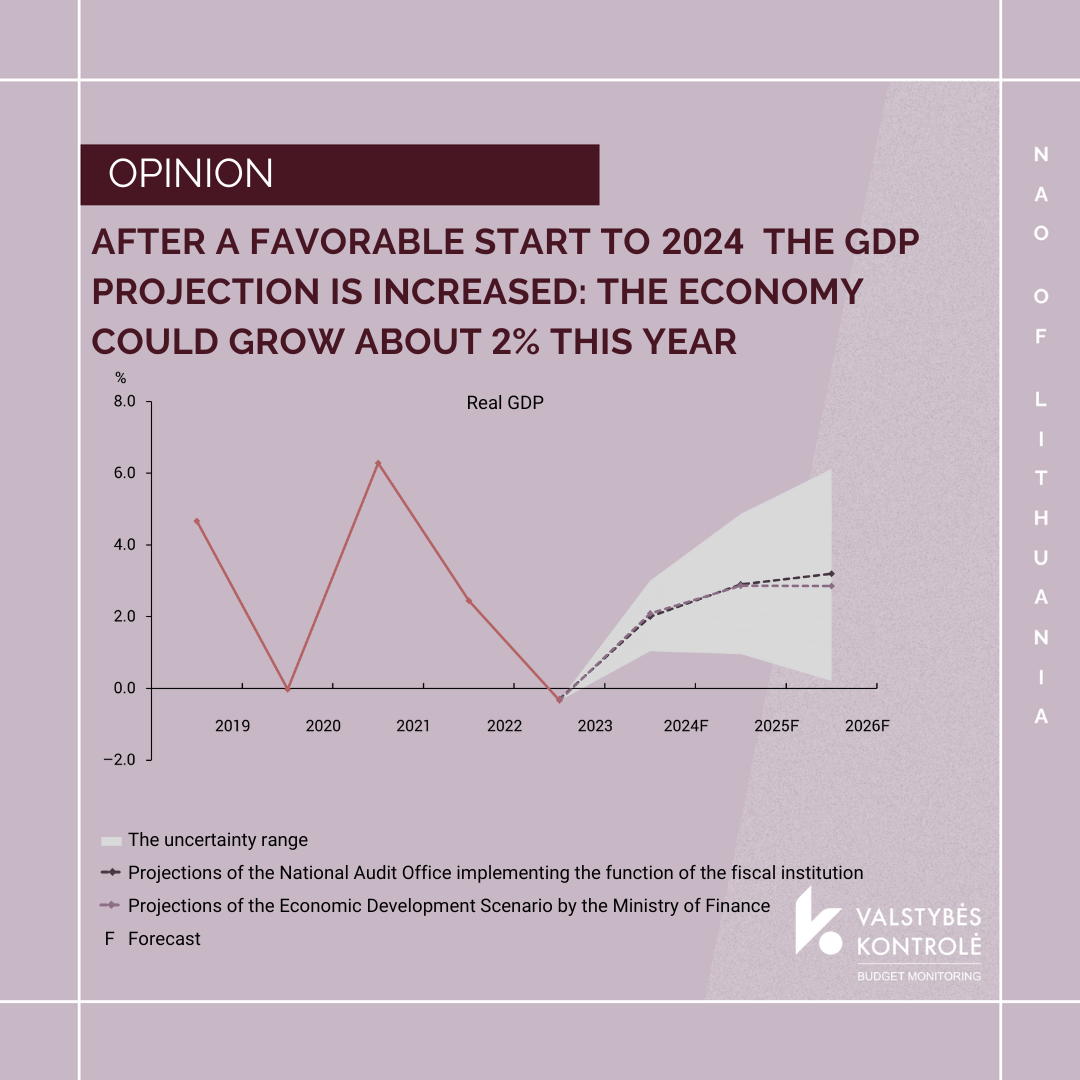 The NAO FI has assessed and endorses the economic development scenario for 2024–2027 published by the Ministry of Finance on 20 June. It is consistent with the assumptions identified and is based on relevant statistical data. The NAO FI's view on the Lithuanian economic outlook is similar to that of the Ministry of Finance.
"We have increased our real GDP projection for this year to 2%, due to better-than-expected data for Q1 2024. Economic growth will be driven mainly by household consumption, which will be boosted by the strengthening purchasing power of the population in the face of slowing inflation and rising wages. Investment will also contribute to economic growth, but at a slower pace than projected in March. As export markets recover, economic growth should return to more normal growth rates of 3% between 2025 and 2027. On the other hand, uncertainty about the international environment remains," said Jurga Rukšėnaitė, Head of the Budget Monitoring Department.
Both the Ministry of Finance and the NAO FI have similar views on the evolution of GDP in 2024–2027. Both institutions project the country's economic growth to be stronger in 2025–2027 than in 2024, driven by real exports, which will benefit from a recovery in external demand. Both institutions forecast that wage and employment growth in 2024 will be stronger than expected in March and that the labour market situation will remain stable between 2025 and 2027. Consumer price inflation is expected to remain below 2% this year. In the medium term, it will be driven mainly by rising service prices.
Risks to Lithuania's future economic growth are mainly related to the geopolitical situation and international trade. Russia's war in Ukraine and unrest in the Middle East pose risks to international trade and global economic development. The increasingly evident impact of climate change could adversely affect supply chains and inflation. A return to fiscal discipline could also limit the ability of governments to stimulate their economies, which could reduce demand for Lithuanian exports. However, a more favourable labour market situation, a faster expansion of public investment and less restrictive monetary policy could lead to stronger economic growth.
Opinion on the Endorsement of the Economic Development Scenario