




2024-05-22
Additional sources of revenue are needed to ensure quality public services and the sustainability of public finances
- In 2023, general government budgets were in line with fiscal discipline rules.
- The general government deficit in 2024 is likely to be lower than foreseen in the 2024 Budget Law. The economic stimulus path for 2024 is maintained.
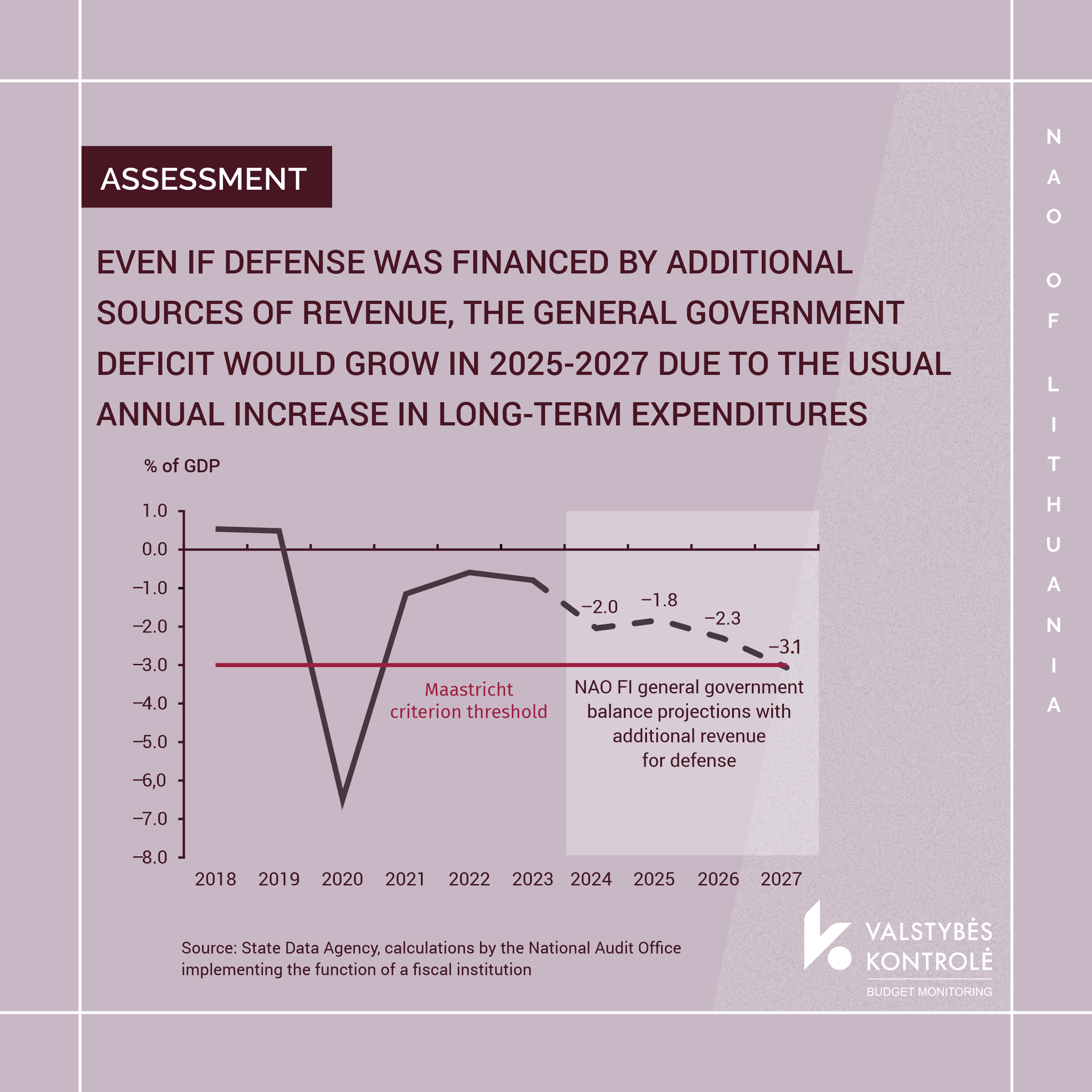
- The additional revenue sources for defence would result in a slower growth of general government deficits and debt between 2025 and 2027. However, the usual annual increases in long-term expenditure without additional revenue sources would lead to a deficit above the 3% of GDP Maastricht criterion threshold in 2027.
- Changes to the tax system are necessary to achieve a fairer, simpler tax system and to meet growing financing needs.
 The National Audit Office, implementing the function of the fiscal institution (NAO FI), has carried out an own-initiative assessment of Lithuania's general government finances for 2024–2027. It should help policymakers make more informed decisions as budget plans for the period 2025–2027 start to be prepared. In 2023, general government budgets were implemented in line with their requirements. It should be noted that some of the fiscal discipline rules do not apply from 2020 due to exceptional circumstances in Lithuania. The NAO FI expects a return to full application of the rules in 2025.
According to the NAO FI's assessment, the general government deficit in 2024 is likely to be lower than foreseen in the 2024 Budget Law, at around 2% of GDP. This is due to the March update of macroeconomic projections and a lower-than-expected deficit in 2023. Revenue from personal income tax is likely to be higher in 2024, but uncertainties remain. In the assessment of the NAO FI, with the economy below its potential level, the economic stimulus path is maintained in 2024. Importantly, the stimulus should also be based on investment. It is worth noting that nationally financed investment in 2016–2023 was in line with the European Commission's recommendations to maintain the investment level.
The additional revenue sources for defence would lead to a slower increase in general government deficits and debt between 2025 and 2027. However, without offsetting the usual annual increases in long-term expenditure with additional revenue sources, the deficit would be above the Maastricht criterion threshold of 3% of GDP in 2027 and debt would reach 44.1% of GDP. This long-term expenditure includes decisions such as increasing social benefits, raising salaries for public sector workers, including doctors and teachers. These decisions are routine and expected in the future to respond to rising macroeconomic indicators, such as average wages or others.
"To meet society's growing need for quality services, general government spending is increasing year on year. The challenges of an ageing population contribute to rising costs. There are many challenges and many needs that are likely to become real costs for the State budget. However, with revenue levels remaining low, we will not be able to meet them without undermining the sustainability of public finances. In our view, the additional revenue sources currently under consideration are necessary, but ambitious decisions are also needed in the future to increase revenue to finance other areas", said Jurga Rukšėnaitė, Head of the Budget Monitoring Department.
Projections show that debt servicing will become twice as expensive in the next 3 years. This means that more resources will have to be devoted to interest payments in the future when they could be used for other areas. One of the areas where underfunding is evident is health care. General government sector health expenditure in Lithuania is low compared to the EU, so relative household out-of-pocket spending on health is twice as high as in the EU.
The NAO FI reiterates that international organisations have made recommendations for the improving the Lithuanian tax system. Currently, horizontal equity is not guaranteed in Lithuania, as people with similar income levels pay different rates of taxes. Vertical equity is also not ensured, because once a certain level of high income is reached and continues to rise, the average personal income tax burden decreases. International organisations recommend expanding environmental and property taxes, and adjusting the tax system by reviewing exemptions and eliminating some of them.