


2024-05-16
National Audit Office assessed the use of education appropriations
- Municipalities have approved plans to reorganise their school network, but the network is not yet optimal, making it difficult to ensure quality education and optimal workloads for teachers.
- With the additional budget money, the average teacher salary in 2023 increased by 10.7%, compared to a 12.6% increase in the national average.
- With the national average salary rising faster than the increase in teacher salaries, even if teacher salaries are increased by a further 10% from September as planned, the State's commitment to achieve a 130% ratio between teacher salaries and the national average salary this year may not be achieved. Meeting the obligation may require the use of the legal right to borrow.
 The National Audit Office carried out the audit "Use of Appropriations for Education" mandated by the Resolution of the Seimas (14 December 2023, No. XIV-2378) and assessed whether the commitments on the teacher and other educational staff salaries and the rational use of other appropriations were properly implemented.
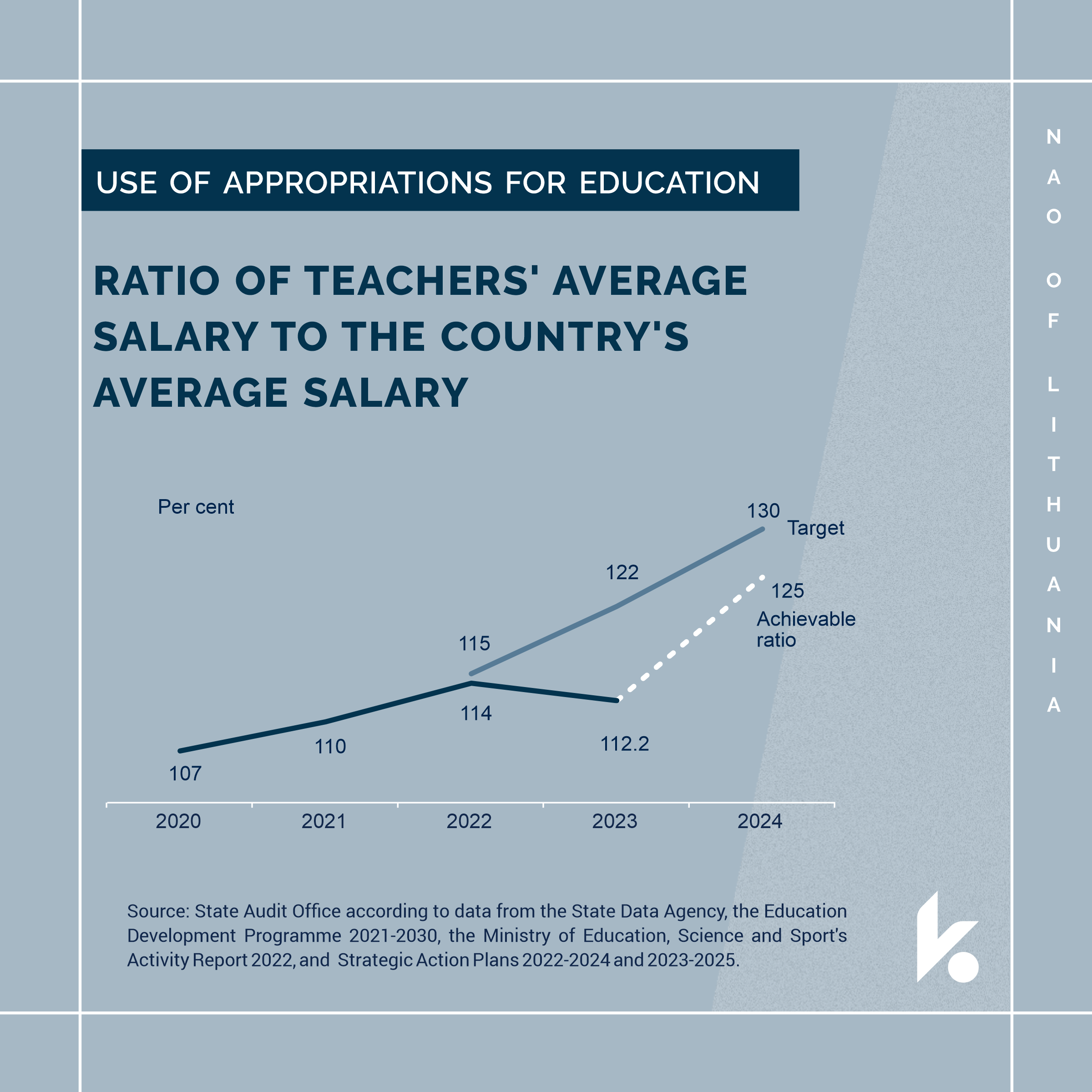
One of the main audit questions is whether educational institutions are using the salary fund in a way that meets the State commitments on salaries. The State is committed that the ratio of teacher salaries to the national average salary should reach 130% in 2024. With the additional budget money, the average teacher salary increased by 10.7% in 2023, while the national average salary increased by 12.6%.
"Due to the country's average salary rising faster than the increase in teacher salaries, the auditors estimate that even if teacher salaries are increased by a further 10% from September as planned, the state's commitment to achieve a 130% ratio between teacher salaries and the country's average salary this year may not be met. It is likely to be 125%. Meeting the obligation may require the use of the legal right of borrowing. It is important that the State, when setting the pay commitments for teachers, properly assesses the possibilities to implement them and to ensure their continuity in the event of changes in the economic or political environment," said the Auditor General Mindaugas Macijauskas.
The audit found that only expert teachers, who account for 3% of all teachers, could have a potential maximum salary (with a 25% increase in the coefficient) higher than the target average teacher salary in 2023 of 122% of the national average salary (EUR 2 457). The only salary increases for full-time teachers could be in the form of substitution payments, lump sums and other irregular bonuses. The National Audit Office had already pointed out in its last year's assessment "Assessing the need for educators" that teachers aged 25-34 earn the lowest salaries of all teachers, which is one of the reasons why it is difficult to retain them in schools.
The audit also assessed the rational organisation of the network of educational institutions. Between 2020 and 2023, the network of general education schools was optimised and the number of schools reduced from 971 to 917. However, it was found that on 1 September 2023, Lithuania had one gymnasium with less than 60 pupils, 30 schools with up to 100 pupils and 30 general education schools with classes of less than the minimum 8 pupils. In these schools, primary classes are combined due to the extremely low number of children, and in at least one school, pupils in grades 6 to 9 are also combined in a number of subjects, such as chemistry, physics or history.
In summary, the audit shows that the school network is not yet rational, with class sizes too small, municipalities not always contributing to their funding, pupils facing difficulties in getting a quality education and teachers facing difficulties in having an optimal workload. The audit results show that the further results of the optimisation of the school network depend on the exemptions foreseen, as very small classes are formed by national minority schools in Vilnius, Trakai and Šalčininkai districts, which are now subject to exemptions in the network formation.
As of 1 September 2023, Lithuania had a total of 1,639 general and pre-primary schools: municipal (1,331), state (27) and non-state (281). They were attended by 475,500 pupils. Between 2023 and 2024, they employed 55.4 thousand teachers and other educational staff.
Please click on this link, to see data on the salaries of teachers and other educational staff in the audited schools.