


2024-03-27
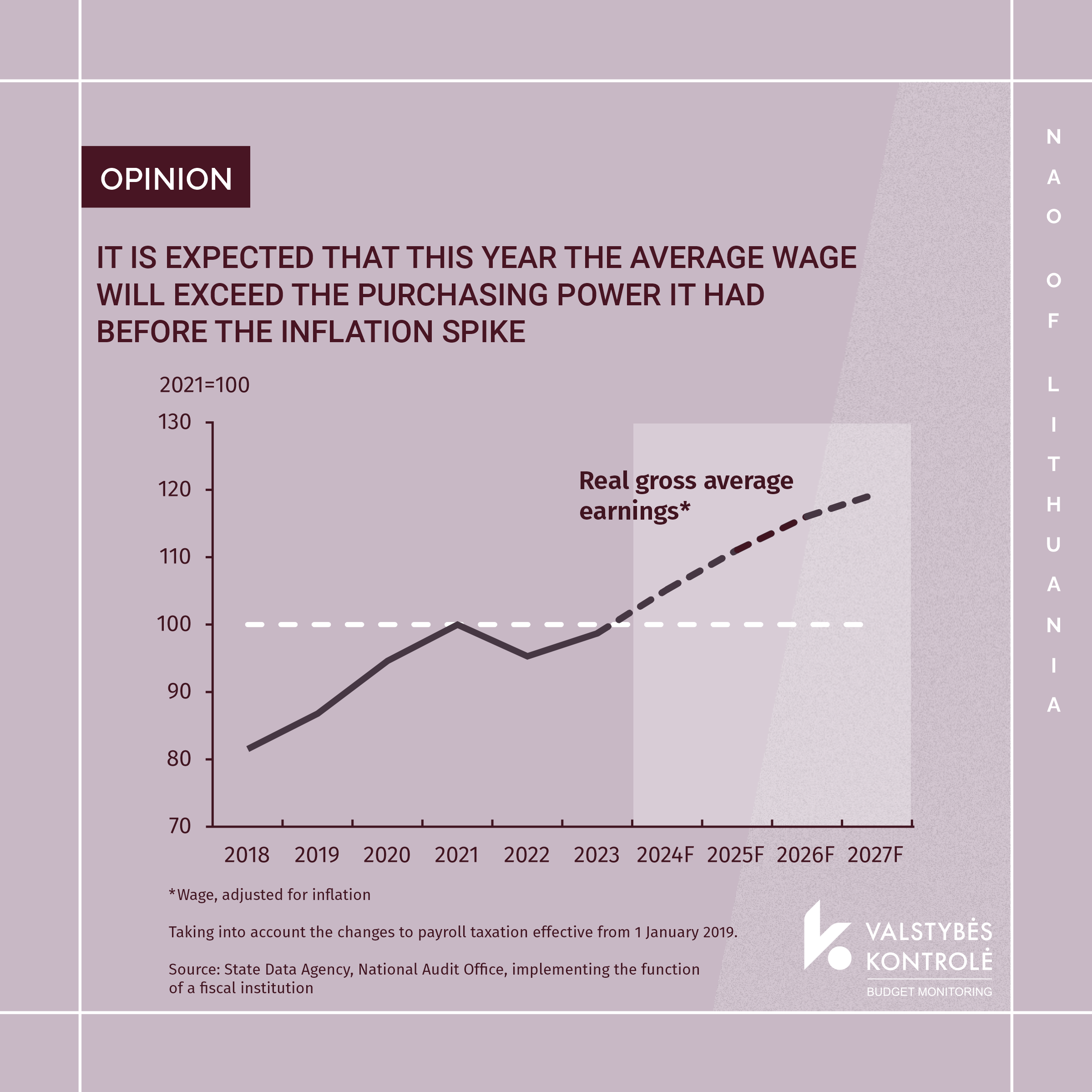
It is expected that this year the average wage will exceed the purchasing power it had before the inflation spike
- The NAO FI endorses the March Economic Development Scenario for 2024–2027 published by the Ministry of Finance.
- Moderate economic growth in 2024 will be driven mainly by household consumption and investment, and GDP is projected to expand faster in 2025 as export markets recover.
- Lower energy prices are dragging down inflation, which, together with continued strong wage growth, will allow purchasing power to exceed its 2021 level.
- Higher growth in the wage bill may allow personal income tax revenues to offset possible lower receipts from corporate income and value-added taxes.
 The National Audit Office, implementing the function of the fiscal institution (NAO FI), has assessed and endorses the economic development scenario for 2024–2027 published by the Ministry of Finance on 18 March. It is consistent with the assumptions identified and is based on relevant statistical data. The NAO FI's view on the Lithuanian economic outlook is similar to that of the Ministry of Finance.
"Rapidly falling inflation will allow average wages to regain the purchasing power lost during the inflation shock. This will boost domestic consumption growth. In view of the expected stronger growth in household consumption and investment and the weaker development of export markets, we leave our forecast published in January unchanged and project GDP growth of 1.8% for 2024. The recovery in export markets should see the economy return to a more typical 3% growth path between 2025 and 2027. On the other hand, uncertainties in the geopolitical situation pose risks to the stable development of the economy", said Jurga Rukšėnaitė, Head of the Budget Monitoring Department.
Both the Ministry of Finance and the NAO FI have similar views on the evolution of GDP in 2024-2027. The labour market is also projected to remain stable, with wages continuing to grow, the number of employed persons increasing in 2024. In the medium term, the number of employed persons is expected to shrink due to population ageing. As energy prices stabilise, inflation is projected at around 2% in the medium term.
Risks to Lithuania's continued economic growth are mainly related to the geopolitical situation and international trade. Russia's war in Ukraine and unrest in the Middle East could affect supply chains. In addition, the return to fiscal discipline in the European Union and high interest rates could limit the ability of governments to stimulate their economies, which would negatively affect Lithuania's external demand.
The economic development scenario published in March 2024 foresees slower inflation and economic expansion compared to the projected macroeconomic development underlying the draft budget for 2024. This implies that revenues from corporate income and value-added taxes could be lower. However, higher projections for the number of employed persons and wages also lead to a higher forecast for the wage bill. According to the NAO FI, this could lead to higher personal income tax receipts, which should offset lower budget revenues from corporate income and value-added taxes.