


2023-10-27
With the deficit approaching 3% of GDP, without sustainable sources of revenue, further spending increases would risk not complying with the Maastricht criteria in the future
 The National Audit Office, implementing the function of the fiscal institution (NAO FI), assessed the draft Law on the Approval of Financial Indicators of the State Budget and Municipal Budgets of the Republic of Lithuania for 2024 (hereinafter - the draft budget) and submitted its opinion to the Seimas.
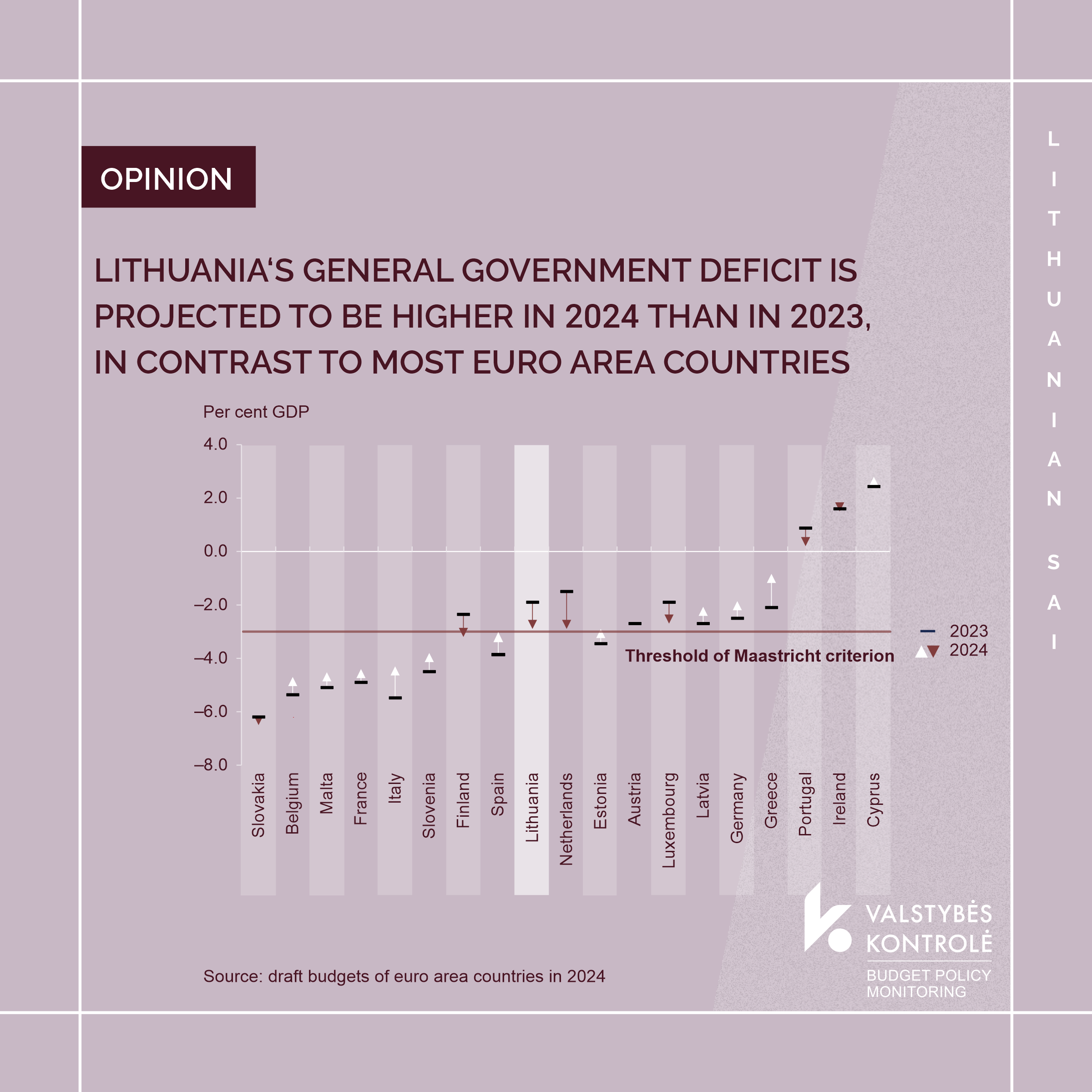
There are no significant differences in the projections of the general government deficits for 2023–2024 between the NAO FI and the Ministry of Finance. The general government deficit in the draft budget is projected to be below 3% of GDP in 2024 but higher than in 2023. By contrast, many euro area countries project lower deficits in 2024 than in 2023. Most countries, including Lithuania, will comply with the Maastricht 3% of GDP deficit criterion. The debt and deficit criteria in the Maastricht Treaty set out the requirements for fiscal discipline in the European Union.
According to the assessment of NAO FI, the country's economic stimulus will be stronger in 2024 than in 2023. Such a stimulus is warranted when the economy is growing below its potential level. However, in the opinion of the NAO FI, stimulating the economy with even higher expenditures than foreseen in the draft budget would not be appropriate at this stage. Existing risks, especially related to the need for higher spending on national defence and security, and the deterioration of the economic situation could lead to a higher deficit. In the absence of decisions on the size of non-taxable income, social benefits or salary increases for public sector employees in the period 2025–2026, the draft budget does not reflect their impact. According to the assessment of NAO FI, if these decisions were taken and without additional revenue sources, the general government deficit in 2025–2026 could exceed the threshold of the Maastricht criterion. Accordingly, this would lead to a faster increase in debt, which would reach almost 46% of GDP in 2026.
"Every year, decisions are taken with the budget that have a negative impact on the general government balance. According to the assessment of the NAO FI, the deficit of this sector is likely to grow in the medium term and its financing is becoming more expensive due to the increase in interest rates. For these reasons, additional sustainable sources of revenue are needed. If such revenues are not foreseen, this could lead to future restrictions on public spending or non-compliance with fiscal discipline rules", said Jurga Rukšėnaitė, Head of the Budget Monitoring Department.
From 2020, only part of the fiscal discipline rules laid down in the Constitutional Law on the implementation of the Fiscal Treaty apply due to the declaration of exceptional circumstances. According to the preliminary assessment, the budgets of the State Social Insurance Fund and Compulsory Health Insurance Fund for 2024 are drawn up in accordance with the rules applicable to them. In the assessment of the NAO FI, considering the geopolitical situation as a basis for the continuation of the exceptional circumstances, it is important to assess whether the structural deficit is increasing for this reason. The structural balance is calculated by eliminating the effects of the business cycle and the impact of one-off and temporary measures from the general government nominal balance. According to the data from the Ministry of Finance, it is projected that in 2024 it will be above the medium-term objective of –1% of GDP adopted by the Seimas. This situation persists even after the elimination of support measures for Ukraine. This suggests that it is not only this expenditure that is causing the increase in the structural deficit and indicates risks to future compliance with fiscal discipline rules and the sustainability of general government finances.