


2022-05-06
Assessment of Lithuania’s Stability Programme for 2022: no specific measures to decrease expenditure projected for 2023-2025
 Implementing the functions of the fiscal institution, the National Audit Office carried out an assessment of Lithuania’s stability programme for 2022.
The assessment notes that the medium-term projections for the general government balance presented in the preparation of this programme do not take into account part of the liabilities made by the State, such as increases in wages of healthcare and education workers as well as a need of further increase of the budget for defence up to 2.5 % of GDP . The National Audit Office, implementing the functions of fiscal institution, estimates that as a result of inclusion of these commitments the general government deficit will make 4.9 % of GDP in 2022 and 3.3 % of GDP in 2023, whereas it will decrease to 3.0 % of GDP in 2024 and 2025.
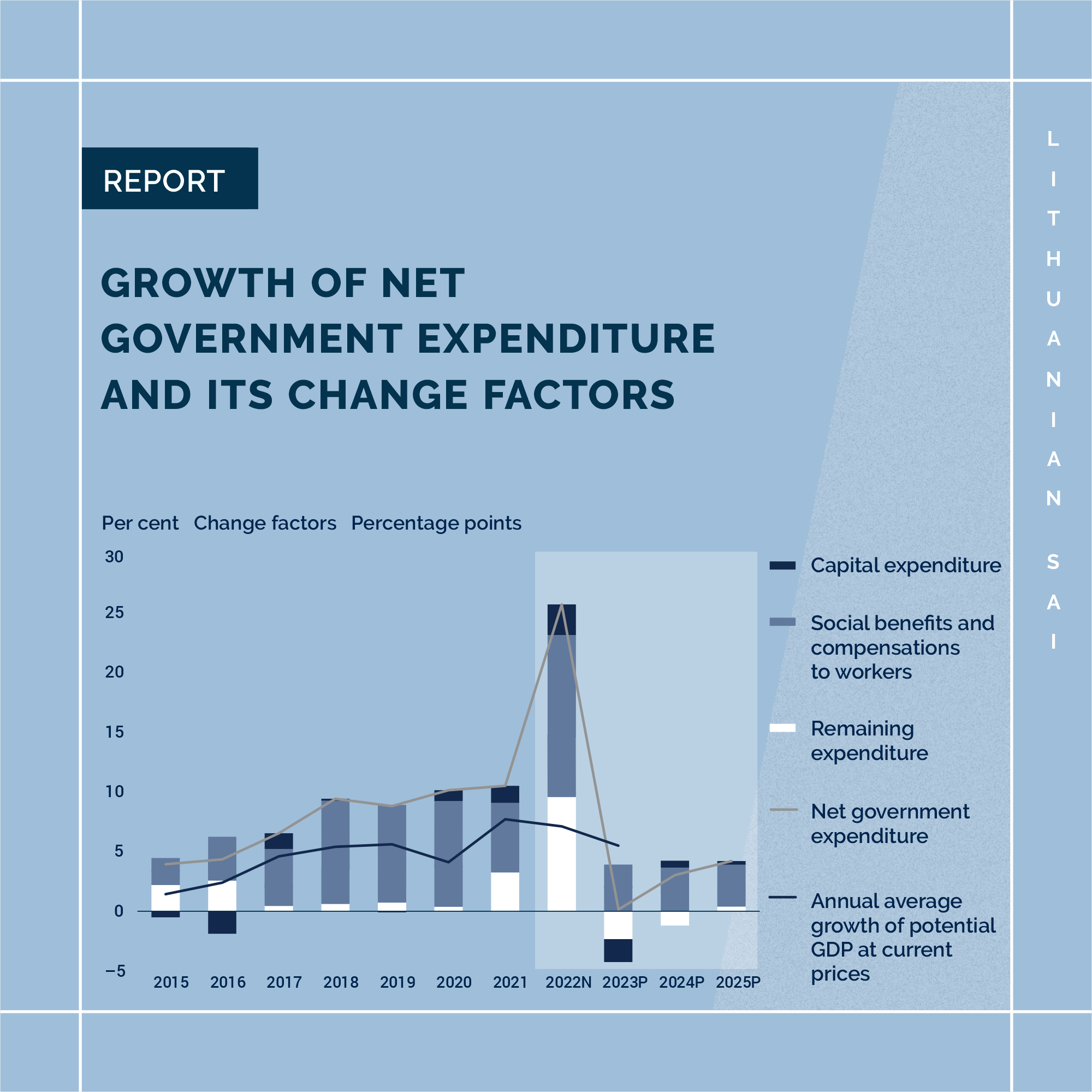
“Lithuania’s 2022 Stability Programme projects a reduction of the structural general government deficit from 3.0 % to 1.0 % of GDP for the period 2022–2025. The structural deficit is expected to narrow as net expenditure is expected to grow slower than the multi-annual potential GDP at current prices, but no specific measures are foreseen to ensure such a fall in the expenditure level between 2023 and 2025. Net expenditure growth over the medium term will largely be driven by expenditure on social benefits and compensation of employees. The impact of the share of capital expenditure is expected to be negative in 2023, which is not consistent with the direction recommended by the European Commission for the promotion of national investment," says Saulė Skripkauskienė, Head of the Budget Monitoring Department.
The level of general government revenue projected in the Stability Programme for the period 2023–2025 remains close to the projected level for 2022. It should be noted that the high level of general government revenues in 2021 was temporary, because it was driven by a favourable economic cycle, one-off measures and a low comparative base. Without taking into account the impact of one-off measures, Lithuania’s fiscal policy is expected to be pro-cyclical in 2022 and to change its direction and become neutral in 2023.
Without additional sources of revenue, the general government debt-to-GDP ratio will increase steadily over the medium term. The indicator will be increased by the primary deficit but mitigated by favourable dynamics in real GDP and interest rates. With interest rates rising over the medium term, general government debt management costs are likely to increase, while debt refinancing may require the replacement of available low-cost Government securities issuances by more expensive ones.
In view of the narrowed application of fiscal discipline rules, a retrospective assessment of compliance with fiscal discipline rules was observed in 2021.
The Stability Programme is a document in which EU Member States present their fiscal plans for the next three years in April each year. These plans must comply with EU and national rules on fiscal discipline and help to prevent the emergence of fiscal challenges.