


2021-12-23
As the temperature of the Lithuanian economy rises, it is appropriate to decide on the continued application of exceptional circumstances
 The National Audit Office implementing the functions of the fiscal institution has assessed and endorses the Economic Development Scenario for 2021–2024 published by the Ministry of Finance on 22 December.
During the first three quarters of this year, the Lithuanian economy maintained strong growth. Compared to the same period a year ago, real GDP grew by 4.9 %. Investment and household consumption expenditure had the greatest positive impact on economic growth, however with the strong increase in imports, impact of net exports was negative.
In the submitted opinion it is noted that domestic risk factors for the economy remain related to the ongoing pandemic, situation in the labour market and rising inflation. It is underlined that due to growing geopolitical tensions negative external risk factors are prevalent. The migrant crisis at the border of Belarus, sanctions against this country and possible counter-measures as well as disruptions to trade with China may have a negative impact on international trade. Consequently, this would affect the development of Lithuania’s economy in the medium-term.
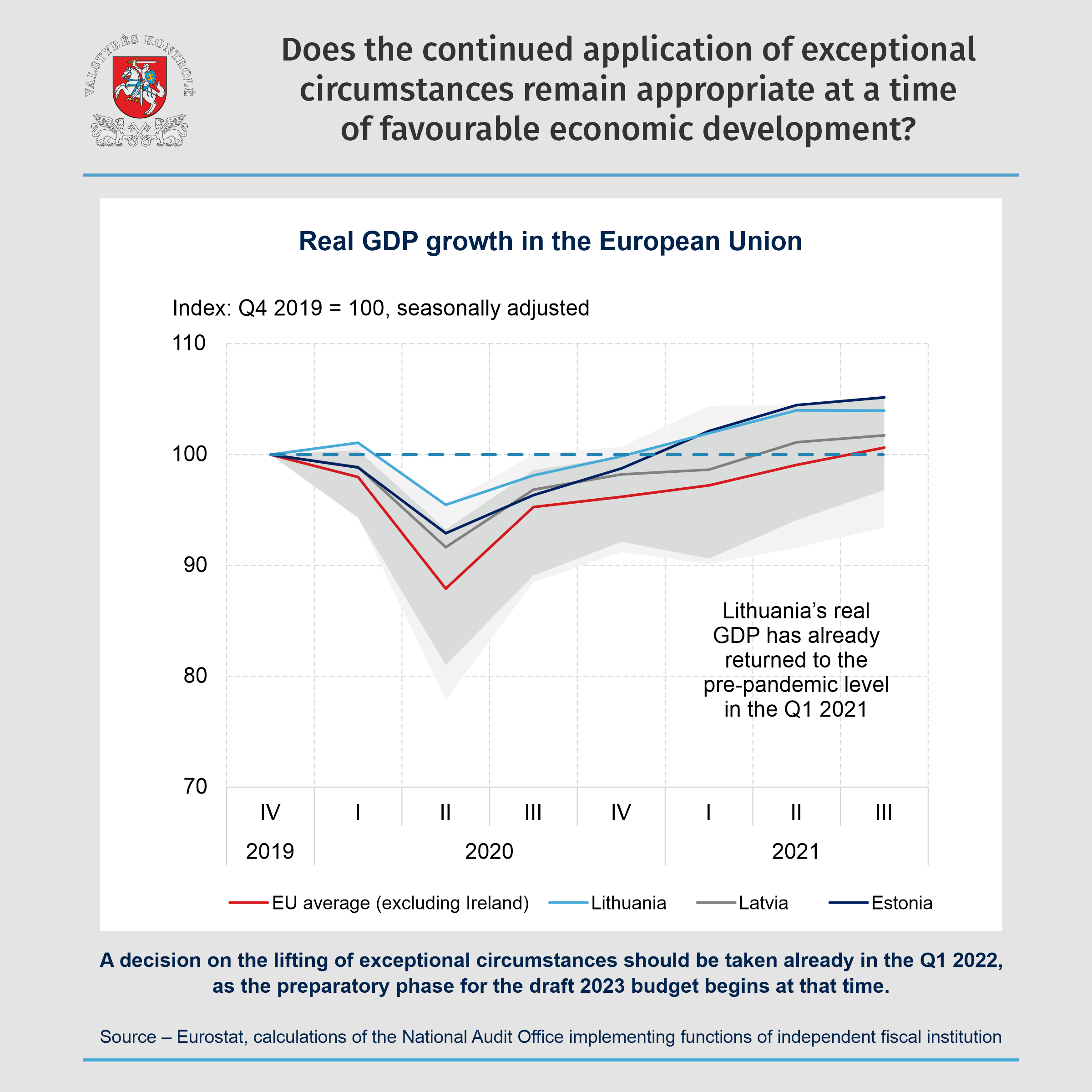
In the Economic Development Scenario prepared by the Ministry of Finance it is projected that, due to strong domestic demand, Lithuania’s real GDP growth will reach 4.8 % in 2021 and slow to 3.7 % and 3.5 % respectively between 2022 and 2023. Taking into account these favourable medium-term economic development projections, the appropriateness of the application of exceptional circumstances that allow Member States to deviate from the requirements for general government budgets should be discussed.
“According to the European Commission, the main criterion for deactivating the escape clause in the Stability and Growth Pact is the return of the economic activity levels of the EU Member States to pre-pandemic levels. The Lithuanian economy has already returned to this level in the first quarter of 2021. As uncertainty about the COVID-19 pandemic decreases, it is also likely that the expenditure for its mitigation measures will have less effect on public finances. For these reasons, it should be considered whether it is prudent and appropriate to maintain exceptional circumstances. This decision should be taken already in the first quarter of 2022, as the preparation phase for the Draft Budget for 2023 begins at that time," says Saulė Skripkauskienė, Head of Budget Monitoring Department.
According to the assessment of the National Audit Office implementing the functions of the fiscal institution, Lithuania’s real GDP is likely to exceed the potential level in 2021–2024. The positive cyclical position of Lithuania’s economy is also reflected in observable macroeconomic indicators, such as the industry’s production capacity utilisation rate and the number of job vacancies that remain at long-unseen heights. This can also be seen in the updated Heatmap of the Lithuanian economy. Its forecast for the fourth quarter of 2021 shows that the temperature of the Lithuanian economy continues to rise in 2021 and exceeds the pre-pandemic level.
Following the revision of the actual data by the Lithuanian Department of Statistics on 1 October 2021 and the update of the Economic Development Scenario by the Ministry of Finance, the positive estimate of the output gap obtained by the National Audit Office implementing the functions of a fiscal institution is higher than that estimated in September 2021. This means that the share of cyclical general government revenue in 2021 is higher than was estimated in the Draft Budget assessment. As economic activity returns to potential level, structural deficits will emerge as excessive current long–term expenditures are being financed by cyclical revenues.
Risks remain that the Scenario may not materialise due to changes in internal and external conditions leading to a significant change in the economic situation.