




2021-11-08
Temporary general government expenditure related to COVID-19 is replaced by growing long-term liabilities
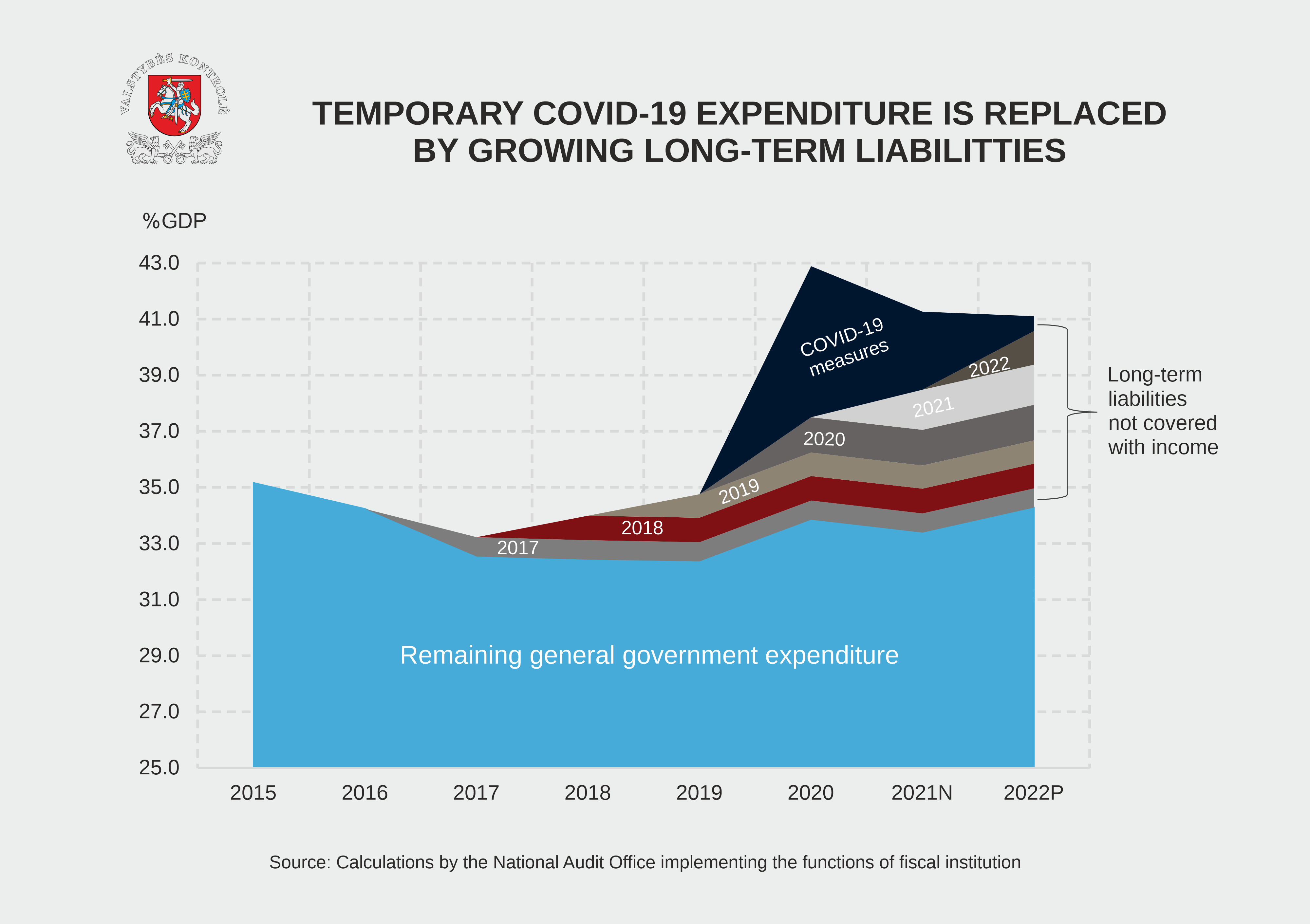 Implementing the functions of the fiscal institution, the National Audit Office carried out an assessment of the Draft Law on the Approval of the Financial Indicators of the State Budget for 2022 and issued its opinion to the Seimas. The general government deficit is expected to reach 3.8 % of GDP in 2021 and 2.9 % of GDP in 2022. Considering favourable real GDP and interest rates dynamics, the general government debt-to-GDP ratio is expected to decline moderately between 2021 and 2022, reaching 45.3 % and 44.7 % of GDP respectively.
It is noted that in the Draft Budget for 2022, as temporary expenditure decreases for further containment of the COVID-19 pandemic, long-term expenditure is growing faster than revenue. Such rapid growth in long-term expenditure would be possible if sustainable sources of income were foreseen to cover them. This long-term expenditure will increase by EUR 695.6 million in 2022 (1.2% of GDP). It should be noted that this type of expenditure represented an average of 1.0 % of GDP for the 2017–2021 budgets annually. Prior to the pandemic, they were covered by unsustainable cyclical revenues due to the faster growth of the Lithuanian economy than its potential GDP.
According to the assessment of the fiscal institution, whose functions are performed by the National Audit Office, economic development between 2021 and 2022 is likely to exceed its potential. Excluding the impact of COVID-19-related and other one-off measures, Lithuania’s fiscal policy is expected to change its direction and be procyclical in 2022. There is a risk of inflationary pressure and overheating of the economy.
“In the long term, population ageing will pose challenges to Lithuanian public finances: taking into account the current demographic structure of the country, a decline in the number of employed persons and an increase in the number of people of retirement age are projected. In order to reduce poverty among elderly by increasing social security pensions, changes to the calculation of social security pensions are proposed alongside the Draft Budget for 2022. When adopting changes that may affect the sustainability of the pension system, it is important to take into account demographic challenges and anticipate long-term sources of income," says Saulė Skripkauskienė, Head of Budget Monitoring Department.
In the near future, public finances will be exposed not only to the pressures of an ageing population, but also to the effects of climate change. Both adaptation and combating it will require public resources. The damage to society and the economy caused by climate change can be significant and it is therefore important to pay attention to the risks arising from it.
The application of fiscal discipline rules has been temporarily narrowed since 2020 due to exceptional circumstances. According to preliminary assessment, with the exception of the rules that are not validly applied for this reason, the budgets attributable to the general government for 2022 have been drawn up in accordance with the rules on fiscal discipline laid down in the Constitutional Law. It is expected that in 2023 fiscal discipline rules will be applied in full.
In the updated fiscal indicator scoreboard, most of the macroeconomic indicators submitted for the period 2021–2022 signal low fiscal risks, while majority of the fiscal indicators – high risks.