
2021-06-22
National Audit Office: the economic situation is better than it was expected in the spring
 The National Audit Office of Lithuania, implementing the functions of the fiscal institution, endorsed the Economic Development Scenario, which was published by the Ministry of Finance on 11 June. The risk remains that the scenario may not materialise due to changes in internal and external conditions leading to a significant change in the economic situation.
Despite the quarantine regime in place in Q1 2021, the development of the Lithuania’s economy has been more favourable than expected. Lithuania’s real GDP grew by 1.2%, compared to a decline of 1.3% in the euro area. The country’s economic growth was mainly supported by investment and household consumption expenditure. Stronger economic growth is expected in Q2 2021, driven by the base effect. The strict quarantine restrictions, compared to the same period a year ago (when GDP fell by 4.6%), are not observed in Q2 2021.
In the Economic Development Scenario, the growth rate of Lithuania’s real GDP is projected to reach 4.1% in 2021, with the acceleration to 4.4% in 2022 and moderate growth rates in 2023–2024. The upward revision of projections was led by more favourable than expected results of economic development in Q1 2021, the inclusion of the funds of the Recovery and Resilience Facility (RRF) and improved assumptions on the growth of the main export markets. GDP growth is expected to be driven mainly by household consumption and accelerating investment.
The easing of restrictions and the increase in the number of people vaccinated against COVID-19 are expected to improve consumers’ perception of the economic situation and increase spending on goods and especially services. Private consumption will be boosted by an increase in average monthly gross earnings, which are projected to grow at a higher rate than inflation, and by an increase in the number of employed persons. Inflation is projected to reach 2.6% in 2021. This could be due to low base effect, fluctuations in oil prices and disruptions of supply chains. Inflation is expected to stabilise at a 2% level in 2023–2024.
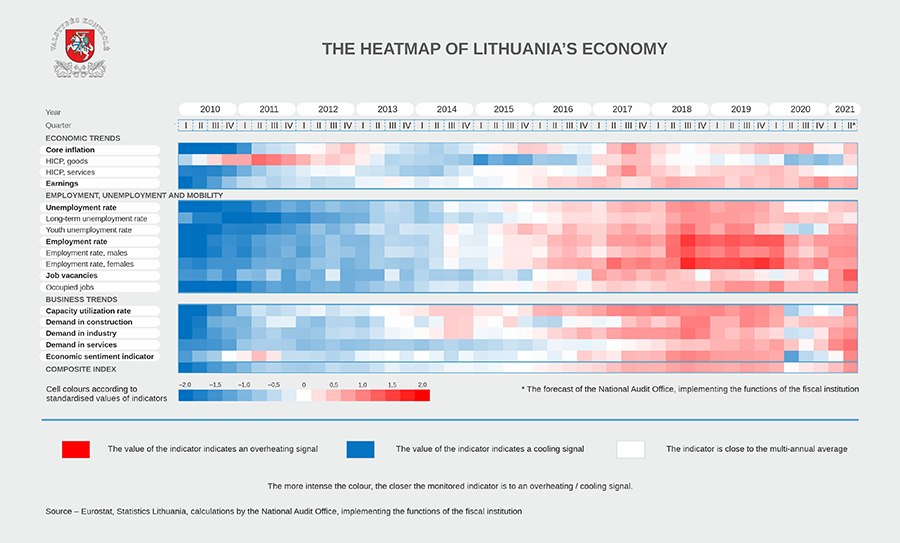
“Although the economy is expected to perform better this year than it was expected in the spring, the situation in the country’s various economic activities is not even. The industrial production capacity utilization had returned to pre-pandemic levels in May 2021. The number of job vacancies in this period is the highest since 2008. In the industry sector, the share of companies constrained by a shortage of labour force has reached 2019 levels, while in the trade and construction sector it is close to the multi-year average. However, activities of food service and accommodation, arts, entertainment and recreation are subject to quarantine restrictions. The need of more targeted stimulus measures with the focus on economic activities, that are the most affected by the pandemic, remains relevant”, says Jaroslav Mečkovski, Chief Specialist at the Budget Policy Monitoring Department.
Lithuania’s economic development may be adversely affected by risks related to the growth rates of international trading partners and the dynamics of the COVID-19 pandemic. As the global industrial sector recovers, demand for raw materials in the world’s major economies is growing faster than expected. This raises potential risks due to disruptions in supply chains.
Internal risk factors remain related to inflation and labour market challenges. The rapid growth in global production will push up commodity prices due to shortages of raw material supplies and rising oil prices. As the COVID-19 vaccination continues and restrictions loosen, the number of employed persons will increase and people and businesses will need to adapt to changes in the labour market.
The National Audit Office, implementing the functions of the fiscal institution, has updated the heatmap of Lithuania’s economy. The forecast for the second quarter of 2021 shows that the temperature of the Lithuanian economy will rise and is likely to reach the average level of 2017–2019.