



2014-01-09
National Audit Office: not all fire and rescue forces are adequately prepared to fight fires
The National Audit Office conducted an audit to assess whether state and municipal fire and rescue forces are adequately prepared to fight fires. “The audit results showed that during the audited period the Ministry of the Interior and the Fire and Rescue Department failed to ensure adequate preparation of all fire and rescue forces to fight fires and rescue people and property," said Auditor General Mrs Giedrė Švedienė summing up the audit results.
Fire safety in Lithuania falls under the responsibility of state and municipal institutions. The annual amount allocated to the state fire safety and rescue service for carrying out this function totals about LTL 190 million. The annual amount allocated to municipalities from the state budget for performing the fire safety function delegated thereto is about LTL 50 million.
Almost half of the fires over the period 2010-2012 broke out in small towns and rural areas, which are inhabited by one third of the Lithuanian population. However, the number of people killed in these fires is nearly twice higher than in cities. Although firefighters of municipal fire and rescue services are usually the first forces that arrive in case of fire, they are not always able to start rescue operations due to a shortage of special clothing and breathing apparatus. Not all firefighters are equipped with special uniforms to protect them from risk factors, less than one-fifth of firefighters of the municipal fire services (FSs) have breathing apparatus. The auditors found that provision of personal protective equipment and communication devices for firefighters is organised improperly.
Legislation contains no clear and detailed provisions concerning specific works to be carried out by firefighters of municipal fire services during firefighting and rescue operations. Absence of such definition results in failure to plan what devices and equipment will be required. Consequently, there are cases where FSs in different districts perform only certain rescue operations according to the equipment or devices available thereto. For example, firefighters of Jurbarkas FS rescue drowning people because they have boats, lifebuoys, life jackets, meanwhile Rokiškis FS is able to respond to oil spills in the environment because it has a special truck.
The auditors also found a shortage of human resources in the fire and rescue services - part (about 20 per cent) of firefighters vacancies are not filled, there is a lack of firefighters to be able to form shifts on duty, which results in incomplete fire brigades being on duty and arriving to the place of fire. For example, last February two fire brigades arrived to fight the fire in an outbuilding in Kupiškis district, however, there was only one firefighter in each brigade, hence they could only carry water but were not able to perform their key function - to extinguish the fire.
The audit revealed insufficient competencies of firefighters. 15 per cent of firefighters of municipal fire services do not have the firefighter’s qualification and thus are not adequately prepared to fight fires.
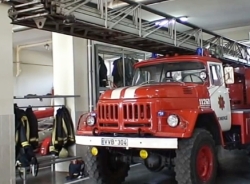
It was also found that not all fire and rescue forces have adequate and sufficient firefighting and rescue equipment and technical facilities, over 60 per cent of fire trucks are more than ten years old, so it happens that seven vehicles have to be sent to fight a fire because three of them break down upon arrival to the place of the fire.
The auditors stated a lack of technical facilities for firefighting and rescue operations in buildings higher than three-storeys. According to the minimum requirements, every municipality must have at least one 20-meter-long truck ladder, however, no such ladders are available for firefighters in 21 municipalities, including Kelmė disctrict where Tytuvėnai church and monastery burned down. A truck- ladder was received from Radviliškis Fire Service, but it took almost one hour to deliver it.
Having analysed the documents provided, the public auditors found insufficiently proper organisation of fire prevention activities. Preventive measures are lacking in objects where fires break out most often, i.e. residential buildings.
In order to ensure more efficient use of human resources and state budget funds allocated for the performance of the fire safety function and better management of fire, fatality and property destruction risks, the National Audit Office made recommendations to the Ministry of the Interior and the Fire and Rescue Department.