


2026-11-24
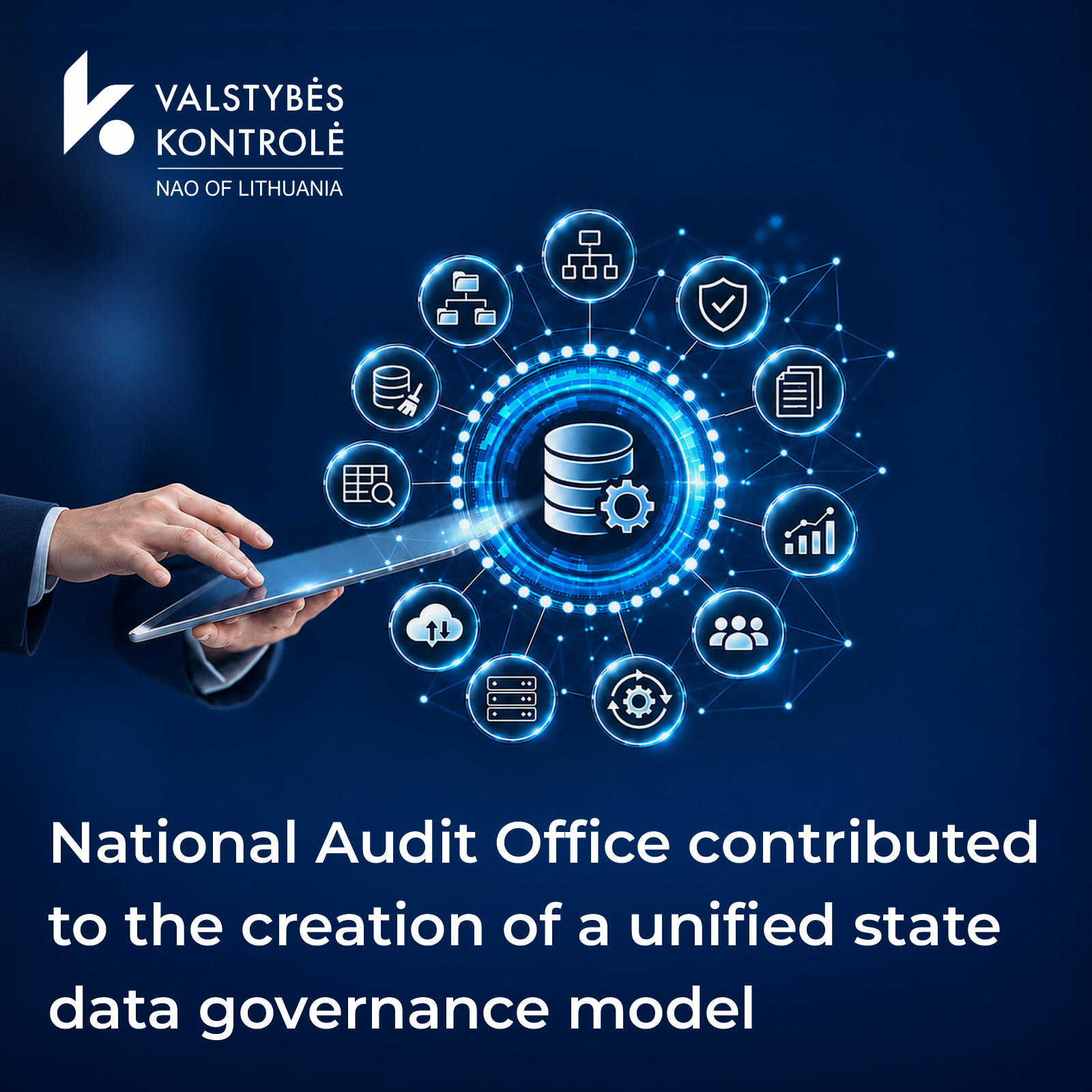 The National Audit Office, together with other public sector institutions, participated in the implementation of the State Digital Solutions Agency’s project “Development of a Data Governance Model”, which aimed to ensure more efficient management of state data, simpler data exchange between institutions and improved data accessibility. The project was implemented by the State Digital Solutions Agency (VSSA), with a total value of €16.3 million.
Until now, state institutions have developed and managed their information systems and registers primarily on the basis of individual needs. Due to a lack of common standards and coordination, the exchange of data between institutions has not always been smooth, and searching for and obtaining the necessary information has taken a long time. The implementation of this project has established a common framework for state data governance, which will make it easier for institutions to find, exchange and reuse data, reduce the need for duplicated solutions, and help to use public resources more efficiently.
The National Audit Office contributed to the implementation of this project by granting access to some of the data it manages and by installing specialised VSSA software, which will enable the secure exchange of data with other public sector bodies and the more efficient use of information in day-to-day operations. Common data governance standards and technical solutions also lay the groundwork for the further digitalisation of the institution’s operational processes in collaboration with other public sector bodies.
Shared solutions – more than 200 information systems and registers
The solutions developed as part of the project will help public sector organisations to access the information they need for their operations more quickly, to collaborate more efficiently and to reduce the time and financial costs associated with data exchange. One of the project’s most significant outcomes is the creation of a common metadata standard, which enables data managed by state institutions to be described according to uniform principles. A metadata generation tool has been implemented in more than 200 state information systems and registers, and a centralised repository for storing this metadata has been established.
A standardised model for the development and management of application programming interfaces (APIs) has also been established. API interfaces have been implemented in more than 200 information systems and registers and integrated into a single centralised repository. These solutions facilitate smoother data exchange between institutions and reduce the need for each organisation to develop its own technical solutions.
In addition, a common data governance model has been developed and implemented, establishing principles for more consistent data management and paving the way for improved data quality and a clearer allocation of responsibilities.
Benefits – a more efficient public sector and more accessible data
Unified data model will create better conditions for using data collected by the state when making public administration decisions, developing business and implementing initiatives by non-governmental organisations. The project also contributes to Lithuania’s preparations for participation in the European Union’s common lifecycle of information resources, in which the secure, reliable and standardised exchange of data is of key importance.
The project “Development of a Data Governance Model” (No. 02-009-P-0001) was implemented from 11 October 2022 to 30 October 2026. Its exact total value was €16,270,760.26. It contributed to the implementation of Objective No. 1.7, “Promote the Digitalisation of the State”, of Lithuania’s National Progress Plan, through Progress Measure No. 05-002-01-07-07 “Promote Data Accessibility and Re-use”.
Read more about the project here: Development of a Data Governance Model