



2026-11-09
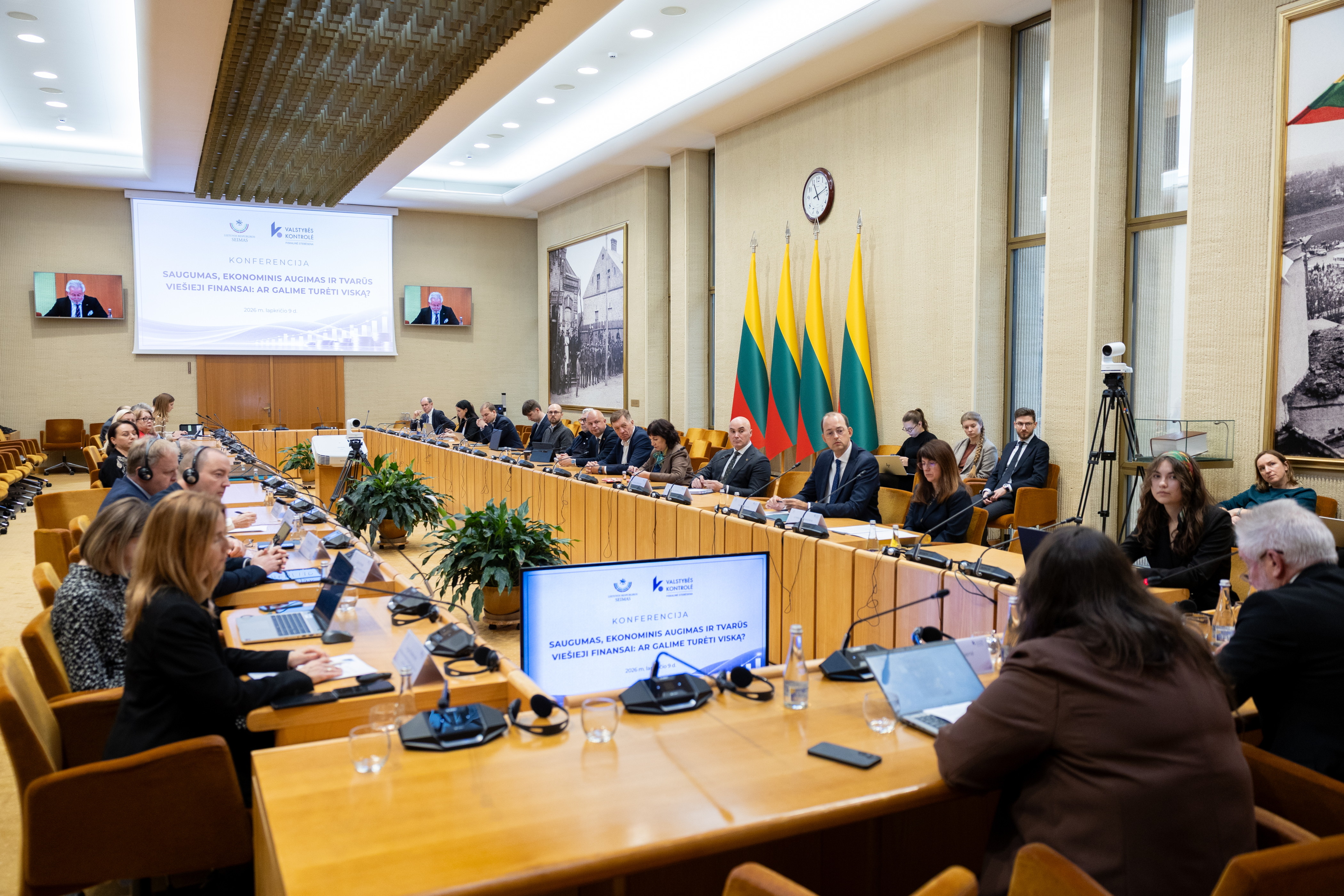 With defence funding requirements on the rise, Lithuania and other European countries must seek solutions to strengthen security while preserving opportunities for economic growth and maintaining sustainable public finances. Simply increasing public debt is not a long-term or sustainable solution. This requires stable sources of revenue, clear spending priorities and fiscal discipline. These key insights were discussed at the international conference ‘Security, Growth and Sustainable Public Finances: Can We Have It All?’, held at the Seimas on 9 November.
At the conference, organised by the National Audit Office – as an independent fiscal institution – and the Seimas Committee on Budget and Finance, experts from Lithuania, Latvia, Estonia and Sweden shared their experiences on how to reconcile growing defence funding needs with the long-term sustainability of public finances.
“Strong defence requires a solid long-term financial foundation. When making decisions today, we must plan how we will finance the commitments we have undertaken in five or ten years’ time. Our ability to consistently strengthen the country’s security and ensure other services vital to society depends on economic growth and the sustainability of public finances. Experience from other countries shows that the longer decisions on long-term financing are postponed, the more difficult the choices will be in the future,” emphasised Auditor General Irena Segalovičienė.
Algirdas Sysas, Chair of the Seimas Committee on Budget and Finance, who moderated the conference, emphasised the need to seek solutions that would ensure the country’s security while maintaining the state’s capacity to fulfil other important obligations.
“National security means, first and foremost, the safety of every individual and the opportunity to live with dignity and security. Therefore, while strengthening the state’s defence, we must not forget that accessible healthcare services, high-quality education, social security and an improving quality of life are no less important to people. It is our duty to strike a balance between these needs and to ensure that the state’s financial decisions serve the people not only today, but also in the future. This requires responsible budget planning, clear priorities and long-term funding solutions,” emphasised Algirdas Sysas, Chair of the Seimas Committee on Budget and Finance.
The Baltic states face similar challenges
Jānis Priede, Head of the Latvian Fiscal Discipline Council, emphasised that fiscal sustainability is an important part of national resilience. According to him, temporary fiscal flexibility can help to make urgent investments in defence, but long-term funding solutions are necessary for consistently higher expenditure. Latvia’s experience shows that, when increasing defence funding, it is important not only to find additional funds, but also to set clear priorities for public spending and to maintain fiscal discipline.
Peter Lõhmus, Chair of the Estonian Fiscal Council, also spoke about similar challenges. According to the outlook he presented, due to rising defence and other expenditure, the country is expected to face a persistent general government deficit of 4–4.5 percent of GDP in the near future. Estonia’s public debt, which had remained low for a long time, is growing rapidly, while interest payments are becoming an increasingly significant part of budget expenditure. According to Mr Lõhmus, the low initial debt burden and the flexibility afforded by EU fiscal rules have allowed decisions on how to finance the increased defence needs on a sustainable basis to be postponed.
Sweden’s experience: long-term policy helped maintain low public debt
Niklas Frank, Deputy Head of Agency at the Swedish Fiscal Policy Council, presented Sweden’s experience in managing public debt. Three decades ago, Sweden began to consistently reduce its public debt and has so far managed to keep it at a relatively low level. The conference discussed how the country managed to achieve this result and whether this policy will remain sustainable in the future, given the growing pressure on public expenditure. The Swedish example shows that the sustainability of public finances depends not only on budgetary decisions made over one or a few years, but also on long-term fiscal policy.
Lithuania needs solutions that would ensure sustainable financing
Jurga Rukšėnaitė, Head of the Fiscal Monitoring Centre at the National Audit Office, pointed out that, alongside defence funding requirements, the funding needs of other important public sectors are also growing in Lithuania.
The risks identified in Lithuania’s draft budget for 2027–2029 indicate that financing additional expenditure in the long term solely by increasing debt is not sustainable. Decisions are therefore needed to ensure sustainable sources of revenue. The decisions taken today will determine whether, in the future, Lithuania will have sufficient fiscal space to respond to crises, fund strategic priorities and maintain high-quality public services. It is important to assess not only how much additional funding will be required in the coming years, but also how current commitments will affect public debt, interest expenditure and the ability to fund other needs in the future.
A recording of the conference can be viewed here: https://youtube.com/live/AluQ0vePoV4.
Photo credit: Office of the Seimas (by Ūla Liškevičiūtė)