




2026-11-06
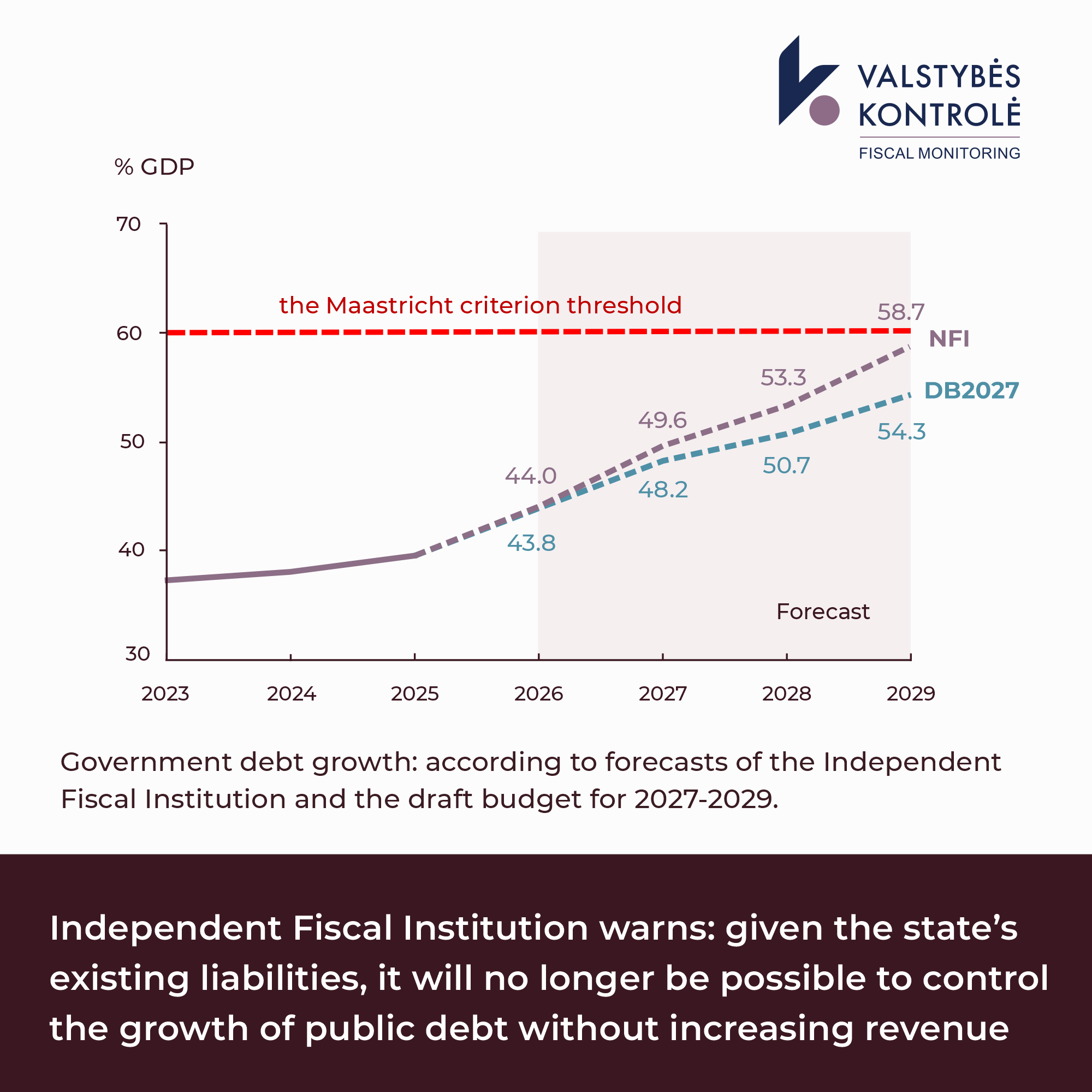 The draft budget plan for 2027–2029 has been drawn up in breach of national and European Union fiscal discipline rules. According to the assessment of the Independent fiscal institution, the general government deficit may grow considerably faster than the Government projects, approaching 6% of GDP in 2029, whilst public debt may approach the 60% of GDP threshold. With growing funding requirements for defence and other public services, it will be particularly difficult to return to fiscal discipline without additional sustainable sources of revenue.
The National Audit Office, as the independent fiscal institution (IFI), has assessed the draft budget for the period 2027–2029 and, in its Opinion, has presented an assessment of compliance with fiscal discipline rules as well as its own forecasts for fiscal indicators for the period 2026–2029.
The draft budget does not comply with the fiscal discipline rules
According to the IFI’s assessment, for 2026–2029, even taking into account the temporary defence expenditure clause, the expected growth in net expenditure* exceeds the permitted limits. Furthermore, the draft budget provides for a general government deficit of more than 3% GDP each year.
In accordance with the principle of “comply or explain” enshrined in the Law on Fiscal Governance, the Government should amend the draft budget so that it complies with the fiscal discipline rule or provide a reasoned explanation as to why it is not being complied with. In the IFI’s view, the explanation should set out a plan of measures to reduce the deviation from the fiscal discipline rules, along with a timetable for their implementation.
“Long-term general government liabilities are growing faster than revenue. It is becoming increasingly difficult to comply with the fiscal discipline rules, but their purpose remains the same – the liabilities we have today will have to be paid for in the future. If decisions are postponed, future generations may bear the cost: a heavier debt burden or poorer public services. The Government should therefore present a concrete plan setting out what revenue and expenditure measures will be taken and when they will yield results,” emphasises Auditor General Irena Segalovičienė.
The general government deficit may be significantly higher than expected in the draft budget
According to the IFI’s assessment, some expected expenditure has not been included in the draft budget, whilst planned revenue may be lower than expected. For example, the 2027 expenditure plan does not include expected expenditure on railway infrastructure, aid to Ukraine and other items. On the revenue side, the draft includes €197 million in additional revenue from improvements to tax administration. The impact of such measures is subject to considerable uncertainty; therefore, in the IFI’s view, they should not be included in the projections.
The 2028–2029 draft fails to adequately account for previously undertaken government commitments relating to public sector wage growth, additional pension indexation and rising government contributions for persons insured at the state’s expense. For these reasons, the general government deficit may be higher than expected in the draft budget.
The higher general government deficit for 2026–2029 compared with that projected in the 2026 Annual Progress Report is largely attributable to the rate of change in the statistical accrual adjustment for expenditure on the procurement of military equipment in the national defence sector, which is on average 0.8% GDP higher per year. Expenditure on the procurement of military equipment, weapons and supplies is recorded on an accrual basis in general government financial statistics; consequently, it is reflected in the deficit when economic ownership is acquired, usually upon delivery. According to the IFI’s assessment, even without any additional discretionary decisions, the general government deficit would remain above 3% of GDP in the medium-term.
“Our forecasts indicate greater pressure on public finances than expected in the draft budget. The problem is not limited to new decisions to increase expenditure – some of the government’s commitments already exist, but their impact on future budgets is not sufficiently reflected. Taking these expenditure items and the risks of revenue shortfalls into account, the deficit could approach 6% of GDP by 2029. Decisions on sustainable government revenue are therefore essential,” notes Jurga Rukšėnaitė, Head of the Fiscal Monitoring Centre.
With public debt rising rapidly, interest payments will require ever-increasing expenditure
With the IFI projecting a larger deficit, public debt will grow faster than expected in the draft budget and will approach the Maastricht criterion threshold of 60% of GDP in 2029. This threshold may be exceeded as early as 2030.
As debt rises, the expenditure involved in servicing it will also increase rapidly. According to IFI calculations, interest payments could rise from around €1 billion in 2026 to €2.1 billion in 2029. This means that an ever-increasing proportion of the budget will have to be allocated to servicing previously incurred debt and not public services or investment.
Without solutions regarding revenue, it will not be possible to ensure the sustainability of public finances
According to the IFI’s projections, in 2029, for the general government deficit not to exceed the Maastricht criterion threshold, it would need to be more than €3 billion lower. The IFI points out that the draft budget lacks a clear plan for how the general government deficit will be reduced in the medium-term and how compliance with fiscal discipline rules will be restored.
In terms of revenue from taxes and social contributions as a proportion of GDP, Lithuania ranks 23rd out of the 27 EU Member States. At the same time, long-term funding requirements for defence, social protection and healthcare are increasing.
In the IFI’s assessment, improving cost-effectiveness alone will not be sufficient to address these challenges. It is essential to seek sustainable additional sources of revenue – by consistently broadening the tax base, reviewing tax concessions and improving tax collection.
* Net expenditure – General government expenditure minus interest payments, discretionary revenue measures, expenditure on EU programmes, national expenditure on co-financing of EU programmes, cyclical unemployment benefits, and one-off and other temporary measures.