


2026-11-05
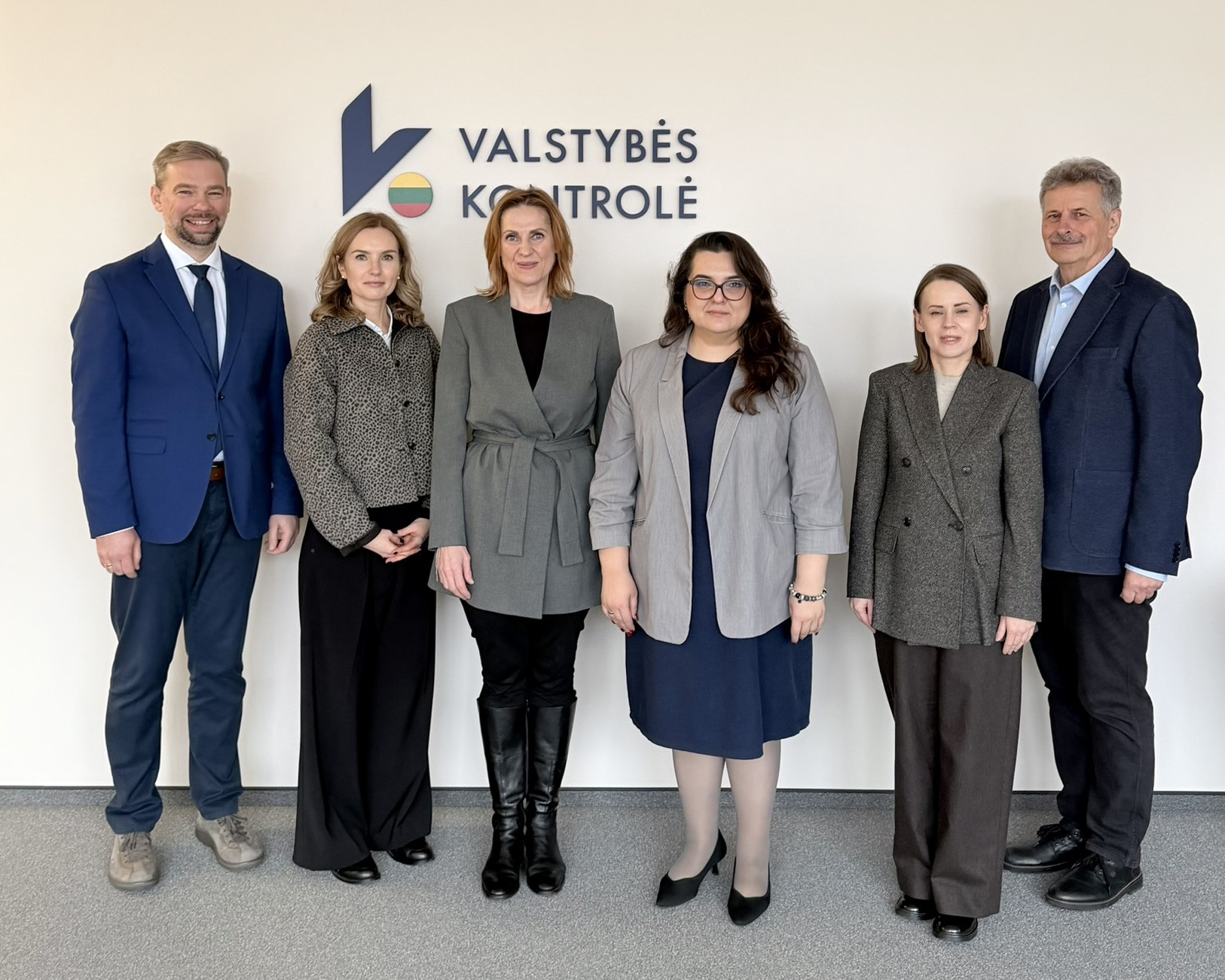 The National Audit Office operations in the area of reconciling public and private interests comply with the objectives and requirements set out in the Law on the Reconciliation of Public and Private Interests. This was confirmed by a compliance assessment of the National Audit Office operations carried out by the Chief Official Ethics Commission (VTEK), which was initiated voluntarily by the National Audit Office.
On 5 November, Auditor General Irena Segalovičienė and VTEK Chair Jolanta Bernotaitė met at the National Audit Office to discuss the findings of the assessment in more detail and the future direction of the partnership between the two institutions. The meeting was also attended by Edita Kavoliūnienė, Head of the Compliance Division, and Jurgita Jurkienė, Senior Adviser at the VTEK, Audrius Misevičius, Deputy Auditor General, and Gediminas Švetkauskas, Compliance Officer at the National Audit Office.
High standards of transparency and examples of good practice
The VTEK conclusions emphasise that the internal regulations governing the National Audit Office operations set out in detail the obligations laid down by law, ensure consistent monitoring of compliance with them, and organise staff training. The institution’s operations are also aligned with the highest standards of transparent conduct, the organisation develops and applies examples of best practice in the management of conflicts of interest, and risks of conflicts of interest are not tolerated in public procurement procedures.
“When assessing others, we must lead by example and consistently scrutinise our own activities. By voluntarily opening up our conflict of interest management system to assessment by the VTEK, we sought to ensure that we apply high standards of transparency and ethics in our work and to identify areas for further improvement. The insights gained and the methodological cooperation that has been established will help to further strengthen our resilience to risks and shape good governance practices in the public sector. I therefore invite other institutions to take the initiative and boldly open up their processes – this is the only path to trust-based public administration,” says Auditor General Irena Segalovičienė.
From assessment to mutual cooperation
During the meeting, emphasis was placed on the transition from the assessment of the National Audit Office’s conflict of interest management system to mutual cooperation based on shared expert experience. The heads of the institutions discussed the possibilities for updating their mutual cooperation agreement in the context of conducting public audits and fulfilling the tasks set out in the legislation governing both institutions.
It is planned that, where necessary, the VTEK will advise the National Audit Office’s auditors on the preliminary assessment of circumstances identified during audits, as well as provide information on observed risks in those areas of the public sector where the maturity of the conflict of interest management system is lowest. For its part, the National Audit Office has undertaken to inform the VTEK of systemic problems identified during audits in the public sector and to provide observations on gaps in legal regulation and practical implementation.
The heads of the institutions agreed that such mutual methodological support strengthens governance across the entire public sector, the prevention of conflicts of interest and the transparency of decision-making.
The recommendations issued by the VTEK form the basis for further improvements to the system
Although the organisation of the National Audit Office operations complies with legal requirements, the VTEK has made several non-binding recommendations that will contribute to improving the institution’s operations.
The National Audit Office plans to regulate in greater detail the processes for monitoring declarations and private interests, verification and risk assessment, as well as the responsibilities of staff involved in these processes; to define more clearly the functions and powers of the compliance officer; to apply preventive measures, make proposals for recusal or issue preliminary recommendations to staff; and to implement other additional measures to ensure comprehensive management of potential risks of conflicts of interest.