


2026-10-02
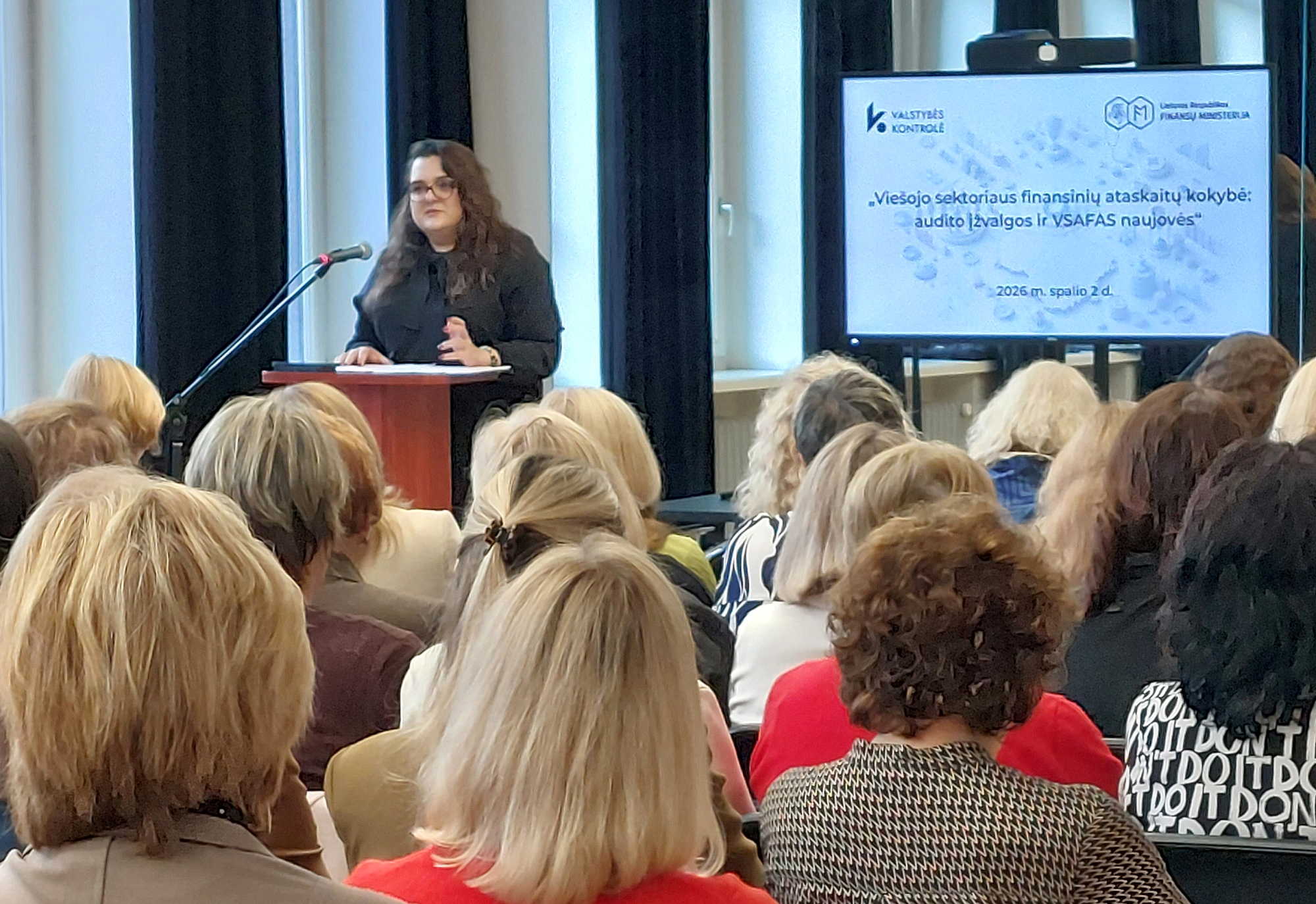 Today, the National Audit Office, in cooperation with the Ministry of Finance, invited municipal control and audit services (SKAT) staff responsible for municipal financial accounting to a practical conference entitled “The Quality of Public Sector Financial Accounts: Audit Insights and VSAFAS Updates".
The conference focuses primarily on the quality of financial accounts, accounting practices and municipal fiscal discipline.
During the event, auditors from the National Audit Office will present the results of the financial audits of the 2025 national and state financial accounts, highlight the most common accounting errors and discuss ways to avoid them. Economists from the Fiscal Monitoring Centre at the National Audit Office will present the insights of the National Audit Office, as an independent fiscal institution, regarding the assessment of fiscal discipline rules.
“Reliable accounting, high-quality data and fiscal discipline are not merely a requirement for accountability. They are a prerequisite for responsible decision-making. Municipalities make daily decisions on how to manage assets, plan investments and ensure services for residents; therefore, these decisions must be based on reliable information. The higher the quality of data and the stronger the culture of accountability, the greater the trust in public finances and in the decisions taken by institutions,” said Auditor General Irena Segalovičienė in her welcome to the conference participants.
“Accurate and reliable financial data are essential for planning, assessing risks and making decisions, while financial accounts and budget implementation reports are not merely technical documents – they are an expression of the public sector’s accountability to society, showing the financial position, operational results and their changes for a specific institution, group of institutions, municipalities and the state as a whole, enabling an assessment of the impact that particular decisions have on public finances,” noted Rūta Carik, Vice Minister of Finance, while welcoming the conference participants. She emphasised: “I would also like to express my delight that the qualitative maturity of Lithuania’s public sector financial reporting is highly regarded internationally. The International Federation of Accountants (IFAC) ranks Lithuania amongst the exemplary countries whose financial accounts are maintained on an accrual basis and in accordance with adapted International Public Sector Accounting Standards.”
Audits of the 2025 key state financial accounts conducted by the National Audit Office have revealed that material misstatements have been found in the most important sets of state accounts for the fourteenth consecutive year. Recurring errors in asset accounting relate to the accounting for forest land and stands, mineral resources, infrastructure assets and other state assets. The public sector manages assets worth almost EUR 91 billion, but the auditors were unable to confirm the accuracy of the data for more than EUR 19 billion of these assets.
Another key topic of the conference was municipal fiscal discipline. The updated fiscal governance system provides municipalities with greater opportunities to invest and manage their budgets more flexibly, but at the same time requires a responsible approach to the management of public finances. Therefore, according to economists at the Fiscal Monitoring Centre, it is important that municipalities adhere to the established fiscal discipline requirements when planning and implementing their budgets.
In the second part of the event, representatives of the Ministry of Finance will present the latest amendments to the public sector accounting and financial reporting standards (VSAFAS) and related legislation, and will discuss their application in municipalities.
This practical conference is the second in a series of events continuing the cooperation between the National Audit Office and the Ministry of Finance, aimed at improving the quality of financial information in the public sector. On this occasion, the focus was on local government – specifically, municipal finance officers and SKAT auditors, who assess the reliability of data and the management of municipal finances.