


2026-09-18
 Today, Tony Murphy, President of the European Court of Auditors (ECA), visited the National Audit Office as part of his official visit to Lithuania. During bilateral meetings with the management of the National Audit Office and the heads of its departments, discussions focused on the reform of the forthcoming 2028–2034 European Union (EU) budget, the challenges of funding defence and security, and the role of supreme audit institutions (SAIs) in ensuring the control and accountability of EU funds.
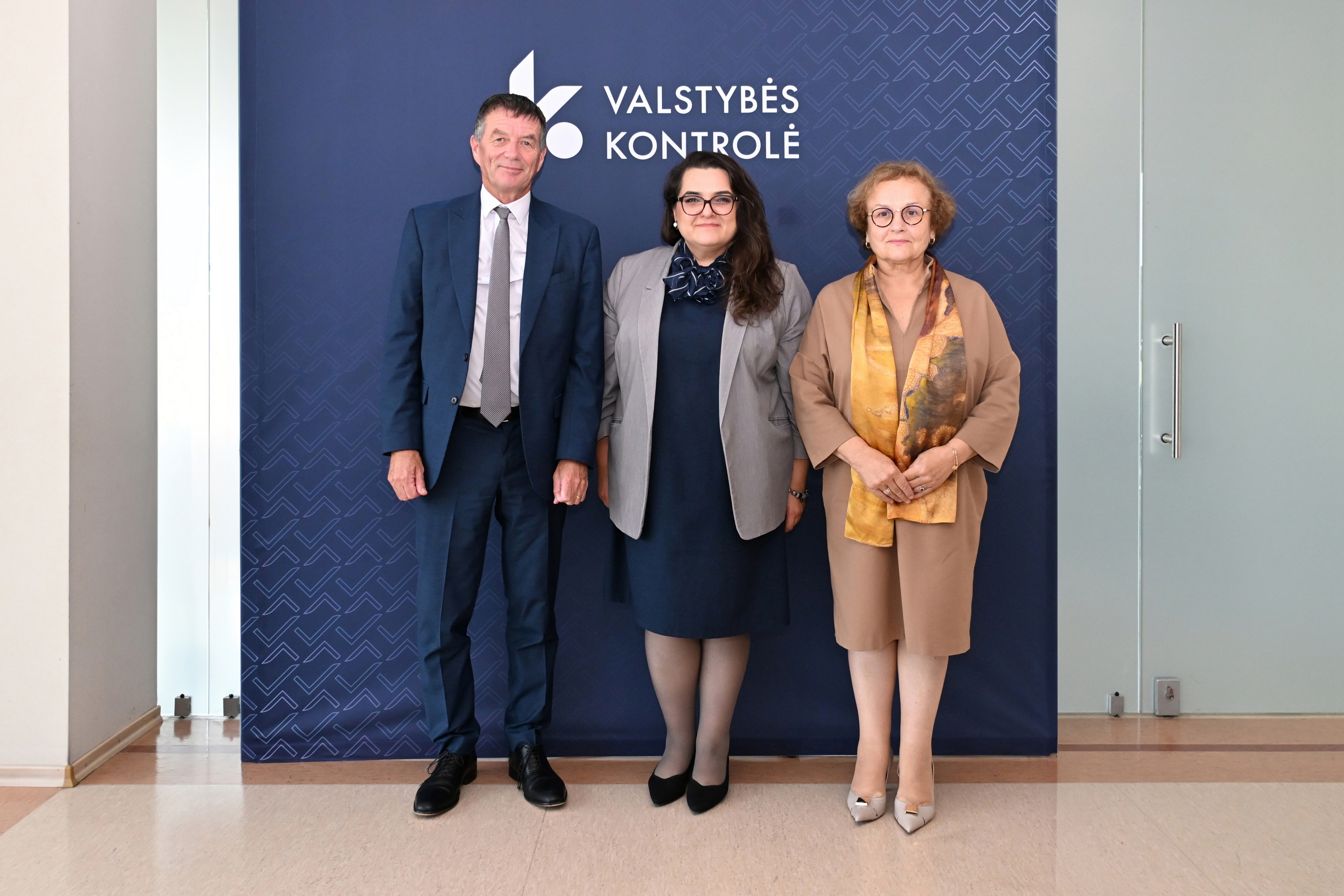 Mr Murphy's visit to the National Audit Office aligns with his broader official agenda in Lithuania. During this visit, the Head of the ECA also met with the President of the Republic of Lithuania, Gitanas Nausėda; the Speaker of the Seimas, Juozas Olekas; the Prime Minister, Mindaugas Sinkevičius; members of the Seimas Committees on Audit and European Affairs; and representatives of the business community.
“Under the new EU budget model, Member States will bear greater responsibility for achieving results, so the role of national audit institutions will inevitably grow. It is important to ensure that greater flexibility does not lead to reduced transparency, and that the results of the use of EU funds are clearly measurable and reliably audited. The European Court of Auditors is our key strategic partner on the international stage. Cooperation between our institutions is not merely an exchange of professional expertise; it is a bond of shared values that ensures a unified approach to the transparency and accountability of EU finances,” says Auditor General Irena Segalovičienė.
At a meeting between the ECA delegation and the management of the National Audit Office, issues relating to the strengthening of defence and security were discussed, as well as the forthcoming audit of the EU’s long-term budget for 2028–2034 (the multiannual financial framework) and cooperation between the ECA and the National Audit Office in responding to geopolitical challenges.
Discussions also covered preparations for Lithuania’s forthcoming Presidency of the Council of the EU, the organisation of joint events and conferences, and career and internship opportunities at the European Court of Auditors for Lithuanian professionals.
At a meeting with the heads of department at the National Audit Office, discussions centred on instruments for strengthening defence and security, such as SAFE (Security Action for Europe), and 12 opinions issued by the ECA on the European Commission’s proposals relating to the new EU long-term budget for 2028–2034 were presented. The proposed budget amounts to almost EUR 2 trillion and envisages fundamental changes – the merging of expenditure categories, greater flexibility for Member States and an expanded model for the Recovery and Resilience Facility (RRF), whereby payments are linked to the achievement of targets rather than the reimbursement of actual expenditure. It was emphasised during the discussions that, while greater budgetary flexibility allows for a better response to crises, it must not undermine the budget’s transparency, predictability and auditability.
During the presentation by the ECA delegation, attention was also drawn to the emerging risks relating to the measurement of results, the definition of EU added value, and the need to maintain unrestricted access to information for audit institutions. During the visit, the institutions’ operational priorities were discussed, and the role of the National Audit Office as a fiscal institution was explained in greater detail.
The ECA is a European Union institution established in 1977 to audit the Union’s finances. It acts as the EU’s independent external auditor, checking whether these funds are accounted for correctly, whether they are allocated and used in accordance with the relevant rules and other legislation, and whether they deliver economic value. The ECA operates as a collegial body comprising 27 members – one from each Member State.