


2026-09-14
Work on planning the national budget is currently underway, and in just over a month’s time the draft budget for 2027–2029 will be submitted to the Seimas. This is a plan setting out how much revenue the state will collect and how it will be spent. These policy decisions will determine not only the provision of public services and the levels of benefits, but also the state’s financial capacity in the future.
AUTHOR

Jurga Rukšėnaitė
Head of the Fiscal Monitoring Centre
email: [email protected]
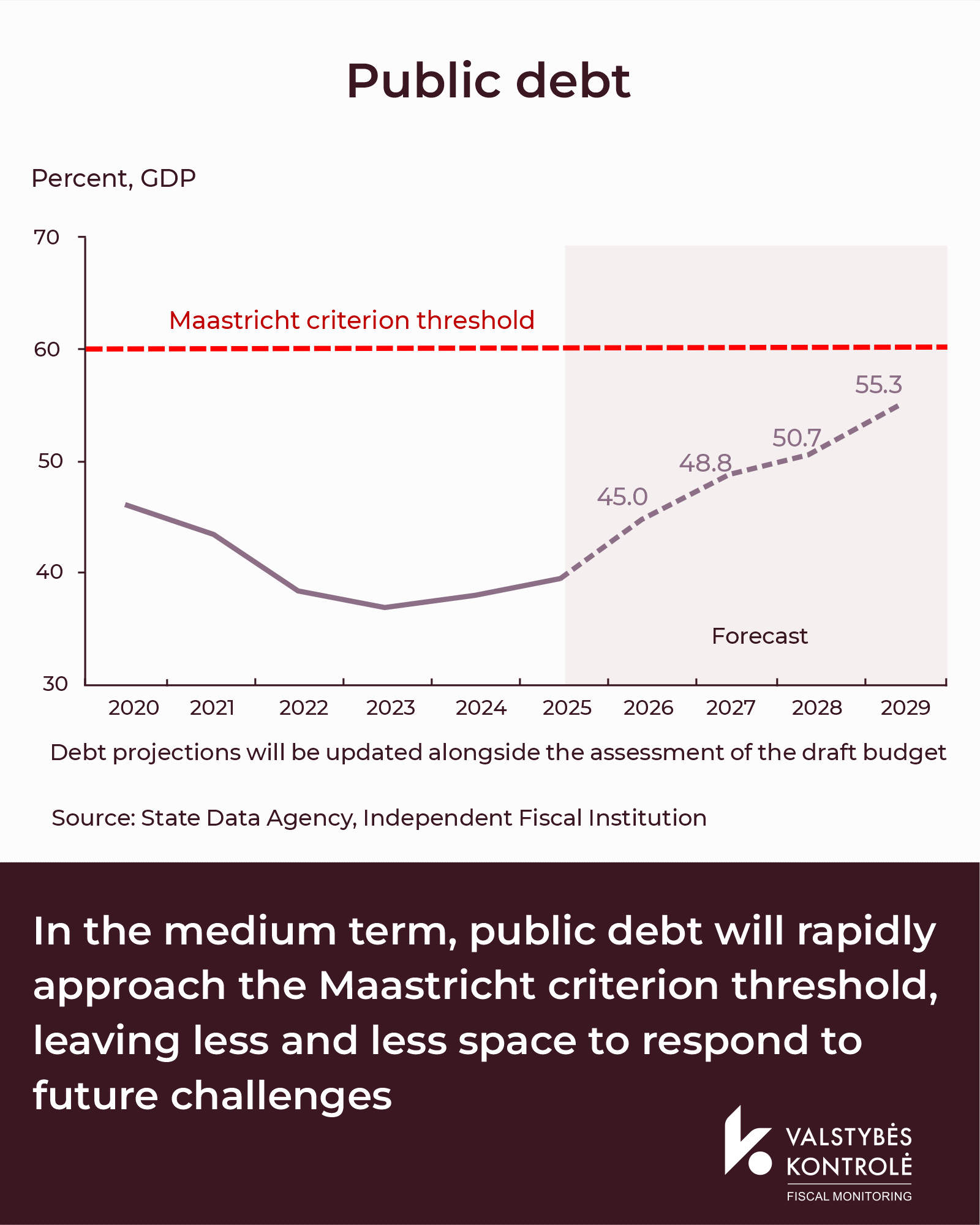 Public debt is approaching 60 percent of GDP
In the spring, the National Audit Office, as an Independent Fiscal Institution, warned – while assessing Lithuania’s 2026 Annual Progress Report – that as early as this year, Lithuania faces the risk of failing to comply with fiscal discipline.
The fiscal institution forecasted that, in the coming years, general government debt would rapidly approach the 60 percent of GDP Maastricht criterion. This is not merely a formal debt threshold. It is important for the country because adhering to it helps to ensure the stability of public finances and investor confidence in the country’s economy. As debt rises rapidly, there is less and less space in the future to respond to potential geopolitical or economic challenges. It is forecasted that by 2029, debt servicing costs could approach 1.8 billion euros and continue to rise if rising debt were to undermine investor confidence and increase the cost of government borrowing.
Sustainable revenue sources have yet to be identified
More than 5 percent of GDP needs to be allocated to defence – this is a priority, but we are also hearing calls in the public sphere for further increases in pensions and civil servants’ salaries, as well as for support for families and the promotion of investment.
In its conclusions, the Fiscal Institution reiterates that when planning new permanent expenditure, sustainable sources of revenue must also be identified. We must also adhere to fiscal discipline. The rules of fiscal discipline are not a formality or a theoretical indicator. Adherence to these rules helps to ensure that the state will be able to finance its priorities not only today, but also in the future.
Where can we “find” sustainable sources of revenue?
There is discussion about reducing the shadow economy – in Lithuania, the value-added tax gap is one of the largest among EU countries. This means that less VAT is collected for the budget than could theoretically be collected. Until changes have been made and more VAT revenue has actually been collected, the projected revenue from reducing the shadow economy cannot be considered sustainable, and therefore no additional expenditure should be planned on this basis.
ax reforms were implemented a year ago, and no further adjustments are planned; however, it should be borne in mind that Lithuania’s tax revenue collection is among the lowest in the EU. International organisations are also drawing attention to Lithuania’s tax system, as the changes made are insufficient.
Link to the IFI’s opinion on the Annual Progress Report 2026 Product | National Audit Office