






2026-09-03
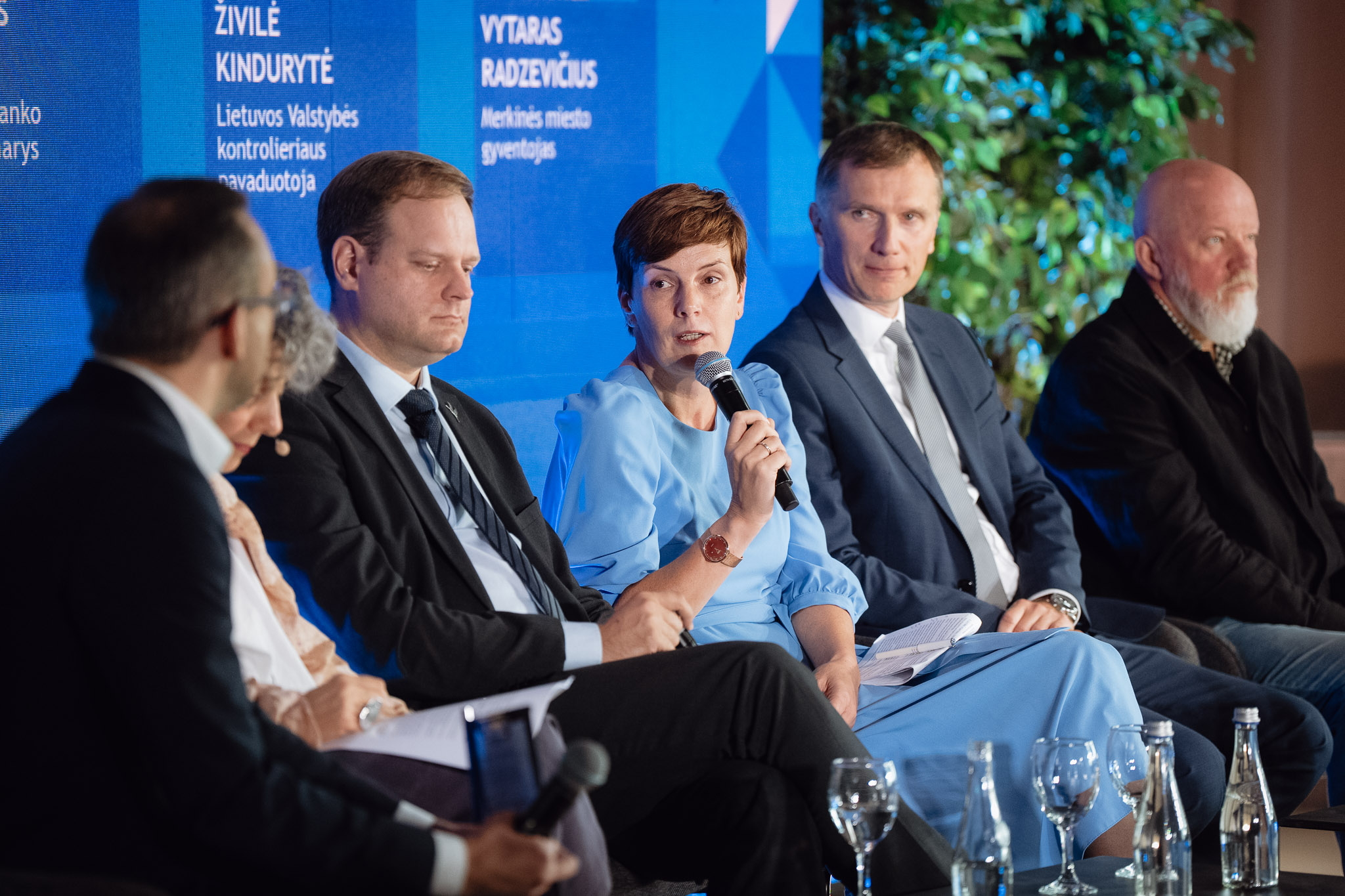 What services should the state guarantee regardless of place of residence, and where does the line lie between their accessibility and economic efficiency?
These were the issues that Živilė Kindurytė, Deputy Auditor General, discussed at the Regional Policy Forum in Šeduva. The forum was organised by the Ministry of the Interior in conjunction with the Central Project Management Agency.
The discussion “Access to essential services in remote and rural areas. What is the optimal solution?” was attended by representatives from the Organisation for Economic Co-operation and Development, the Bank of Lithuania, local authorities and communities. The forum sought to find a way to reconcile the needs of the population with the limited resources of the state, municipalities and the business sector.
National Audit Office’s audits have repeatedly shown that access to public services in Lithuania still depends on where one lives. One of the conclusions of the audit “Promoting Active Ageing” is that social protection in old age cannot be a matter of “geographical luck”. A broader question was raised at the forum: can we agree at national level which services must be accessible to everyone, regardless of where they live, and how will we assess their accessibility?
“Efficiency is not simply about the lowest cost of providing a service. If we make savings by closing a service in one location, but this means a person has to travel several dozen kilometres as a result, we are simply passing on part of the cost to them. That is why we must assess not only how much it costs to provide the service, but also whether people can actually access it,” says Živilė Kindurytė, Deputy Auditor General.
Optimisation does not necessarily mean closure
The efficiency of a service network cannot be assessed solely on the basis of its running costs. By concentrating services in larger centres, we can reduce the costs of providing them, but for some residents, journey times and costs will increase. It is therefore important to assess the full impact of any decision.
Physical service locations can be complemented by digital and mobile services, transport schemes or other solutions. However, the most important thing is to assess the outcome – whether a person can actually access the service they need. This is particularly relevant for those whose ability to use digital services or travel independently to another town is limited.
Access to services – a matter of regional vitality
Access to essential services is one of the factors that determines whether people choose to live, work and build their future in a region. Therefore, decisions regarding the service network should be assessed not only on the basis of how much they cost today, but also on the impact they will have on the region in the future.
Photo credit: event organisers, photographer Rytis Šeškaitis.