


2026-08-28
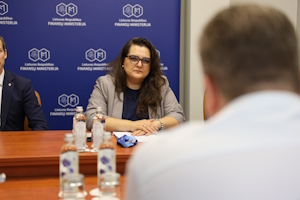 Yesterday, Auditor General Irena Segalovičienė, together with her team and the Minister of Finance, Taurimas Valys, discussed how to maintain sustainable public finances in the face of rising defence and social spending, as well as other state needs.
“Public needs are growing faster than our financial capacity. It is therefore becoming increasingly important not only to have the funds for new priorities, but also to make better use of what we already have. Every new long-term commitment must be assessed in relation to its source of funding and its impact on public finances in the future,” says Auditor General Irena Segalovičienė.
One of the main topics of the meeting was fiscal discipline and the rise in public debt. According to the National Audit Office’s assessment, debt may grow from 39.6 percent to 55.3 percent of GDP by 2029. As it approaches the 60 percent threshold, the state’s ability to respond to future economic or geopolitical shocks diminishes.
Long-term defence funding was also discussed, along with the National Audit Office’s recommendation that the strategic continuity of defence funding beyond 2030 must be clearly embedded in national legislation to ensure the sustainability of development and the confidence of partners. The use of EU funding was also addressed – a loan of EUR 6.375 billion is earmarked for the national defence system for the period 2026–2030. Long-term clarity regarding defence funding would allow for better planning of major acquisitions and the funding of other areas of government.
At the meeting, the Auditor General expressed her hope for more proactive government measures to improve the efficiency of the public sector by making better use of existing state resources – ranging from the centralisation of general functions and the management of state assets to the simplification of financial reporting. The meeting also addressed the status of implementation of the National Audit Office’s recommendations to the Ministry regarding the management of reserves. By the end of the year, the Ministry of Finance has undertaken to establish common principles for their creation and management – how much is required, what risks they are intended to protect against, and how their accumulation should be balanced with borrowing.
An important topic discussed at the meeting was the quality of the state's data, as without reliable data it is difficult to expect high-quality, data-driven decisions or to assess whether the state's planned initiatives are delivering the expected results.
It was agreed at the meeting to continue cooperation in finding solutions to reconcile the state's growing needs with the long-term sustainability of public finances and the more efficient use of state resources.