




2026-08-28
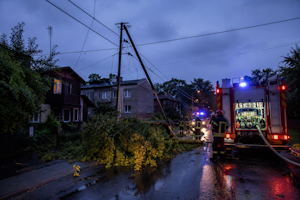 The storm that swept through at the weekend, and whose effects are still being felt, serves as a reminder of how important it is to be prepared for emergencies. Audits carried out by the National Audit Office and subsequent monitoring of the recommended changes show that preparedness has improved in recent years, but there is still important work to be done – ranging from the modernisation of electricity networks and risk assessment to the readiness of the national reserve and emergency services.
“An emergency very quickly reveals whether what we have planned actually works in practice. What matters then is not the number of plans and documents, but whether the infrastructure is reliable, whether the authorities are acting in a coordinated manner, and whether help reaches people in time. That is why we must address weaknesses in advance, rather than when we are already having to deal with the consequences of a crisis,” says Auditor General Irena Segalovičienė.
Preparation starts with a resilient infrastructure
A reliable electricity supply is essential for the functioning of many vital state and public services – the operation of telecommunications, water supply, healthcare and other vital services depends on it.
An audit carried out by the National Audit Office in 2023, entitled “Management of the Electricity Sector”, revealed that, during the period audited, around a quarter of the assets used in electricity transmission and distribution had been in use for longer than their specified useful life. Operating such infrastructure increases the likelihood of faults and defects.
Infrastructure modernisation was also delayed. 37.5 percent of transmission network and 61.5 percent of distribution network modernisation and construction projects were not completed on time.
Energy Distribution Operator AB (ESO) has been advised to modernise key elements of the distribution network more promptly, reduce the duration and frequency of prolonged power cuts, and better manage the risks of delays in infrastructure projects. These changes are expected in 2027–2028.
Institutions need to know what to prepare for and how to act
In the event of an emergency, it is important that institutions have assessed the greatest threats in advance, are fully aware of their responsibilities and are prepared to act cooperatively.
The 2022 audit, "Preparedness of Institutions to Respond to Emergencies", revealed a lack of inter-agency coordination and a need for a higher-quality assessment of potential hazards and emergencies.
Following the implementation of the audit recommendations, the responsibilities of the institutions have been more clearly defined, the role of the National Crisis Management Centre in coordinating preparedness for crises and emergencies has been established, and procedures for the preparation and updating of crisis management plans have been laid down. However, there have been delays in drawing up the National Risk Analysis Methodology, which would ensure the consistent identification and assessment of high and very high-risk threats.
During an emergency, it is important to know who needs what kind of assistance
In the event of a disruption to communications or other essential services, some members of the public may require assistance. To ensure that this assistance reaches those who need it, it is important to identify in good time who requires help and to involve NGOs and volunteers in this process, who could help to provide it.
The 2025 audit by the National Audit Office, "Preparation of Citizens of the Republic of Lithuania for Civil Resistance", showed that preparations for this are still insufficient. At national level, there is a lack of coordination in the mobilisation of NGOs and volunteers, while at municipal level there is a lack of specific action plans for assistance and data on residents who would require help in the event of a crisis, emergency or mobilisation.
It has been recommended that the Office of the Government draw up a nationwide plan specifying the tasks for which, the methods by which, and the timing for which NGOs and volunteers would be engaged, so as to ensure that the public receives the necessary assistance. Whether the changes resulting from the audit have delivered the expected outcome will be assessed in 2028.
The national reserve must be built up after assessing real threats, and both municipalities and the public must be prepared for crises
It is important to properly assess potential threats when determining what stocks the state needs to build up.
An audit completed this year, entitled "Formation, Accumulation and Management of State Reserve", showed that the state reserve is not being established with sufficient regard to the threats posing the greatest risk. The requirement for reserves is not based on specific management scenarios. Consequently, in a critical situation, some of the accumulated reserves may be insufficient or may not meet a specific need. Furthermore, the audit revealed that the system does not ensure that, when necessary, reserves are delivered promptly to where they are most needed.
The National Audit Office recommended linking the reserve requirement to the highest risk threats and their scenarios. It must be clear what stocks are required, in what quantities and for what situations, who is responsible for them, and how their logistics will be ensured. Major changes are expected by the end of 2026.
The audit also showed that, in the event of a crisis, municipalities, which are closest to the public, play a vital role. Under the proposed model, residents themselves should provide for their own essential supplies for the first three days; on days 4–6, municipalities should take responsibility for supplying residents; and thereafter, the national reserve would be utilised. However, not all municipalities have assessed how much stock would be required for this. It is important that residents know what they need to provide for themselves, and that municipalities are prepared to ensure the supply of essential resources to residents.
The preparedness of the fire and rescue services remains inadequate
In many emergency situations, the assistance of the fire and rescue services is required. For example, the assistance of firefighters may be required to rescue people and their property from the consequences of storms, such as accidents caused by fallen trees, fires caused by lightning strikes and other dangerous situations. It is therefore important that there are sufficient firefighters, and that they are properly trained and equipped. However, monitoring of the implementation of the National Audit Office’s recommendations shows that challenges remain in this area.
Between 2020 and 2025, the proportion of on-duty shifts of firefighters in the State Fire and Rescue Service meeting the requirements increased from 19 percent to 25 percent. The proportion of firefighters capable of carrying out all firefighting and rescue operations rose from 52 percent to 57 percent over the same period. The proportion of firefighting and rescue equipment meeting the requirements did not increase – it stood at 62 percent in 2020 and 60 percent in 2025.
The National Audit Office has recommended that the Ministry of the Interior and the Fire and Rescue Service strengthen the human resources and organisational structure of their forces, and improve their equipment, in order to ensure constant readiness to carry out firefighting and rescue operations. The implementation of these recommendations is behind schedule.
The protection of critical infrastructure is also being assessed
The continuity of operations in the energy, communications and other critical infrastructure sectors is one of the most important prerequisites for national resilience. Disruptions to these sectors can hamper vital state functions.
It is therefore extremely important to know in advance what needs to be protected, from which threats, and what measures are required to ensure that protection. This is precisely what the National Audit Office is currently assessing in its audit entitled “Organisation of the Physical Protection of Objects Important for Ensuring National Security". The audit is also examining who is responsible for the protection of these objects and whether the security measures in place adequately address the identified threats. The audit findings are scheduled to be published in early 2027.