


2026-08-21
The system for acquisition of armaments and military equipment is failing to keep pace with the armed forces’ needs

- As defence funding has increased, the volume of acquisition of armaments and military equipment has risen rapidly: procurement contracts worth EUR 8.7 billion were concluded between 2023 and 2025, while funding for this area within the national defence system rose from 14 percent to 40 percent of total expenditure.
- The efficiency of armaments and military equipment procurement is declining – the proportion of unsuccessful procurements rose from 24 percent (in 2023) to 59 percent (in 2025).
- Decision-making is slow – 42 percent of procurement consultations with advisory bodies took between 30 and 374 days, while advisory groups effectively make decisions without declaring conflicts of interest.
- Armaments procurement under exemptions accounted for almost half (EUR 3.4 billion) of the contract value; no significant systemic breaches were identified in procurement, but 38 percent of standard armaments procurement contracts were found to contain high and/or medium significance non-conformities.
- No significant systemic breaches were identified in procurement but increasing funding and reputational risk necessitate the strengthening of controls, monitoring of efficiency and prevention of conflicts of interest.
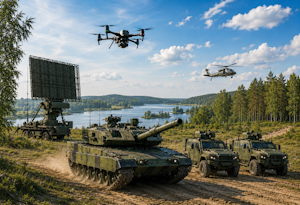
Funding for Lithuania’s national defence is growing rapidly and has reached record levels, with the focus on accelerating the armed forces’ readiness for national defence. To ensure deterrence and national security, modern armaments are being procured, the armed forces’ requirements are being updated, and the First Division of the Lithuanian Armed Forces is being developed. However, an audit carried out by the National Audit Office entitled “Acquisitions of Weapons and Military Equipment” revealed that the proportion of failed procurements in the defence sector has increased by as much as 2.5 times over two years, and that decision-making could be more efficient.
The audit showed that both internal and external factors are hindering the system for acquisition of armaments and military equipment from meeting the armed forces’ needs in a timely manner. Internal causes include fluctuations in funding and priorities when planning procurements, failure to update capability development plans, protracted decision-coordination processes, a shortage of qualified specialists, insufficient monitoring of procurement efficiency and fragmented management of key armaments procurement projects. Meanwhile, the external environment is characterised by growing demand for armaments on the international market, limited manufacturers’ capacity, and long lead times for the production and supply of armaments and military equipment. For these reasons, some of the armed forces’ requirements are met later than planned.
“Today, time is just as critical a resource in the defence sector as funding. The number of failed procurements has doubled, and the months-long process of coordinating decisions is directly hindering the necessary expansion of the armed forces. We must therefore not only review the legal framework but also eliminate other internal causes that are causing procurement bottlenecks and delays in decision-making. Our audit has provided a clear picture of what needs to be improved and how. Now all the responsible institutions must work together constructively – the defence procurement system must be given a real priority, not just a declarative one, guaranteeing concrete results for the armed forces and our defence capabilities,” emphasises Auditor General Irena Segalovičienė.
The arms procurement process is slowed down by lengthy coordination and a lack of capacity
Audit data show that, as funding levels increased, the proportion of unsuccessful arms procurement contracts rose from 24 percent in 2023 to as much as 59 percent in 2025. This was due to changing requirements, unprepared operational specifications, suppliers’ tenders not being submitted on time, or prices that were too high and therefore unacceptable to the contracting authority.
In turn, the coordination of decisions significantly prolongs the procurement process. In as many as 42 percent of the procurement cases analysed, coordination with ministry departments and advisory groups took between 30 and as many as 374 days, even though the recommended maximum duration for an international procurement process should not exceed 180–240 calendar days. Furthermore, advisory bodies such as the Defence Resources Council or the Armaments and Military Equipment Group effectively make decisions, even though they have no independent legal powers, and their members, as participants in the procurement process, do not declare any private interests, which creates a risk of bias and a lack of transparency.
Due to ineffective selection processes and the rotation of officers, the Defence Resources Agency also faces a shortage of specialists with specific knowledge and military qualifications. Procurement of armaments and military equipment requires not only a thorough understanding of public procurement procedures, but also the expertise of officers and specific military experience. As procurement needs grow, procurement capacity is not increasing, which hinders the continuity and smooth completion of projects already underway.
Procurement under exceptional circumstances accounts for almost half the value of arms procurement
The Defence Resources Agency, having made use of the exemptions provided for in the Law on Public Procurement in the field of defence and security between 2023 and 2025, concluded 62 contracts for the acquisition of armaments and military equipment, with a total value of nearly 3.4 billion euros. This accounted for 48 percent of all contracts for the acquisition of armaments and military equipment and 40 percent of the total value. The exemptions were applied lawfully.
When assessing routine public procurement of armaments, no significant breaches of the law were identified that would have altered the outcome of the procurements; however, serious control deficiencies were identified – 38 percent (8 out of 21) procurements were found to contain high and/or medium significance non-conformities. During the preparation stage, procurement officers often fail to carry out or document market research, which poses a direct risk of the improper planning of public funds.
It was also found that the start of procurement procedures following approval by the Public Procurement Service took anywhere from a dozen or so days to one and a half years, even in cases where the Service had to be approached urgently. A lack of control was also noted during the contract implementation stages: information on concluded contracts and their amendments was not published in a timely manner, and some contracts were implemented for a certain period without the mandatory bank guarantees or letters of guarantee, thereby jeopardising the state’s financial protection.
Lithuanian Armed Forces capabilities and project management
The capabilities of the Lithuanian Armed Forces are strengthened with a view to increasing their combat power and ensuring the consistent development of the First Division by 2030. However, of the 16 capabilities relating to armaments acquisition, 13 are still being developed in accordance with plans drawn up some time ago. An audit carried out by the National Audit Office shows that no indicators have been established to specify the level of development each capability must achieve and within what timeframe, nor is the current level of capability development being recorded.
The National Audit Office emphasises that it is important to strengthen monitoring and project management in armaments acquisition. At present, almost half of the procurements carried out under exemptions are not monitored, and their efficiency is simply lost in the overall procurement picture. Not all of the high-priority armaments acquisition projects identified by the Ministry are managed on a project basis by the Defence Resources Agency.
Due to the fragmented application of project management in the analysed projects, no project implementation plans were drawn up, and decisions were taken without assessing the total project value, which includes the life-cycle maintenance costs of ammunition, infrastructure and armaments. Assessing only the purchase price of the equipment itself can give a misleading picture of the actual financial commitments. For example, the value of the ‘Leopard 2 A8 tank project increased by 33 percent when all contracts already concluded and planned were taken into account. This shows that without taking into account all project-related costs, it becomes difficult to plan funding accurately, manage risks and ensure the smooth implementation of the project. This becomes critically important as budgets grow and the scope of modernisation projects expands.
The National Audit Office’s recommendations to ensure change
With a view to ensuring that growing investment in armaments and military equipment is translated in a timely manner into the actual capabilities of the Lithuanian Armed Forces, the National Audit Office has issued recommendations to the Ministry of National Defence, the Defence Resources Agency and the Lithuanian Armed Forces. One of the most important changes envisaged is a clearly defined timeframe for supplying the armed forces. The aim is for no more than 730 calendar days to elapse between the approval of a requirement and its fulfilment. This indicator will make it possible to assess not only the duration of individual procurement procedures, but also the ability of the entire procurement system to supply the armed forces with the armaments and military equipment they require in a timely manner.
It has been recommended that the Ministry of National Defence clearly distinguish between the competences and responsibilities of advisory bodies and those authorised to take decisions and establish the procedures and deadlines for coordinating decisions. Once the planned measures have been implemented, the aim is for all final decisions to be taken by the authorised bodies, whilet the coordination process will be shortened to no more than 35 working days.
The Ministry has also undertaken to improve the system for assessing the efficiency of procurement. It is planned to establish separate performance indicators for the procurement of armaments and military equipment, including procurements carried out under statutory exemptions. The aim is to reduce the proportion of unsuccessful procurements to 20 percent, while ensuring that at least 80 percent of procurements are completed within the recommended timeframe.
To ensure that armaments can be acquired promptly in exceptional circumstances, we have recommended that the Ministry of National Defence initiate legislative amendments and establish a mechanism enabling the prompt acquisition of armaments and military equipment in the event of threats to national security, mobilisation or war.
To ensure greater transparency, we recommended that the Ministry precisely define the persons who may influence the outcome of procurements, and the measures for the prevention and control of conflicts of interest applicable to them. The aim of implementing this recommendation is to ensure that 100 percent of those involved in procurement have duly declared their private interests.
The Ministry of National Defence has also planned to strengthen the management of high-value acquisition projects. The total value of a project must be determined at the very start, covering not only the cost of the armaments or equipment being acquired, but also the costs of the necessary infrastructure, ammunition, maintenance and other life-cycle costs. It is also planned to introduce periodic monitoring of project implementation. The aim is for 100 percent of high-priority projects to be managed in accordance with established project management requirements, and for at least 80 percent of them to be implemented on time, in full and within the approved budget.
The Defence Resources Agency will strengthen procurement controls and traceability, document market analysis, verify the validity of unusually low prices, and establish clear requirements for unadvertised negotiations. It will also be possible to offer the contract to another supplier if the successful tenderer fails to ensure the necessary performance of the contract. The aim is for at least 80 percent of verified procurements to meet the requirements.
The Lithuanian Armed Forces have undertaken to update the capability development plans for all capabilities, to establish the current and target levels of development for each capability, and to set indicators against which the impact of specific acquisitions on the overall progress of military capabilities can be assessed. It is envisaged that by 2030, 80 percent of capabilities will have a target development level set, and 95 percent of capabilities will have actually reached the level of progress planned for 2030.
The measures committed to by the Ministry of National Defence, the Defence Resources Agency and the Lithuanian Armed Forces will be implemented in stages. The National Audit Office will assess their progress against established indicators of change. The expected outcome is not only more efficiently organised procurement, but also faster supply to the armed forces, more accurate planning of the funding required for all defence projects, greater transparency of processes and a measurable strengthening of Lithuania’s military capabilities.
Part of this audit report is classified in accordance with the Republic of Lithuania Law on State and Official Secrets. The full audit report has been submitted to decision-makers authorised to access this information.