


2026-06-03
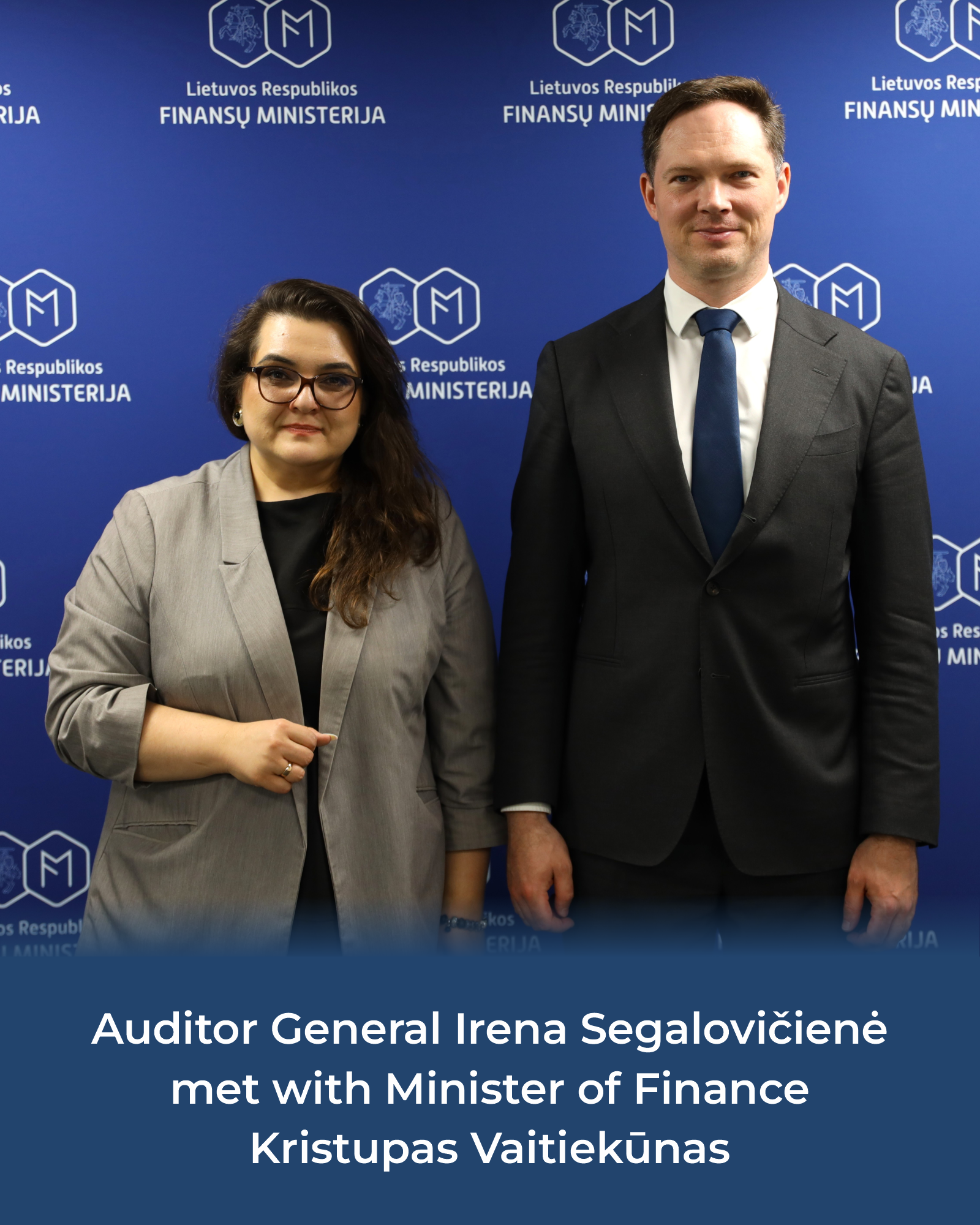 Auditor General Irena Segalovičienė met with Minister of Finance Kristupas Vaitiekūnas today. The meeting addressed current issues relating to public finance management, fiscal policy and the country’s fiscal sustainability as recorded in the National Progress Report. They also discussed the implementation of the National Audit Office’s recommendations in the field of finance, the need for consolidated reporting, and issues regarding further cooperation between the institutions.
The assessment of the fiscal section of the 2026 Annual Progress Report, carried out by the National Audit Office as an independent fiscal institution (IFI), showed that although in 2025 public finances complied with fiscal discipline rules, pressure on public finances will increase in the coming years due to rising government expenditure on defence and the challenges posed by an ageing population.
The Auditor General emphasised once again that without sustainable sources of revenue and more efficient management of public sector expenditure, it will be difficult to comply with fiscal discipline rules in the coming years without reducing the availability of public services. If we do not resolve the issue of additional revenue in time, we will have to choose in the future between defence funding or cutting other expenditure.
“Public finances are not elastic, and the time for convenient solutions has, in essence, already run out. If we do not find sustainable sources of revenue in the near future and do not dare to tackle inefficient public sector expenditure more actively, we will soon be backed into a corner and will have to choose how to fund the country’s defence while maintaining the availability of public services. The National Audit Office is not merely an observer – we are partners of the Ministry of Finance, identifying risks and ready to support unpopular decisions that are necessary for the state’s financial security,” says Auditor General Irena Segalovičienė.
The meeting also addressed the recommendation on state reserves submitted to the Ministry last year. The National Audit Office has recommended that the Ministry of Finance review the legal framework governing reserves and establish common principles for their creation and management, linking them to the state’s borrowing policy.
Ms Segalovičienė emphasised that the accumulation and use of reserves is one of the most important instruments for increasing the state’s financial resilience during periods of economic or geopolitical crisis. The Ministry of Finance is currently preparing a strategic framework for reserve management, which would help to ensure the state’s long-term financial security.
The leaders devoted considerable attention to the issue of improving the efficiency of public sector spending, so that institutions can create greater value for society with the same resources. National Audit Office audits have identified a number of areas where efficiency needs to be improved – ranging from ministry administrative costs, state asset management and the consolidation of IT services to childcare benefits for foreign nationals and transport services.
The meeting also discussed opportunities to improve the state budget formulation and reporting system by applying the accrual principle. Such a practice would enable a more unified, comprehensive and analysis-friendly public sector accountability system, better revealing the financial position of the public sector, fiscal risks and cash flows, while reducing the administrative burden and improving the soundness of decision-making.
Finally, the heads of the institutions reviewed planned and ongoing financial audits, the risks associated with the management of reforms and strategic projects, and issues relating to sustainable funding that strengthens the independence of the National Audit Office.