




2026-04-22
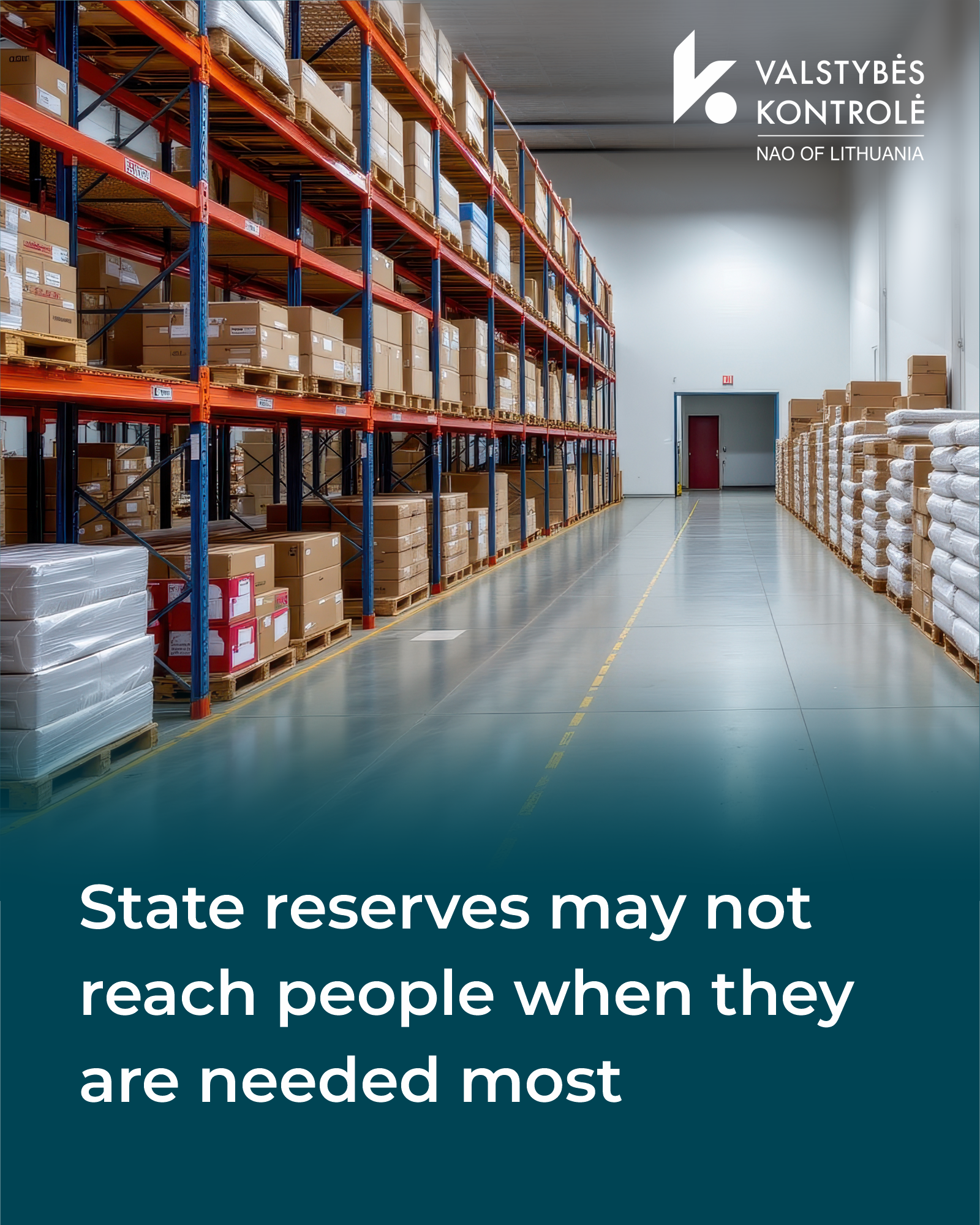 In the event of a crisis or war, State Reserve stocks may not reach people in time, according to the National Audit Office’s audit “Formation, Accumulation and Management of State Reserve”. It found that some stocks are stored in locations that may become inaccessible or destroyed, and that medical and food stocks are not evenly distributed across the country. As a result, in the event of an emergency or threat, stocks may be lost, fail to reach people, or reach them too late.
Only around 10% of stockpile storage locations have been selected after assessing actual threats
In accordance with legal requirements, storage locations must be selected after assessing potential threats. They must not be situated in areas at risk of explosion, collapse, flooding or contamination by hazardous substances. And when stocks are needed, they must be safely and quickly accessible.
However, only 10% of storage locations have been selected after assessing the potential risks and their consequences as identified in the national risk analysis. Some warehouses, including those containing medical and civil protection stocks, are located in areas from which residents would be evacuated in the event of a crisis – this means that stocks may remain inaccessible.
Delivery of stocks is not linked to realistic crisis scenarios, and responsibilities between institutions are unclear
The National Audit Office notes that stocks must be stored closer to the population, and the network of warehouses must be planned according to specific risk scenarios and regional needs. This would ensure that every part of the country has sufficient quantities of essential resources and that they can be delivered quickly.
“The system provides for food stocks to reach the population via local authorities. In the event of a crisis, residents should provide for themselves for the first three days, local authorities for the fourth to sixth days, and the national reserve from the seventh day onwards. However, in reality, most local authorities do not stockpile reserves. There is no clear legal obligation, no national evacuation plan for the population, and no specific action plans. For genuine preparedness, the role of local authorities must be clearly established, and stockpiling must be made mandatory,” emphasises Auditor General Irena Segalovičienė.
The audit also revealed that the delivery of stocks is not properly planned. It is not linked to specific risk scenarios, and responsibilities are not clearly allocated between institutions. This creates a risk that, when transporting necessary stocks to residents from remote warehouses, they will reach residents too late.
Unlike medical or civil protection stocks, food reserves are not stockpiled – stocks are secured through contracts with private suppliers. However, this model also fails to ensure even distribution across the country. There is no guarantee that there will be enough food for all regions during a crisis.
Recommendations of the National Audit Office and their implementation
The National Audit Office recommended that the Office of the Government reorganise the storage of State Reserve stocks. Storage locations should be selected based on potential risks and their consequences, and decentralisation should be increased so that stocks are closer to the population in all regions of the country.
Once the recommendation is implemented, all storage locations would be selected after assessing real threats (currently, only around 10% of warehouses meet this criterion), and stocks would be stored in a decentralised manner. By 30 September 2026, the Office of the Government must prepare a warehouse development strategy and implement it by the end of 2030.
Later this year, the Office of the Government plans to implement the measures recommended by the National Audit Office to ensure that, should the need arise, State Reserve stocks reach the population across the country in a timely manner:
- to prepare and approve a national-level emergency management plan that clearly defines action scenarios, institutional responsibilities and the necessary resources;
- carry out a cost-benefit analysis to assess when it is more appropriate to reserve food products and when to purchase and stockpile them, and to evaluate suppliers’ capacity to ensure sufficient quantities and delivery;
- amend legislation to clearly define the role of local authorities in stockpiling food stocks;
- adopt legislation on the conclusion of centralised logistics service contracts, which would ensure the efficient delivery of State Reserve stocks to users.