





2026-04-15
- Less than half (42.7%) of older people participate in cultural activities.
- Only 2 out of 60 municipalities are planning measures for older people.
- Only around 10% of seniors volunteer, and the state did not take any measures to promote this area in 2023–2025.
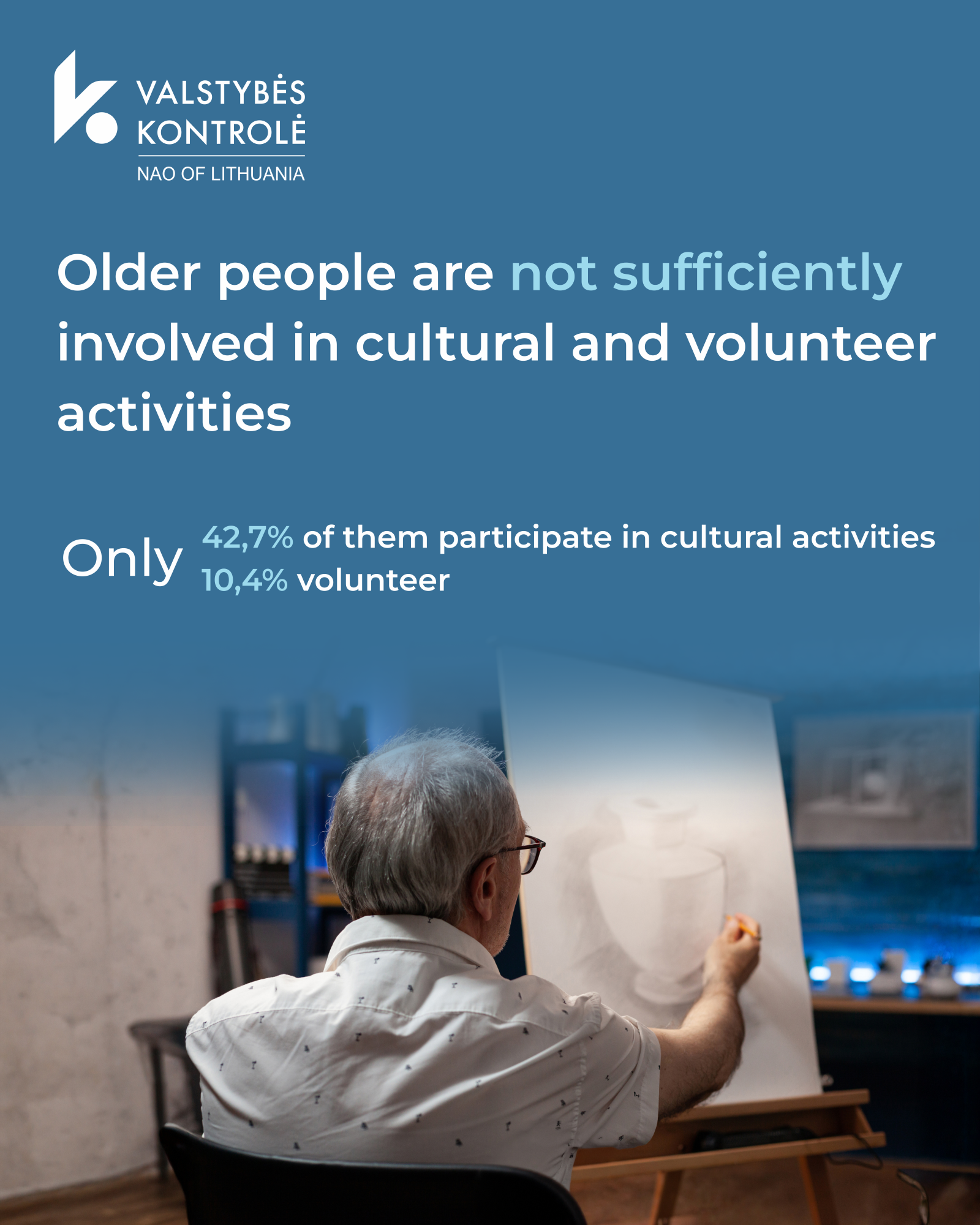 The results of the National Audit Office’s audit “Promoting Active Ageing” show that the involvement of older people in cultural and voluntary activities is not sufficiently encouraged. According to the auditors, there is a lack of strategic government attention, targeted planning of measures and data on the actual needs of older people.
“Investing in active ageing today is an effective way to reduce healthcare and social care costs tomorrow. Volunteering is still mistakenly viewed as an activity exclusively for young people, while the involvement of seniors in cultural life is left to chance. If we do not change this mindset now, we will pay a much higher price in the future for today’s inaction. Therefore, a more consistent and robust government policy is needed to promote active ageing,” says Auditor General Irena Segalovičienė.
Cultural policy – with no clear focus on older people
Cultural activities are popular among older people, but their involvement remains limited. The auditors found that state strategic documents lack a priority to promote the inclusion of older people, while the plans of the Ministry of Culture focus solely on the general accessibility of activities.
Even targeted initiatives such as the “Social Prescription” programme, which is implemented in nearly a third of municipalities and includes cultural activities, have not brought about the expected breakthrough. There is a lack of cooperation between the Ministry of Culture and the Ministry of Health, which means that the target group of lonely, inactive seniors is not being reached, and opportunities to improve their quality of life and to strengthen social inclusion, mental, and emotional well-being through culture are being lost.
The audit findings show that the cultural needs of older people in Lithuania are also largely overlooked. Only 2 out of 60 municipalities had planned specific measures to promote cultural engagement among older people, while the rest carried out activities aimed at the general public without taking the needs of older people into account. Furthermore, only one cultural institution carried out an assessment of the needs of older people. Decisions based on general assumptions rather than objective data result not only in a failure to meet the actual needs of active older people, but also in greater social exclusion.
The audit also revealed a marked disparity in cultural engagement across the country’s regions. The highest levels of activity were found in the counties of Alytus and Tauragė, while the lowest were in the regions of Kaunas and Klaipėda. In the latter, more than half of those surveyed stated that the activities on offer were not relevant to them or that they did not wish to participate in them. This indicates that, without a targeted needs assessment and specialised measures, a large proportion of seniors remain on the margins of cultural life.
Promoting volunteering – a burden on non-governmental and cultural organisations
The National Audit Office’s audit revealed that the Ministry of Social Security and Labour implemented two measures related to volunteering by older people in 2022, while no targeted measures to promote volunteering among older people were carried out in 2023–2025.
The field of volunteering reveals a gap between seniors’ personal motivations and government action. Only 10.4% of older people volunteer; they are most often motivated by a desire to help others (59.6%) and to remain active (40.4%). 72.9% have not volunteered and do not intend to do so in the future. The main barriers are not only a lack of personal motivation, time constraints and health issues, but also a lack of information and encouragement, as well as an unfounded feeling that one is “too old” for such activities.
Until state institutions introduce targeted measures, non-governmental organisations (NGOs) and initiatives by cultural institutions play the leading role in promoting volunteering among older people. The number of older volunteers at the Order of Malta’s Relief Service increased by more than two and a half times between 2022 and 2024; more than 100 seniors are involved in the activities of the Lithuanian Red Cross; and Caritas actively involves them in its aid programmes. Positive trends are also evident in the cultural sector: between 2022 and 2024, the total number of volunteers in cultural institutions increased by almost one and a half times. Cultural centres (39%) and theatres (25%) attracted the most of older volunteers, while libraries and museums attracted fewer.
However, 67 cultural institutions had no volunteers at all, mostly due to the belief that there was “no need” or a lack of people willing to volunteer. Both NGOs and cultural institutions identify the same problems: unstable funding, a lack of human resources for coordinating volunteering, and ineffective communication. The auditors note that without a systematic state policy, this area remains untapped, even though it is important not only for society but also for the well-being of seniors themselves.
The Ministry of Culture is shying away from change
The National Audit Office has recommended that ministries take measures to help older people participate more actively in cultural life and get involved in volunteering. It is recommended that the Ministry of Social Affairs and Labour specifically target older people in the National Voluntary Service Programme and provide for measures to ensure their inclusion.
The Ministry of Culture is recommended to systematically assess the actual cultural needs of seniors and to use the results of this assessment when planning activities. It is also proposed to measure the involvement of older people in cultural activities and to encourage cultural institutions to develop programmes aimed at this audience more actively. Furthermore, the Ministry of Culture was recommended to overhaul the model of the “Social Prescription” initiative and expand its implementation nationwide. This would create more opportunities for older people to participate in cultural and other community activities.
However, the Ministry of Culture stated that, due to limited funding, it would not introduce new measures and declined to implement the auditors’ recommendation. The auditors note that such a delay limits the potential to harness culture to ensure the well-being of an ageing society.