



2026-03-23
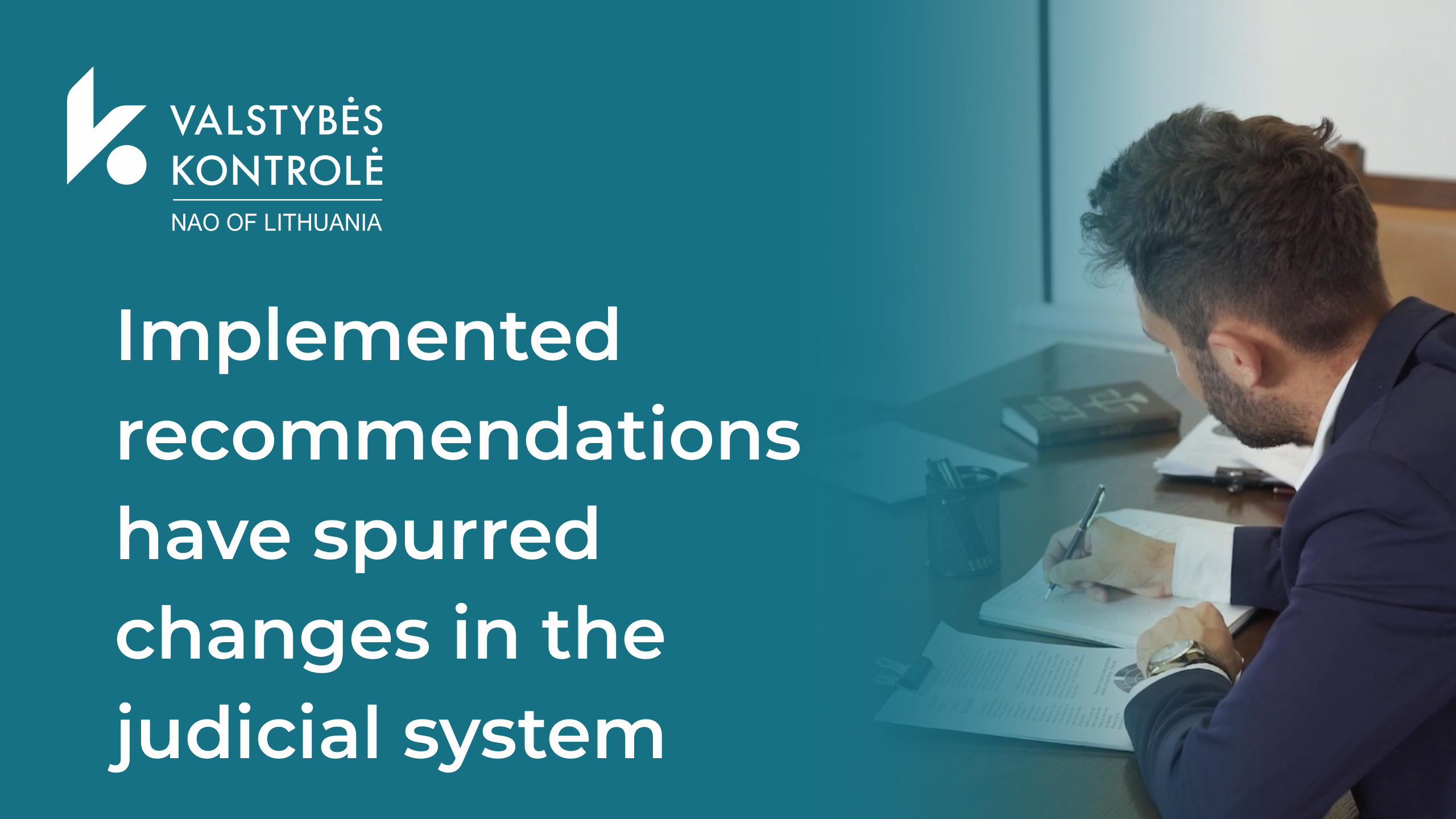 The recommendations of the National Audit Office have spurred changes in the Lithuanian court system. The implementation of the recommendations from the audit “Judicial System” has improved the organisation of the courts’ work, enabled judges to specialise, and continues to contribute to the consistent improvement of the judicial system so that the courts can effectively perform their primary function—administering justice.
Lithuanian courts are successfully streamlining non-core “bureaucratic” functions. Following the implementation of the National Audit Office’s recommendations, the court system has become more efficient—citizens can more easily handle civil matters, and judges can process complex cases more promptly.
An audit conducted by the National Audit Office in 2020 assessed whether appropriate conditions had been created for the courts to administer justice. The audit revealed that the courts are burdened with an exceptionally high caseload, that judges’ workloads are uneven, and that some of the functions they perform are not directly related to the administration of justice. For example, it was found that about 30% of district court judges did not have a clear specialization and were required to be “specialists in all areas”—the same judge would hear civil, criminal, and administrative offense cases.
“When a person turns to the court, they expect two things: that their case will be handled professionally and within a reasonable time. Therefore, it is very important to organise the work of the courts in such a way that judges can focus on their primary function—administering justice. The implemented recommendations help to reduce excessive procedures, strengthen the specialisation of judges, and help to ensure the right to justice,” says Auditor General Irena Segalovičienė.
Fewer unnecessary legal proceedings for residents
Taking into account the audit recommendations, the National Court Administration has developed and approved the “Vision for the Development of Lithuanian Courts 2023–2033,” which sets out the key directions for improving the court system and the expected results.
In response to the auditors’ observations, the Ministry of Justice reviewed the functions assigned to the courts and initiated legislative amendments that eliminated functions not characteristic of the courts, transferring them to notaries or bailiffs. Consequently, residents no longer need to go to court for permits for real estate transactions (when there are minors in the family), divorce by mutual consent, acknowledgment of paternity when there is no dispute, and other matters.
This change not only reduced the number of cases heard in court but also helped people avoid unnecessary legal proceedings.
More efficient work and specialisation of judges
Following the consolidation of district courts and their chambers, there are now 27 district court chambers instead of 43. Expanding their jurisdictions has created more opportunities to balance judges’ workloads and strengthen their expertise: currently, all district court judges specialise in hearing specific types of cases, thereby ensuring higher qualifications among judges and faster case processing. This ensures higher quality and faster decision-making.
Two more of the five recommendations made are currently being implemented. Plans are underway to develop a strategy for the formation of the judicial corps and to review the methodology for determining the optimal workload of district court judges.
Safety for the most vulnerable residents
The audit also revealed shortcomings in the infrastructure, so efforts to improve court infrastructure are continuing. By 2033, all newly constructed, reconstructed, or renovated court buildings must be equipped with interview rooms for minors and separate waiting areas for witnesses and victims, thereby ensuring their emotional safety during proceedings.
Up-to-date information on the status of the implementation of recommendations is published on the National Audit Office’s website at Open Data | National Audit Office of the Republic of Lithuania, while the report on the status of the implementation of the most important recommendations is available in the website section Implementation of Recommendations.