


2026-03-17
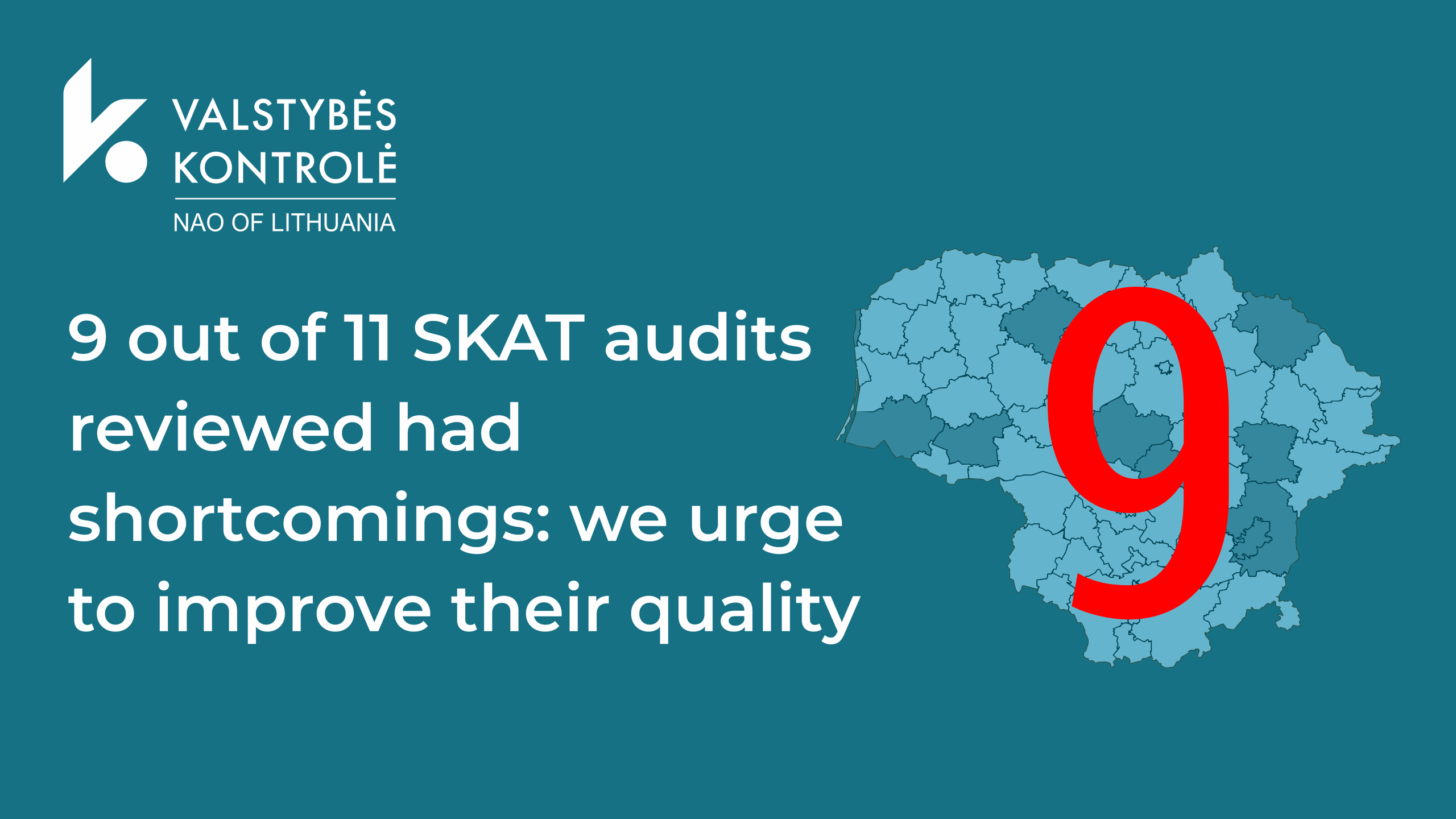
9 out of 11 municipal audits reviewed had shortcomings: The National Audit Office urges to improve their quality
 A review of audits carried out by municipal control and audit services (SKAT) performed by the National Audit Office revealed a clear trend: some municipal audits still lack quality.
A review of audits performed in 2024–2025 found that as many as 9 out of 11 (6 performance and 3 financial) audits assessed had significant shortcomings, and in one case, sufficient and appropriate audit evidence was not obtained to support the conclusions.
Such shortcomings pose a risk to the quality of decisions. If the audit is not sufficiently substantiated, significant risks related to the waste or inefficient management of municipal budget funds may go unnoticed.
“The annual external review of audits is not merely a formal check. It helps identify areas where the audit process needs to be strengthened to ensure it is reliable and useful. Service heads need to make more active efforts to assess the causes of shortcomings and take concrete steps to improve audit quality. Only a high-quality audit can help municipal leaders make the right decisions and strengthen public trust in local government,” says Auditor General Irena Segalovičienė.
The most common audit shortcomings
An assessment of financial audits has revealed shortcomings in planning, and municipal auditors are not always able to gather sufficient audit evidence to ensure that their conclusions are sound and well-founded.
Performance audits have most often revealed that audit objectives and focus areas are not always clearly defined, that the efficiency and economy of operations are not sufficiently assessed, and that the causes of problems are identified inaccurately or described unclearly.
When the causes of problems are not precisely identified, recommendations do not always help resolve them, so the same mistakes may recur.
Which municipalities were subject to audit review?
This year, performance audits were assessed for SKATs in Kėdainiai, Molėtai, Rokiškis, and Šiauliai districts, as well as in the Palanga and Vilnius cities; financial audits were assessed for SKATs in Jonava, Šilutė, Tauragė, and Vilnius districts, as well as in the Vilnius city.
When conducting performance audits, all auditors encountered difficulties in properly planning the audit, and most also faced challenges in assessing the efficiency and economy of the audited entities’ operations.
For example, in four SKAT audits (Kėdainiai District, Rokiškis District, Vilnius City, Palanga City) there was insufficient audit evidence to answer the audit questions designed to assess the aforementioned aspects, while in the Molėtai District SKAT, evidence was not collected in material respects to assess the audit objective.
Without a proper assessment of efficiency and economy, important issues may go unnoticed, and recommendations for improving operations may not be provided to the entity. Municipal auditors do not always succeed in clearly identifying the causes of problems, so recommendations may not be aimed at addressing them, and the same mistakes may recur.
Uneven results in financial audits
An assessment of the financial audits revealed that the SKATs in Jonava and Vilnius districts conducted their financial audits in compliance with legal requirements. However, the audits of the SKATs in Tauragė District, Šilutė District, and Vilnius City revealed significant shortcomings in audit planning and the performance of audit procedures.
For example, systemic shortcomings in the documentation of audits were identified at the Vilnius City SKAT; consequently, during the review, it was not possible to confirm that all planned procedures had been performed properly, while at the Šilutė and Tauragė District SKATs, some required audit procedures had not been planned and were therefore not performed.
Although an appropriate auditor’s opinion was issued in these audits, significant errors may remain undetected if not all procedures are performed.
There are also some good examples
The review also identified examples of best practices. For example, Jonava District SKAT used an external review conducted by another SKAT during its audit—this helps identify shortcomings earlier and strengthens professional cooperation—while SKAT in Šilutė and Tauragė Districts collected feedback from audited entities after the audit to improve the audit process.
What the National Audit Office recommends?
Taking into account the results of the review, the National Audit Office urges all heads of SKATs to act with the utmost responsibility and:
- systematically strengthen audit quality management;
- continuously assess the weaknesses in the audit process;
- plan and implement specific measures to address the identified shortcomings.
Municipal auditors are also encouraged to cooperate more actively through the Association of Municipal Auditors—to implement joint quality improvement initiatives and initiate cooperative performance audits.
Assistance for municipal auditors
The National Audit Office not only performs annual external reviews of municipal audits but also helps strengthen auditors’ knowledge by organizing training sessions and providing guidance on the application of auditing standards.
Contributing to the quality of audits are the National Audit Office’s Audit Methodology website, which is constantly updated, and a repository of methodological audit documents and templates created exclusively for SKAT colleagues in the fall of 2025.
The summary reports on external reviews, titled “Results of External Review of Audits Carried out by Municipal Control and Audit Services,” are available here.
Results of external reviews of municipal control and audit services performed in 2017-2025: Microsoft Power BI