


2026-03-05
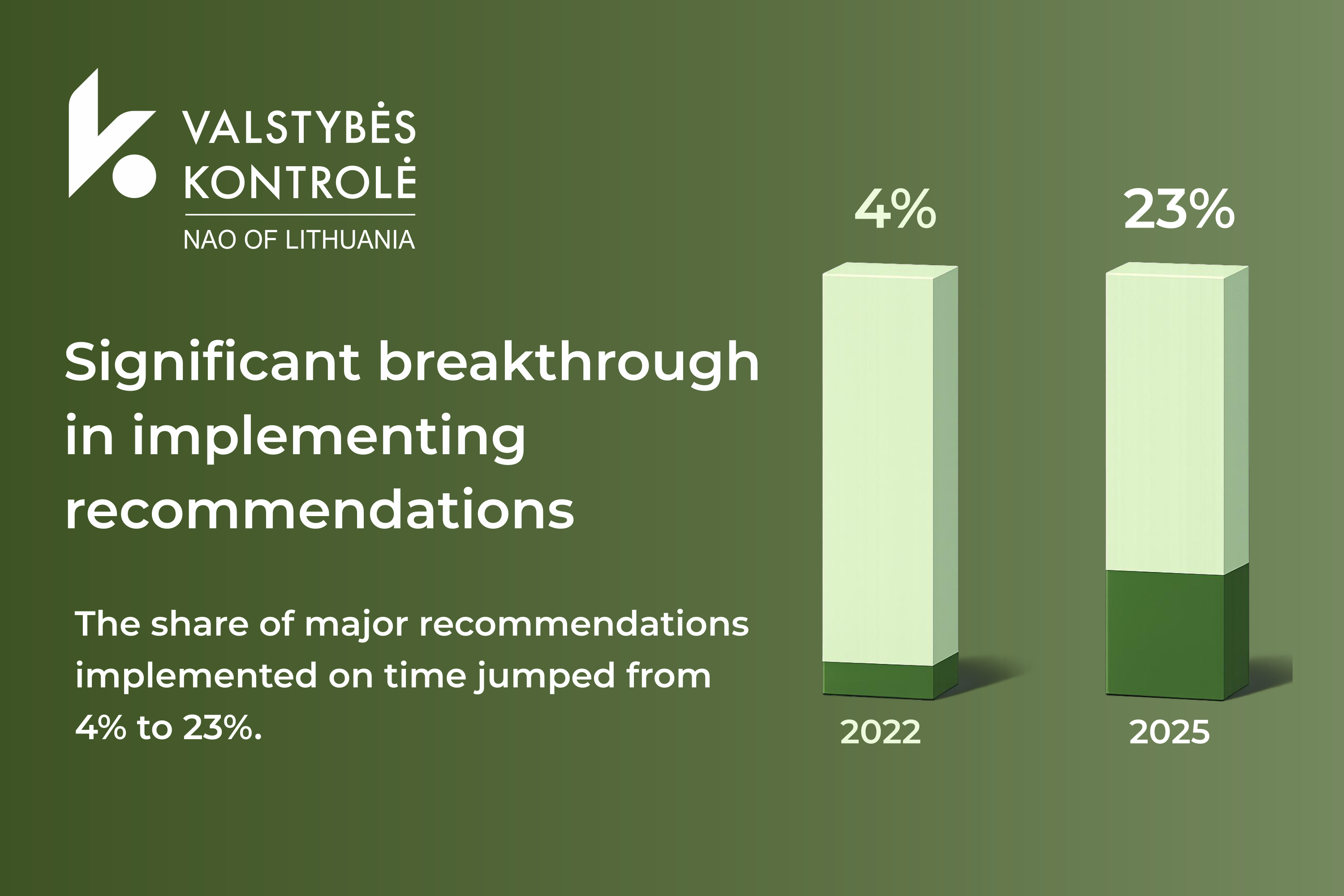 The latest National Audit Office report shows a significant breakthrough – over three years, the share of major recommendations implemented on time jumped from 4% to 23%. These figures are revealed in the March 2026 assessment, which reviews the real impact of audits on the state.
However, systemic flaws continue to slow down the country's development. Currently, every fourth recommendation is delayed. Of the 286 recommendations monitored during this half-year, 68 were not implemented on time. Although the overall trend is improving, Auditor General Irena Segalovičienė emphasizes that lengthy systemic solutions remain a challenge.
A recommendation is not just a tick in a report – it is a concrete decision by an institution and a promise to the public to correct the mistakes of the state, which should make people's lives easier. Although we see progress, the state cannot afford to constantly postpone systemic changes. Legal processes, public procurement, or IT cannot become a permanent cover for unfinished work when it comes to state security or assistance to the most vulnerable. Behind every delay lies an unresolved problem that directly affects our citizens. Ultimately, this costs institutions the trust of society," says Auditor General Irena Segalovičienė.
After assessing the results of the implementation of the recommendations over the last six months, the most significant positive changes have been recorded in the areas of the court system, social assistance administration, and food and veterinary control.
For example, following the implementation of the auditors' proposals, the court system was reorganized to ensure that cases are heard more quickly. District courts were merged, judges' workloads were balanced, judges' specialization was established, functions not typical of courts were abandoned, etc. This creates the conditions for a more effective and efficient administration of justice (audit "Judicial system," 2020).
Another important change is the introduction of a beneficiary summary in the Social Support Information System (SPIS), which allows all information about a person's cash benefits, compensations, social services, etc. to be viewed in one place. This has made it easier for municipalities to ensure that support is targeted and reaches those who need it most (implementing the recommendations of the audit "Does social assistance ensure the minimum consumption needs of people living in poverty and promote the the labour market integration" (2019)). Following the audit carried out in 2023, the State Food and Veterinary Service is focusing its controls and inspections on areas where the risk to consumer health is greatest, thus ensuring more efficient use of resources and greater safety.
In the next half-year, institutional action is expected to bring about changes in the areas of health and public safety. In the area of health, the goal is to eliminate regional disparities—the Minnesota program and motivational therapy must become available in every county, not just in large cities. This is a critical step in ensuring that people with addictions receive help closer to home. The powers of the chief epidemiologist should also be more clearly defined, and emergency preparedness should be strengthened by improving information systems and medical stockpile management. Decisions on the use of psychologists in pre-trial investigations involving minors would better protect children's rights and ensure higher-quality criminal investigations.
However, important systemic changes in the areas of state security, social integration, and public administration are still lagging behind. For example, problems with financing and public procurement are hindering the modernization of the EU's external border surveillance systems. There is also a huge gap in the adaptation of key state buildings for people with disabilities – instead of the planned 40%, only a tenth of the target has been achieved – just 4%. The centralization of financial accounting and personnel administration functions is also progressing slower than planned—the process has been postponed several times, and some of the necessary legislative changes regarding personnel administration processes have not yet been approved.
The National Audit Office monitors the implementation of recommendations on an ongoing basis and actively cooperates with the audited entities following the audit. Up-to-date information on the status of implementation of recommendations is published on the website of the National Audit Office: Open data | National Audit Office of the Republic of Lithuania. A report on the status of implementation of the most important recommendations is submitted to the Seimas twice a year, in March and September, and is made public.
Information on the implementation of all audit recommendations is open to the public on the National Audit Office's website and available here.