




2025-11-19
 The National Audit Office, implementing the function of a fiscal institution, today presented its assessment of the 2026–2028 draft budget to the Seimas Committee on Budget and Finance and submitted its projections. The draft budget complies with the European Union's fiscal discipline rules, but there are visible risks regarding the budget deficit and debt levels. When preparing its projections, the fiscal institution also takes into account decisions that are usually taken (such as additional pension indexation or faster wage increases for public sector employees) but are not included in the 2027–2028 draft budget. Therefore, the projections of public finance indicators presented by the fiscal institution and in the draft budget differ.
"Our projections show that by 2028, general government debt could reach around 51% of GDP or increase by more than 12 percentage points compared to 2024. The increase in debt will be driven not only by the growing general government deficit, but also by advance payments for the purchase of military equipment," says Jurga Rukšėnaitė, Head of the Budget Monitoring Department.
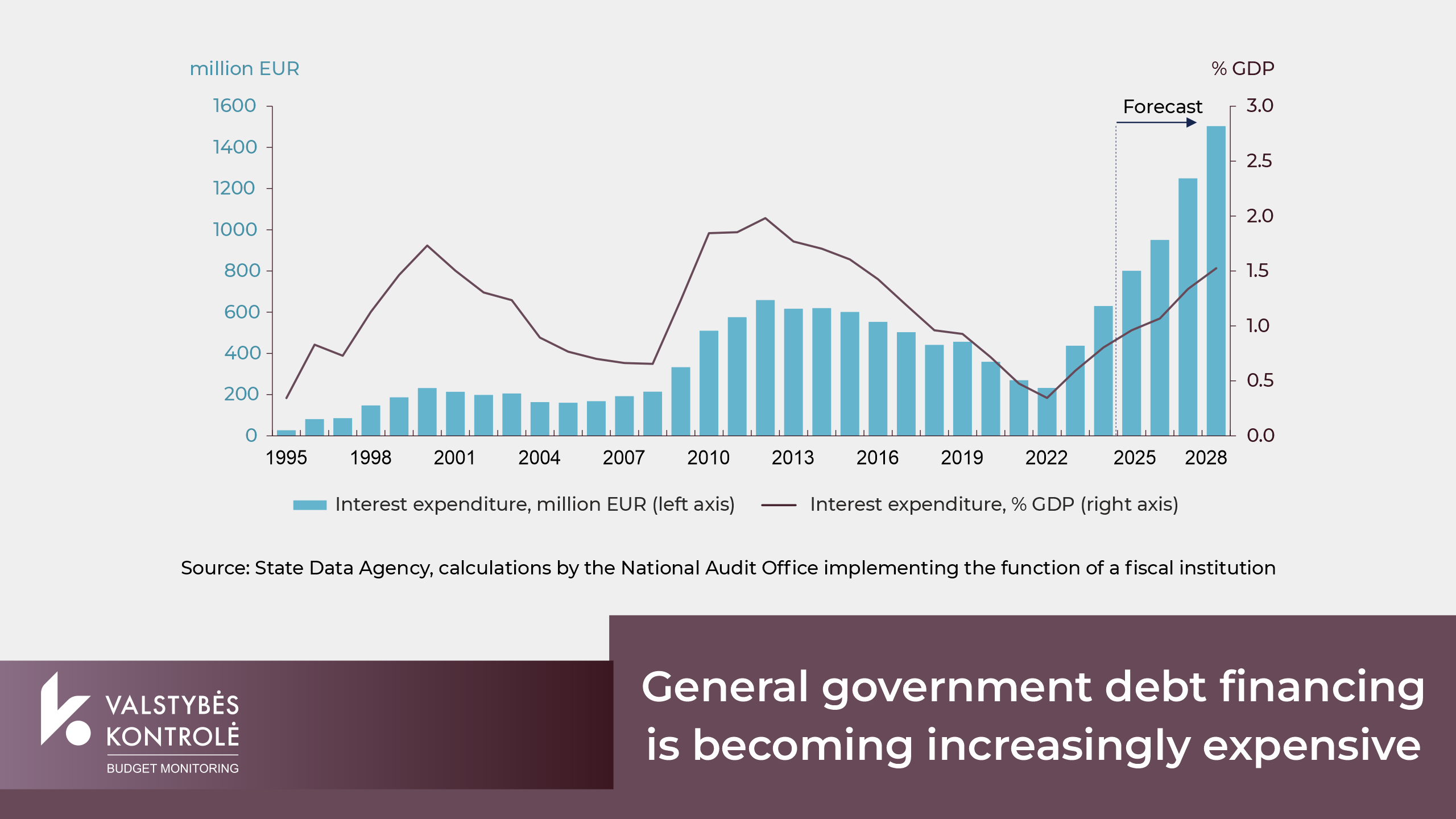
Debt financing is becoming increasingly expensive
Debt servicing is becoming an increasingly significant financial burden for the state. If the current trend continues, interest payments will amount to around EUR 1 billion in 2026 and around EUR 1.5 billion in 2028, or approximately 1.5% of GDP. The growing need to service the debt reduces the possibilities for allocating additional resources to education, health, and other public services.
Once increased, public debt tends to remain at a higher level
The financial crisis has shown that public debt can grow very quickly and not return to its previous level. With rapid increases in defence spending at the expense of debt, a similar scenario is visible - debt will increase significantly next year, but will also rise in the subsequent period.
"Lithuania's economy is small and open, so stronger external shocks could further accelerate debt growth. Even if the Maastricht threshold allows debt to rise to 60% of GDP, this would not be safe for Lithuania. Once this level is reached, according to the European Union's fiscal discipline rules, the debt would have to be reduced, and in the event of economic or other shocks, the government would have less room to respond to crisis situations," says Auditor General Irena Segalovičienė.
After 2028, general government finances may need to be managed more strictly
Until 2028, Lithuania can utilise the EU's defence expenditure escape clause which allows for a deviation of up to 1.5% of GDP from the expenditure plan approved by the European Council. Without additional long-term revenue solutions, public finances may face significant challenges after 2028 when the clause expires. Sustainable revenue solutions must be adopted before 2028. Otherwise, the deficit may have to be reduced rapidly, which would affect defence funding, other public services, and investments.