



2025-11-17
- The project is being implemented not by Offshore wind farm 1, UAB which has obtained a permit for the development and operation of power plants, but by its shareholder Ignitis Renewables, UAB, which does not comply with the requirements of the Law on Renewable Energy Sources and the tender conditions.
- Failure to conclude power purchase agreements and increased prices of electrical components may cause difficulties in financing the project.
- The project price increased by 27% due to market changes, while the projected return decreased by almost 40%.
- There is an increasing risk that the project will not be implemented within the planned timeframe.
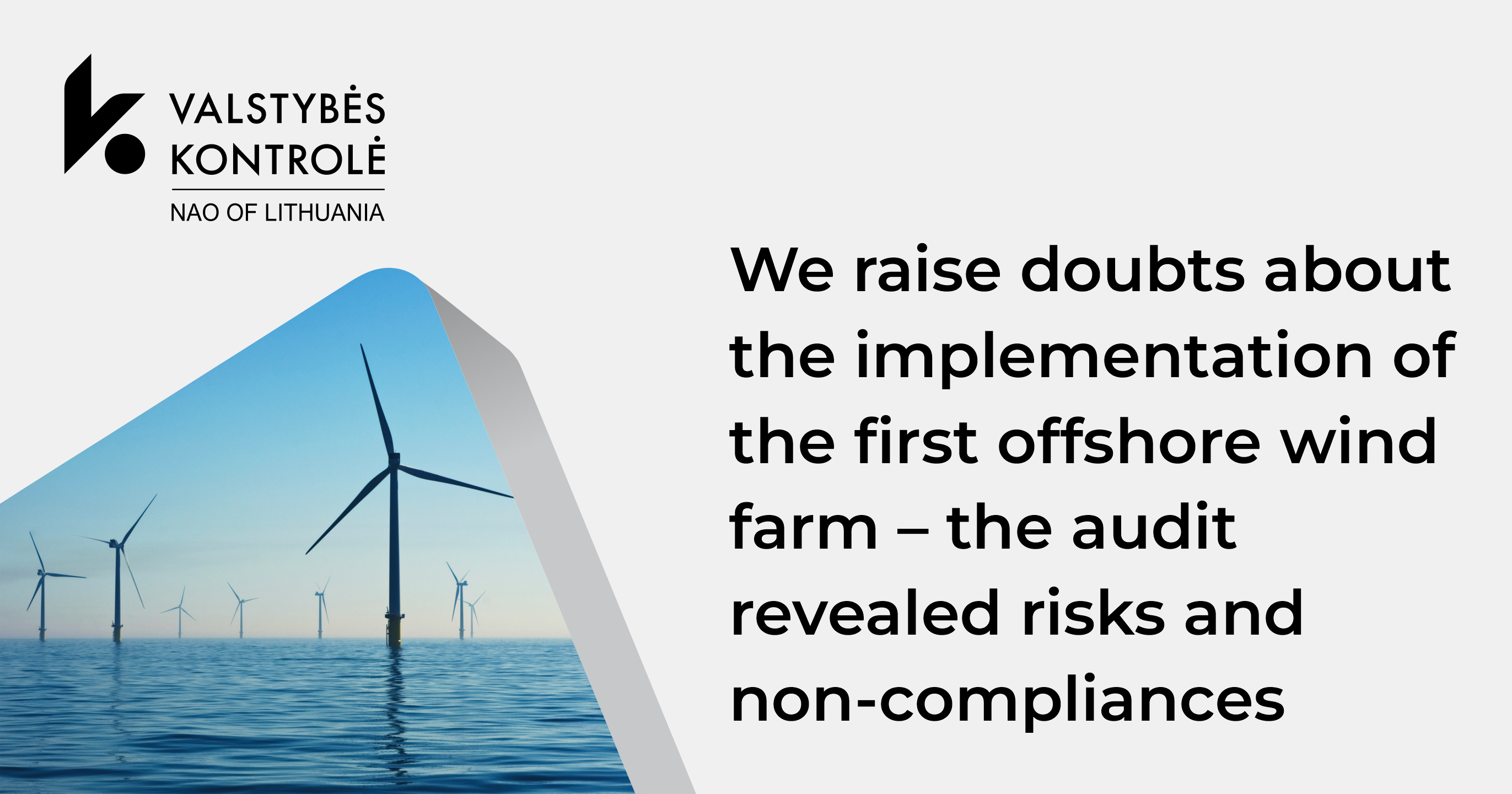 The National Audit Office conducted an audit of the implementation of the Curonian Nord offshore wind farm project in the Baltic Sea, as mandated by a resolution of the Seimas. The results show an increasing risk that the wind farm in the Baltic Sea will not be built and will not start generating electricity by the planned deadline of 2030, therefore important decisions regarding the future of the project must be made.
"This project is one of the most important steps towards Lithuania's energy independence, but the audit results show that plans are stuck, the risks of implementing the project are growing, and the future success of the project is becoming increasingly uncertain. The division of responsibilities and transparent and effective management will determine whether Lithuania will have an offshore wind farm. Postponing decisions would mean not only lost time, but also challenges for energy independence," emphasizes Auditor General Irena Segalovičienė.
The implementation of the project does not comply with legal acts and tender requirements
According to the National Energy Independence Strategy, it is planned that by 2030, all electricity consumed in Lithuania will be generated from renewable energy sources. One element of this plan is the development of two offshore wind farms in the Baltic Sea. The first tender for the construction and operation of the Curonian Nord offshore wind farm, announced in 2023, was won by Ignitis renewables, UAB, a company controlled by Ignitis grupė, AB (Ignitis group) together with its partner OW Offshore, S. L. The companies have committed to building and commissioning the farm, which will cover an area of 120 km² at sea, by 2030.
In the opinion of the auditors, the cooperation and financing model chosen by the project implementing companies Ignitis renewables and OW Offshore, S.L. for implementing the project does not comply with the Law on Renewable Energy Sources and the tender requirement stipulating that the project must be implemented by the company that obtained the development and operation permit.
The audit report notes that OW Offshore, S.L. participated in the tender but did not plan to implement the project, so all development activities are actually carried out by Ignitis renewables, UAB. Offshore Wind Farm 1, UAB was established to implement the project, and the National Energy Regulatory Council issued it a permit to use part of the Baltic Sea territory. However, this company only performed administrative tasks, while Ignitis renewables carried out seabed surveys and other activities related to the development of the project (concluding contracts with contractors, paying for the work performed, etc.).
Auditors note that a situation where one company has a permit to operate but another company actually carries out the activities does not comply with the provisions of the law and the requirements of the tender conditions. It is important to note that during the audit, Ignitis renewables, UAB bought out 49% of the shares in Offshore wind farm 1, UAB held by its project partner OW Offshore, S. L. and took over the results of the analyses and studies carried out by OW Offshore, S.L. during the project preparation phase.
Ambitious plan is stuck: the price is increasing, while the projected return is decreasing
Ignitis renewables, UAB spent EUR 60.3 million on the implementation of the project in 2023–2025. Over two years, the planned price of the project increased by more than a quarter, from EUR 2.2 billion to EUR 2.8 billion, due to the rising cost of construction and equipment. The audit shows that the company did not sufficiently assess future market changes, and the estimated return on investment for the project decreased by about 40% compared to the initial estimates. This means that, under current market conditions, the project is too risky and may not generate sufficient revenue to cover the project cost.
The audit results show that there are less than 18 months left until the construction of the offshore wind farm begins. However, neither the project company Offshore Wind Farm 1, UAB nor the company actually implementing the project, Ignitis Renewables, UAB, have concluded long-term contracts with potential electricity consumers. Therefore, it is unclear who will purchase the electricity and in what quantities. The lack of power purchase agreements and the challenges posed by rising prices for offshore wind farm components may cause difficulties in financing the project.
In 2025, it was also decided to slow down the implementation of the project by reducing further development costs to a minimum. More than 60% of the project implementation work has been postponed. Nevertheless, the planned date for the start of electricity production (12 February 2030) remained unchanged in the project implementation schedule.
In view of the above challenges, there is an increasing risk that the wind farm in the Baltic Sea will not be built and will not start generating electricity within the timeframe set out in the project implementation schedule.
Dividing the seabed project research work into two stages led to the inefficient use of EUR 4 million
The construction of offshore wind farms requires project-specific seabed surveys. In 2025, these works were carried out at a cost of EUR 4 million. The majority of the expenditure – EUR 2.9 million (73%) – was accounted for by the arrival and preparation of two special vessels. Once the ships arrived, only 3% (4 out of 129) of the planned seabed surveys were carried out, with the remaining 97% of the surveys postponed until the beginning of 2027. This means that the same ship arrival costs will have to be incurred again when the next part of the planned surveys is carried out.
According to the auditors, the decision to divide this work into two stages and to carry out small-scale seabed surveys in the first stage, which are not mandatory for obtaining a building permit, created conditions for the inefficient use of EUR 4 million.
In order to assess the possibility of achieving the goal of constructing offshore wind farms by 2030, the National Audit Office made recommendations to Ignitis Renewables, UAB and the National Energy Regulatory Council (VERT). It is recommended that VERT include in the tender conditions an obligation for participants to submit all documents and to inform about any changes in the essential conditions during the tender so that the compliance of the tender participants with the conditions can be properly assessed. It is also recommended to assess whether Offshore Wind Farm 1, UAB complies with the conditions set out in the Law on Renewable Energy Sources.
Ignitis renewables, UAB is recommended to take steps to transfer the assets, works, and obligations created by its shareholders Ignitis renewables, UAB and OW Offshore, S. L. to Offshore wind farm 1, UAB, so that the latter can implement the project. It is also recommended to revise the contracts with contractors conducting seabed surveys and to set realistic deadlines for the completion of works. One of the most important recommendations made to Ignitis Group is to conduct a detailed analysis of the project risks and conditions (market changes, cost increases, technological challenges) and to make specific decisions on the further implementation of the project.