


2025-10-29
 State reserves balances are increasing every year, but it is not defined what risks they are intended to cover in the long term. This was emphasized by Auditor General Irena Segalovičienė, when presenting the financial audit of the 2024 national set of accounts conducted by the National Audit Office at a plenary session of the Seimas. Today, the audit results will also be presented to Seimas committees.
As the audit shows, state reserves – the Reserve (Stabilization) Fund, the State Social Insurance Fund, and the Compulsory Health Insurance Fund – increased by 31.6% in 2024. At the end of the year, they amounted to EUR 4,837.8 million. The increase in reserves was mainly due to the growth of the State Social Insurance Fund Board (SODRA) reserve.
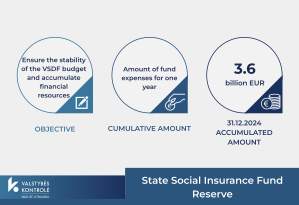
The main purpose of accumulating state reserves is to guarantee the financing of key public functions in unforeseen or critical situations, as well as to ensure the stability of state finances. The State Social Insurance Fund reserve (which amounted to EUR 3.6 billion at the end of 2024) is accumulated in order to stabilize the social insurance system and compensate for shortfalls in benefits when current revenues are insufficient. Its size is also set at the amount of the fund's annual expenditure. Based on 2024 data, this amount would be EUR 8,170.2 million in 2025. At the end of 2024, the amount accumulated in the fund was EUR 3,618.1 million.
The Compulsory Health Insurance Fund (PSDF) reserve is intended to maintain the stability of the health insurance system. Its structure consists of a basic part (1.5% of the fund's planned income) and a risk management part. At the end of 2024, the basic part amounted to EUR 51.9 million and the risk management part to EUR 496.4 million. However, only the basic part of the reserve is sustainable, as the risk management part can be used to cover current expenses. The amount of this fund would be sufficient to cover approximately two months of PSDF expenses, while the actual reserve – the main part (EUR 51.9 million) – would be sufficient for five days.
The Reserve (Stabilization) Fund, which amounted to EUR 671.4 million at the end of 2024, is the main monetary reserve of the state, intended to ensure the financial stability of the state during times of economic downturn. The required size of the fund is not legally defined; it also includes a reserve for the construction of a deep repository for radioactive waste and the management of such waste. In 2024, state budget expenditures amounted to EUR 20,113.9 million. This means that the money in this fund would be sufficient to cover the state's expenses for one and a half weeks of normal operation.
According to auditors, with geopolitical tensions on the rise, strategic reserve management is becoming particularly important in ensuring fiscal resilience, rapid response to economic or security challenges, and the financial independence of the state.
"Having reserves is directly related to the state's ability to independently finance unforeseen expenses without having to borrow under unfavourable market conditions. Reserves increase the ability to respond quickly and efficiently to crisis situations. Therefore, it is necessary to determine what risks they are intended to manage," says Ms. Segalovičienė.
Taking into account that the accumulation and use of reserves is one of the necessary instruments for increasing the financial resilience of the state, the National Audit Office makes a recommendation to the Ministry of Finance to systematically review the legal regulation of reserves and establish common principles for their creation and management in line with the state's borrowing policy.