



2025-10-01
 Today, the Assessment of the fiscal part of Lithuania's medium-term Fiscal-Structural Plan was presented to the Seimas Budget and Finance Committee and the European Affairs Committee by the National Audit Office, implementing the functions of a fiscal institution (NAO FI).
Following changes to European Union legislation, Lithuania had to prepare a medium-term fiscal structural plan (FSP). It was published in April this year, and the net expenditure* plan set out in it became a fiscal commitment until 2028.
"The budget for 2026–2028 is being planned under conditions of great uncertainty. With the war in Ukraine and increased geopolitical tensions, public finances are under considerable pressure. After a break of several years, fiscal discipline requirements have become stricter. From 2025, budget deficits will once again be limited by European Union legislation, and next year national fiscal discipline rules will also apply to the general government sector," emphasized Jurga Rukšėnaitė, Head of the Budget Monitoring Department.
In assessing the plan and seeking to illustrate the pressure on public finances, the NAO FI has prepared two public finance scenarios. The first incorporates decisions taken almost every year that increase long-term general government expenditure (public sector wage increases, additional pension indexation, etc.). Under this scenario, the deficit would be close to 3% of GDP in 2026-2028, and net expenditure growth would exceed the commitments made in the FSP. It should be noted that the fiscal commitment presented in the FSP does not include the national escape clause for defence spending, which Lithuania has requested from the EU Council.
Under the second scenario, in addition to the assumptions of the baseline scenario, an increase in defence spending from 3% to 5% of GDP and the impact of tax changes are assumed. In this case, the deficit would exceed 4% of GDP in 2026–2028.
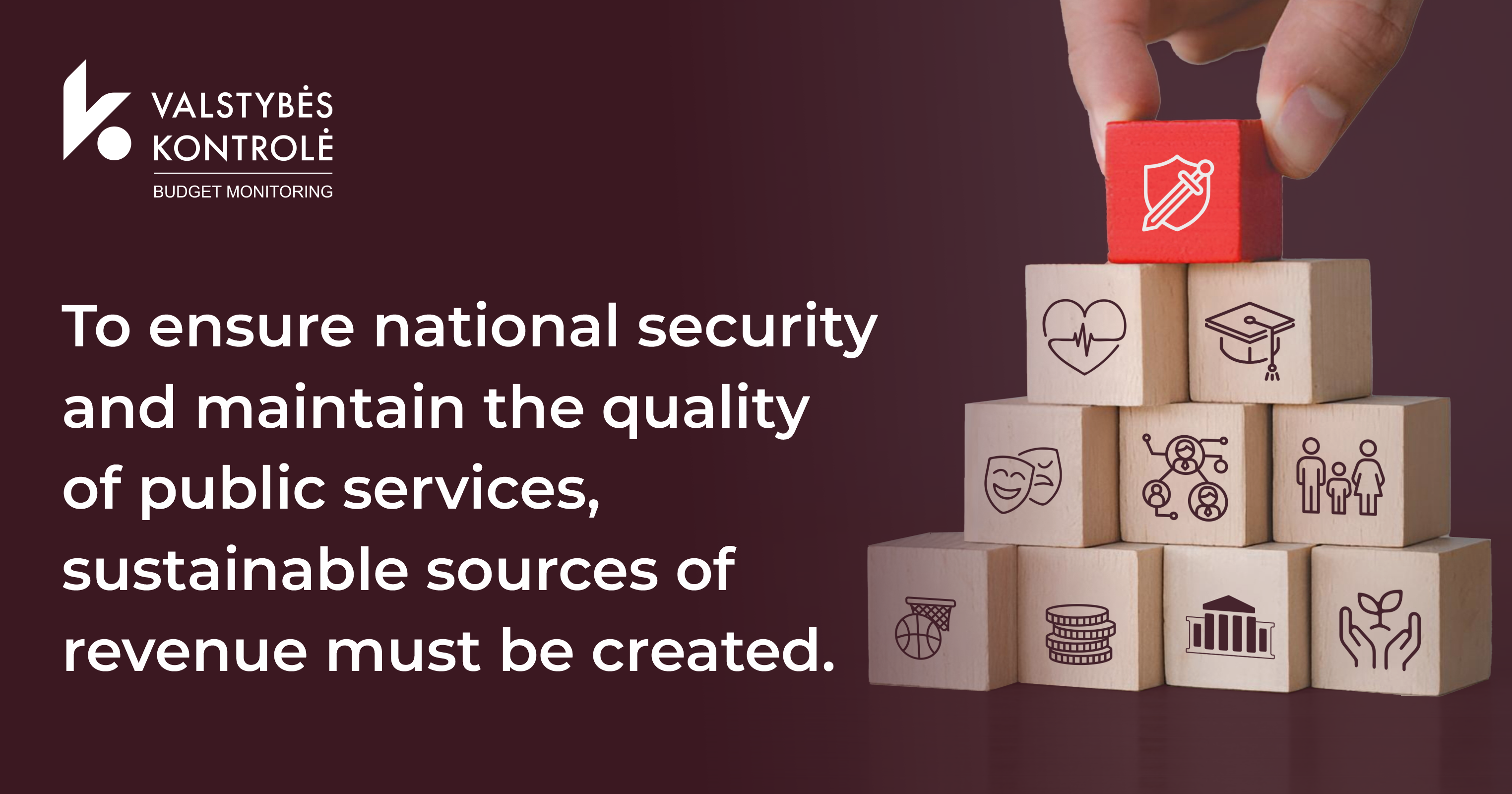
“Uncertainty and stricter fiscal requirements force us to speak openly about what is necessary: if we want security – increasing defence funding to 5% of GDP – and at the same time seek to maintain the availability and quality of public services, no partial solution is acceptable. The tax changes that have been adopted are a significant step towards a fairer tax system, but this revenue will not cover all needs, so we must create sustainable sources of revenue without delay. Otherwise, the public debt will approach the 60 percent of GDP limit," said Auditor General Irena Segalovičienė.
Assessment of the fiscal part of Lithuania's medium-term Fiscal-Structural Plan
* Net expenditure – general government expenditure net of interest expenditure, discretionary revenue measures, expenditure on programmes of the Union fully matched by revenue from Union funds, national expenditure on co-financing of programmes funded by the Union, cyclical elements of unemployment benefit expenditure, and one-offs and other temporary measures.